

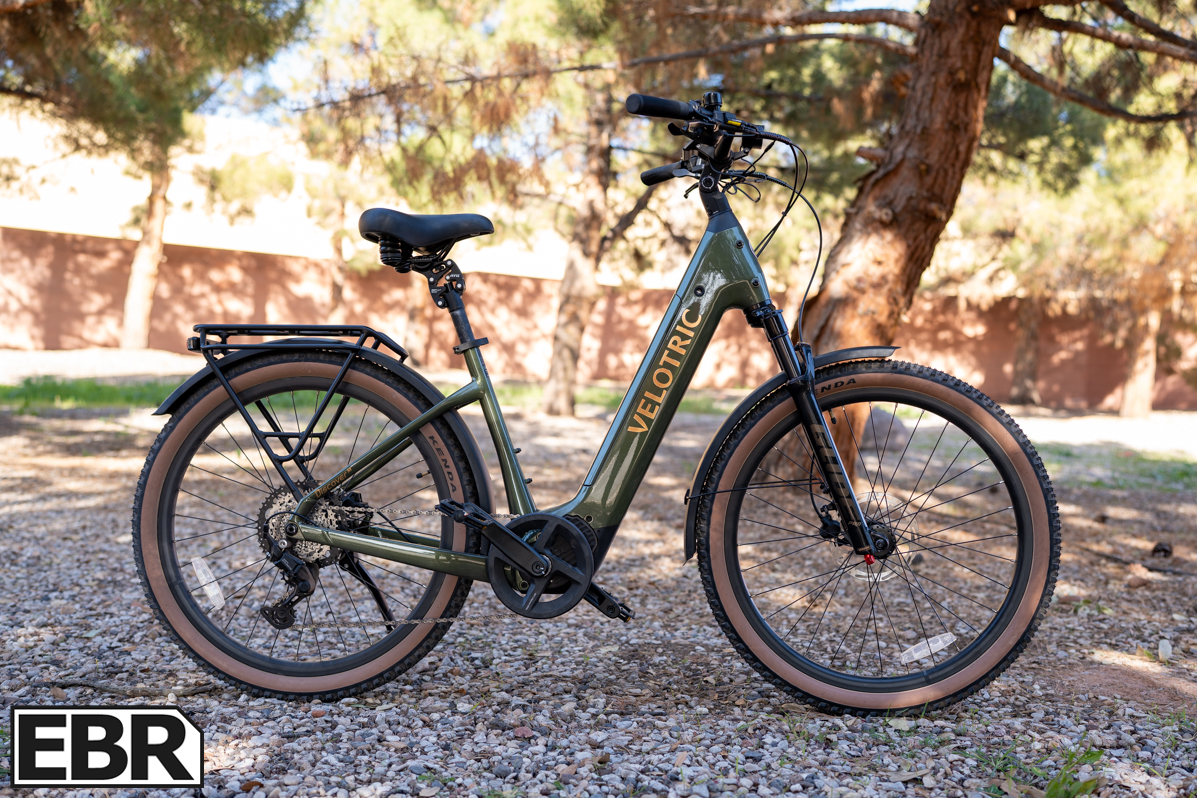
Velotric just dropped a refresh of their Discover lineup, and for the first time, you’ve got a choice between two motor configurations. The Discover 3 keeps the rear hub motor that made the original popular with commuters and casual riders, while the new Discover M, what we’re looking at here, is their first attempt at a mid-drive system. Both bikes share the same step-through frame and come in two new colors: Platinum Silver and Olivine Green. It’s a smart play that lets you pick your motor style without giving up the comfort-first design Velotric has built their reputation on.
The Discover M is clearly aimed at riders who already know their way around e-bikes and want something that feels more like a traditional bike with a power upgrade. The heart of it is Velotric’s new Velocore mid-drive motor, 500 watts nominal, 960 watts peak, 100Nm of torque. That’s paired with an 801.6Wh battery (bigger than the Discover 3’s pack), a Shimano 9-speed drivetrain, and an adjustable air suspension fork. On paper, it reads like they studied what works on pricier mid-drives and figured out how to deliver it for $2,499.
What caught my attention beyond the motor are the tech features and component upgrades. Auto Mode that adjusts assistance based on terrain changes. SensorSwap that lets you toggle between torque and cadence sensing with a button press. NFC unlocking, Apple and Android Find My integration, and a 3.5-inch color display that’s actually usable in bright sun. It’s the kind of stuff you usually see on bikes costing significantly more.
The target is pretty clear: this is for experienced riders, weekend explorers, and anyone who’s outgrown their first e-bike. If you just want simple, powerful assistance, the Discover 3 is probably still the better pick. But if you care about how power is delivered, want close to 100 miles of range, and like having control over every aspect of your ride, that’s where the M comes in.
My Experience Riding The Velotric Discover M e-Bike
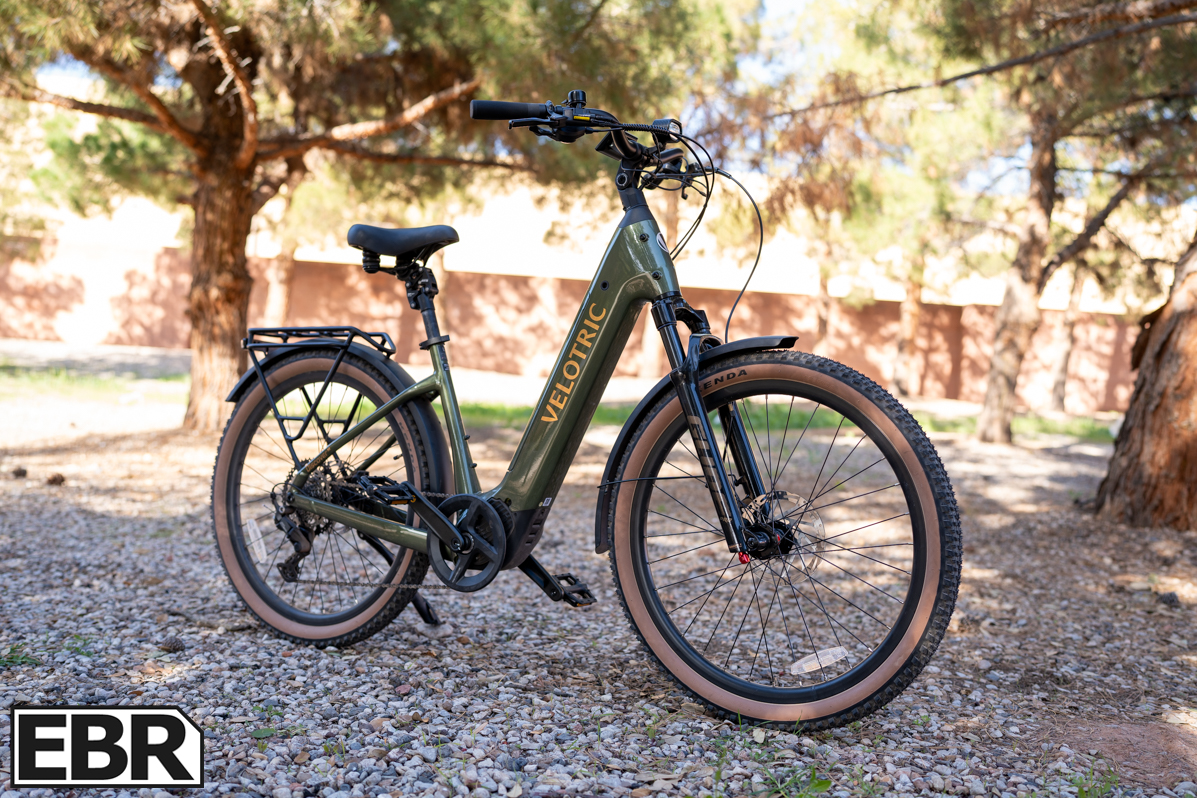
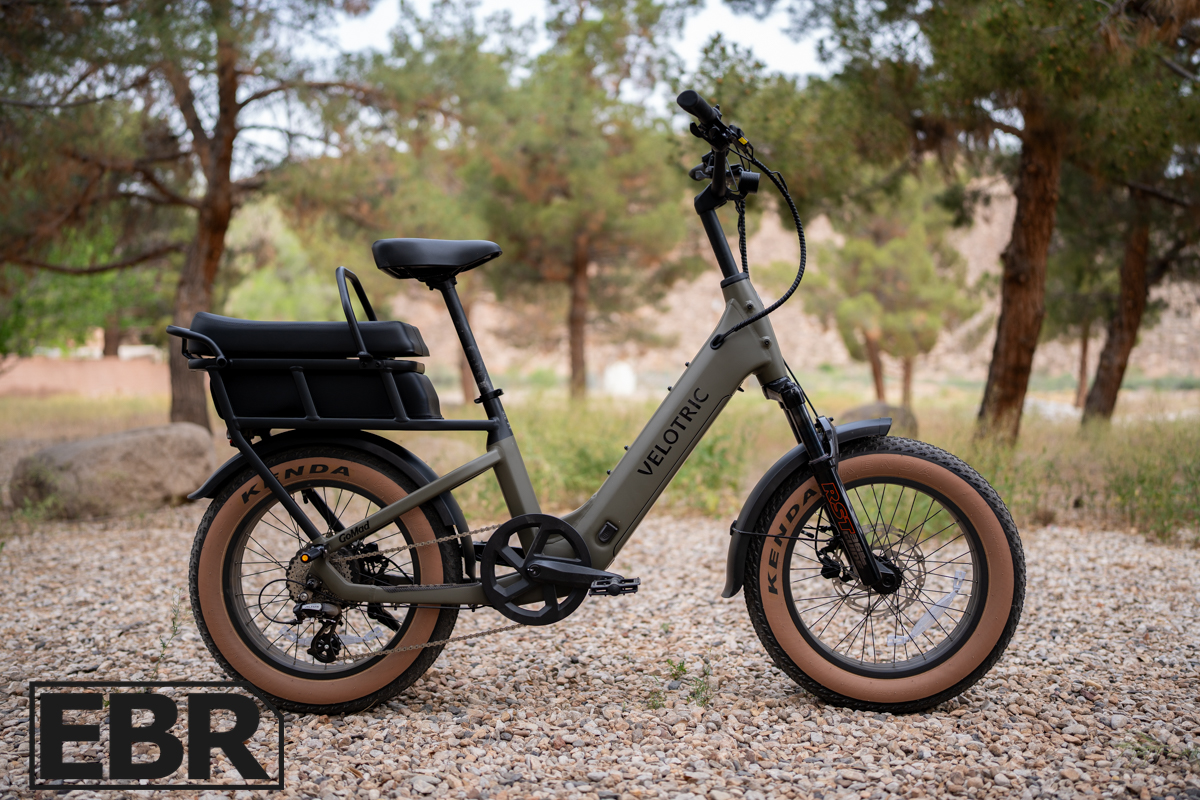
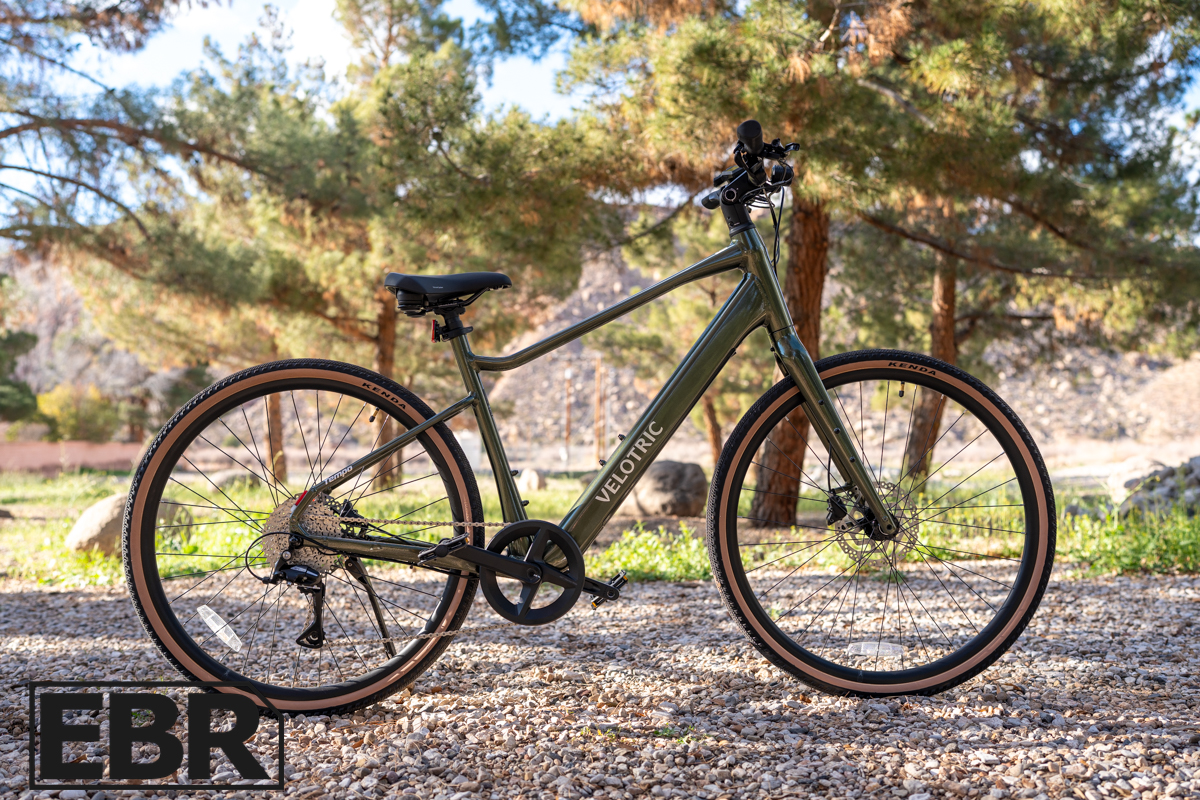
Right out of the gate, the Olivine Green caught my eye. Velotric nailed it with this color, it’s earthy without being dull, and those gumwall Kenda tires with tan sidewalls really make the whole package pop against the black components. If green isn’t your thing, there’s always Platinum Silver, but I’m genuinely a fan of what they did here. It’s one of those bikes that looks good parked outside a coffee shop or leaning against your garage wall.
I tested the Large frame with the suspension seatpost, which puts the fit range at 5’9″ to 6’7″. At 5’11”, I landed right in the sweet spot. Between the adjustable stem and wide saddle height adjustment, dialing in a comfortable position took about five minutes. The 15.6-inch standover height makes mounting and dismounting effortless, even with the bike fully loaded, you’re never doing that awkward swing-leg-over-the-saddle dance.
Velotric calls their comfort setup “ComfortMax,” which sounds like marketing speak until you actually spend time on the bike. It’s the combination of the adjustable 80mm air fork, dual-layer breathable foam saddle, suspension seatpost, upright riding position, swept-back cruiser bars, and ergonomic lock-on grips. On paper it’s just a list of features, but in practice it adds up to a bike that’s genuinely easy to enjoy for hours. I did several multi-hour rides and walked away without the usual stiffness in my lower back or numbness in my hands. That’s not always the case, even on bikes that claim to prioritize comfort.
Out on the road, the M just feels right. It’s smooth, quiet, and looks great doing it. But the real story here is that mid-drive motor, the whole reason for the “M” in the name. This is Velotric’s first crack at a mid-drive system, and the Velocore motor is off to a very strong start. It’s virtually silent, which is immediately noticeable compared to the whine you get from cheaper hub motors. The torque sensing feels natural and intuitive, power delivery scales with how hard you’re pedaling, so it mimics the feel of riding a regular bike, just with a serious tailwind.
The 100Nm of torque really shines when you want to get up to speed quickly. Acceleration is strong without being abrupt, and the motor never feels like it’s fighting you or lurching unexpectedly. You can tune everything through the app or display: speed limits from 12 to 28 mph, independent throttle and pedal assist speed caps, and easy switching between Class 1, 2, 3, or custom modes. It’s the kind of flexibility that makes the bike work for commuting in a 20 mph zone or cruising on open paths where 28 mph is legal.
SensorSwap is one of those features that sounds gimmicky until you actually use it. Being able to toggle between torque and cadence sensing on the fly, just holding the M button, means you can adapt to different conditions in real time. Torque sensing is great for varied terrain where you want responsive, proportional power. Cadence sensing is better for sustained high-speed cruising where you want smooth, predictable assistance. I found myself switching more than I expected, especially when transitioning from smooth pavement to rough bike paths.
Walk mode and cruise control round out the feature set. Walk mode does what it says, pushes the bike along at 2.9 mph when you’re off the saddle. Cruise control lets you set and forget a speed, though any brake input kills it instantly, just like your car. It’s a nice touch for long, flat stretches where you just want to zone out and pedal.
One thing Velotric clearly thought about is drivetrain wear. Mid-drives put way more stress on chains and cassettes than hub motors, and the throttle on the M reflects that, it has a very gradual ramp-up in power. If you want to go fast, use the pedals and you’ll hit speed quickly. But when you’re asking the chain to do all the work via throttle, the motor takes it easy to preserve component life. Velotric also spec’d a KMC e-Glide chain that’s rated 33% stronger than international standards. It’s a smart move that should translate to longer intervals between drivetrain replacements.
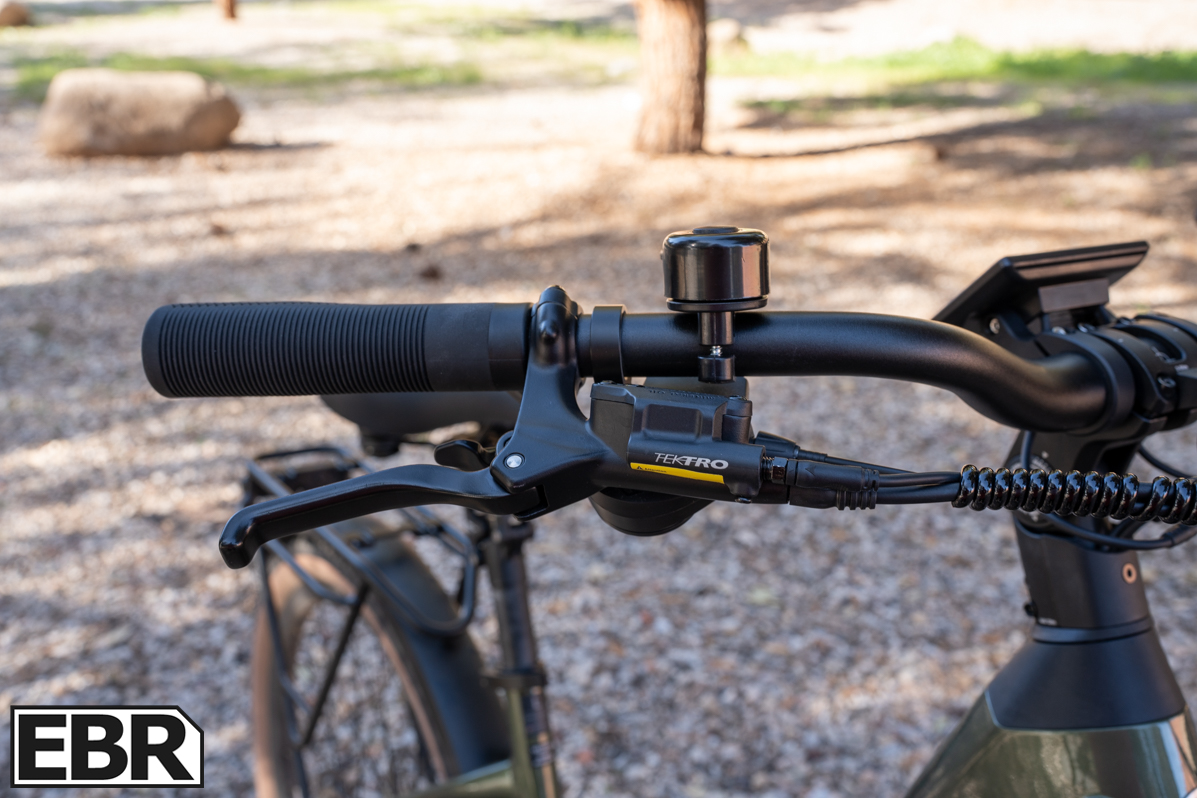
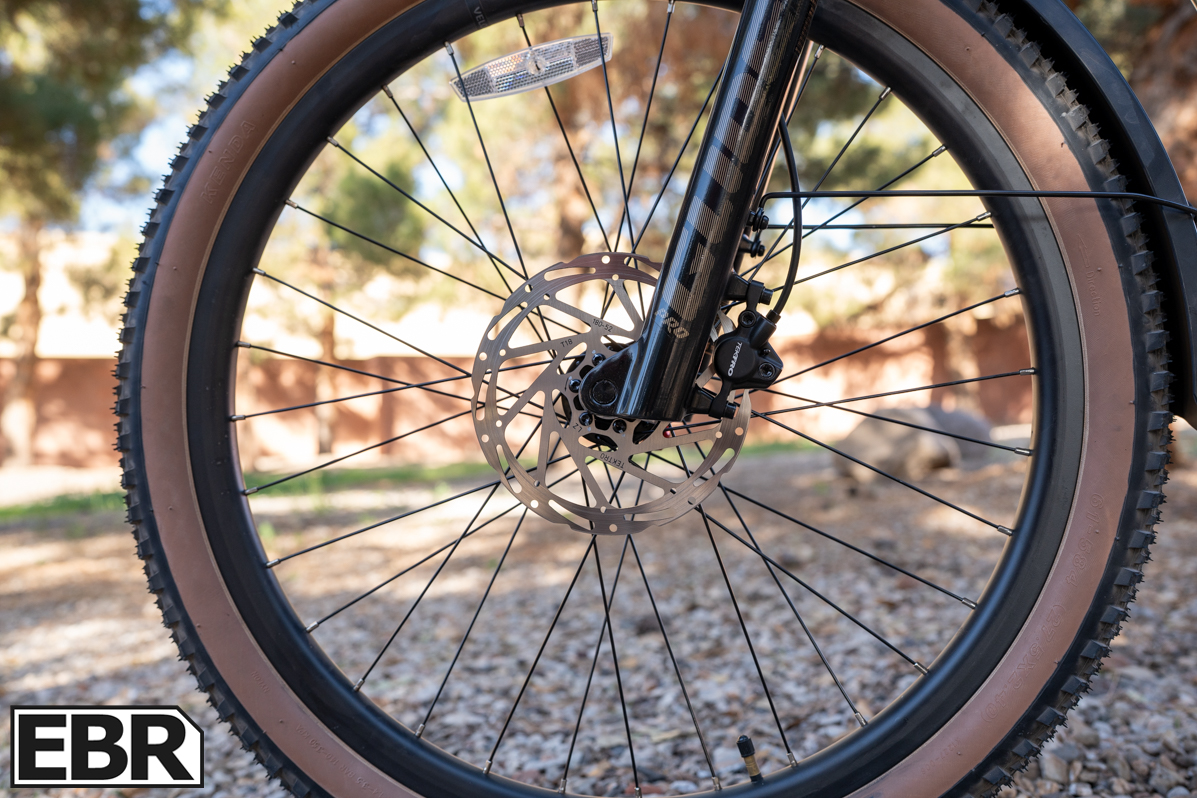
Braking is handled by Tektro hydraulic discs with 180mm rotors front and rear. They’re e-bike rated with motor cutoff sensors, so power dies the instant you squeeze the levers. It’s a common setup that just works, good modulation, plenty of stopping power, and low maintenance. Nothing fancy, but that’s fine. Sometimes the ‘standard’ is exactly what you want.
The Shimano CUES 9-speed drivetrain was a pleasant surprise. Velotric ditched the Altus 8-speed from previous models in favor of CUES, which is Shimano’s e-bike-specific group. The 46T chainring and 11-46T cassette give you a wide range for climbing or cruising, and the CUES U4000 rear derailleur has improved spring tension and durability over older groups. Shifts are quick and clean, and I didn’t experience a single dropped chain over multiple rides. For a mid-drive where chain tension is constantly changing, that’s a win.
Overall, the Discover M left me impressed, not just with the bike itself, but with the experience and value for the money. Velotric has been steadily improving over the almost three years I’ve been reviewing their bikes, and the leap from the Discover 2 to this is substantial. This is a bike that punches well above its $2,499 price point, and it shows that Velotric is serious about moving upmarket without abandoning the value proposition that got them here.
Range
Estimated Range (from Velotric):
- Pedal Assistance: ‘Up to 95 miles’
- Throttle Range: ‘Up to 70 miles’
Real World Range Test Results:
- Maximum Pedal Assistance Range Test: 34 miles
Velotric claims 95 miles on pedal assist and 70 miles on throttle-only for the Discover M, thanks to that massive 801.6Wh battery. Those numbers come with the usual caveats, ideal conditions, lightweight rider, flat terrain, minimal stops, maybe a tailwind and some good karma. Real-world range is always going to be lower, so rather than trying to baby the bike to hit some theoretical maximum, I wanted to see what happens when you just….send it.
I took the M out with one simple goal: ride as fast as safely possible until the battery died. Before starting, I jumped into the Velotric app, selected Boost mode (PAS 5), and cranked the power output from its default 90% all the way up to 100%. Then I just held the throttle wide open and pedaled hard whenever traffic allowed. The route wasn’t flat, I gained 532 feet of elevation over the course of the ride, and there were the usual slowdowns for walkers, other cyclists, and intersections. I weigh 190 pounds, so not exactly a featherweight test case.
The result? 34 miles over roughly an hour and a half of full-blast riding before the battery tapped out. That’s with maximum power output, maximum speed, and zero attempt at efficiency. For context, that’s less than half the advertised range, but it’s also an absurdly aggressive use case. If you’re commuting 10 miles each way and riding at sane speeds in PAS 2 or 3, you’re looking at multiple days between charges. Even heavy riders doing hilly routes with cargo should easily clear 40-50 miles in normal use.
When it’s all said and done, that stress-tested 34-mile full-throttle range is actually a great indicator of what’s on tap. Most people don’t need to ride flat-out for an hour and a half, but knowing you can and still have practical range opens up a lot of possibilities. Weekend adventure? Sure. Long grocery run across town? No problem. Forgot to charge overnight? You’ve still got options, and thats what people need. I’m planning to run a proper efficiency test in PAS 1 when I get the chance and will update this section, but for now, the takeaway is simple: this battery has serious capacity, and even when you abuse it, the Discover M delivers.
Power (Motor & Battery)
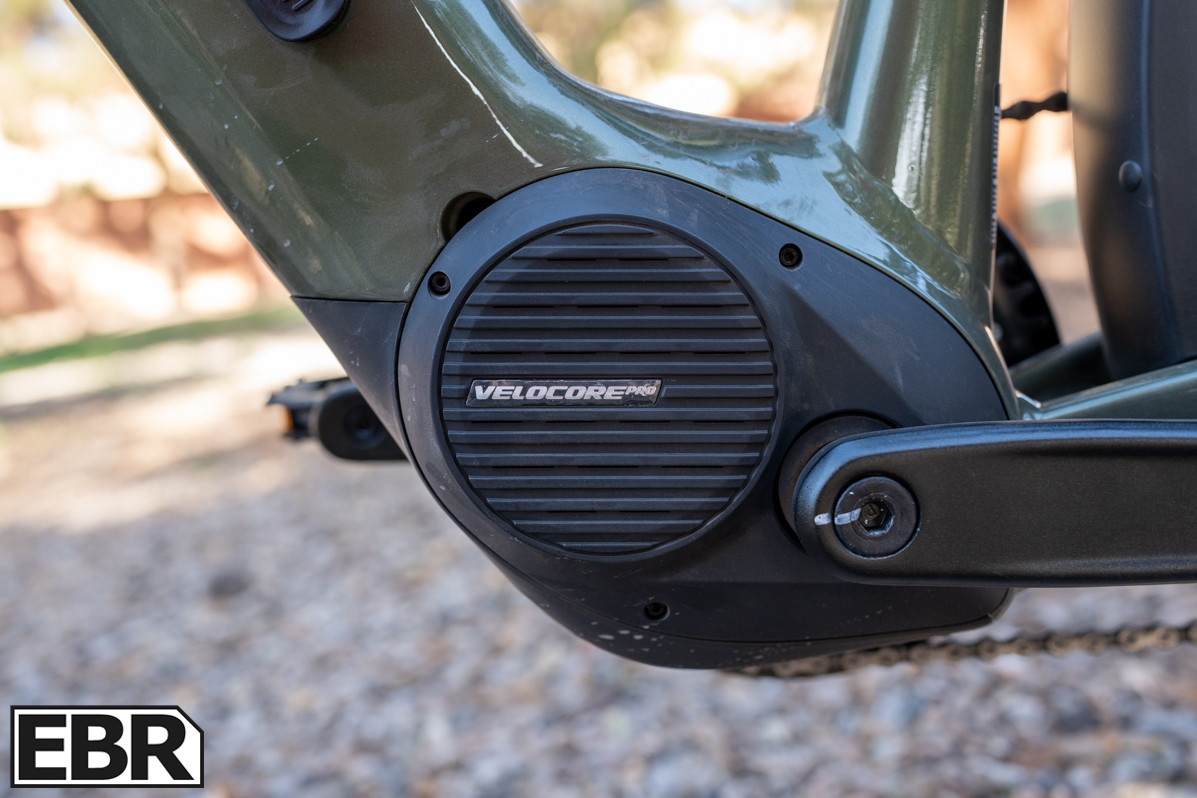
The Velocore mid-drive motor is Velotric’s first venture into this style of propulsion, and they’ve clearly done their homework. The 500-watt nominal rating might seem modest compared to the Discover 3’s 750-watt hub motor, but mid-drives work differently, the power goes through the drivetrain, so you’re leveraging the bike’s gears. That 100Nm torque spec is impressive. It’s not earth shattering new tech, but, it’s competitive with motors from Brose and Bosch in this price range, and significantly higher than the Discover 3’s 75Nm.
What Velotric is particularly proud of is the magnetic rotary encoder integrated into the motor. This encoder detects rotor position up to 100,000 times per second, which translates to incredibly precise torque and cadence measurement. The practical benefit? Smoother power delivery and more natural-feeling assistance compared to simpler sensor setups. The motor placement also centralizes weight, which improves handling compared to rear hub designs where all that mass is hanging off the back end.
Peak power hits 960 watts, which is useful for short bursts, think standing starts at intersections or punching over a steep section. The motor can handle sustained climbs with relative ease (even the steeper ones). In the event you push things to the max often, Velotric includes a temperature display on the screen that’ll warn you if things are getting toasty on long ascents. Yellow means it’s warming up, orange-red means it’s about to dial back power to protect itself.
The battery is a beast. At 801.6Wh, it’s one of the larger packs you’ll find on a sub-$2,500 e-bike, built with Samsung or LG 21700 cells and certified to UL 2271 standards. It’s also IPX7 rated, meaning it can handle being submerged in up to a meter of water for 30 minutes, way beyond what you’d ever encounter in real-world riding. The whole bike is IPX6 rated, so you can blast it with a pressure washer without worrying. Charging is handled by a 3-amp fast charger, and there’s a USB-C port on the display for keeping your phone topped up on longer rides.
One detail worth noting: this is a mid-drive, so Velotric specs it with a beefier chain than you’d find on a standard bike. They claim it uses exclusive riveting tech with 450 kgf interlocking strength and can handle tensile forces up to 1,050 kgf, 33% higher than standard chains. Whether you’ll ever stress-test those numbers is debatable, but it’s nice to know the drivetrain is built to handle the torque this motor can deliver.
Components
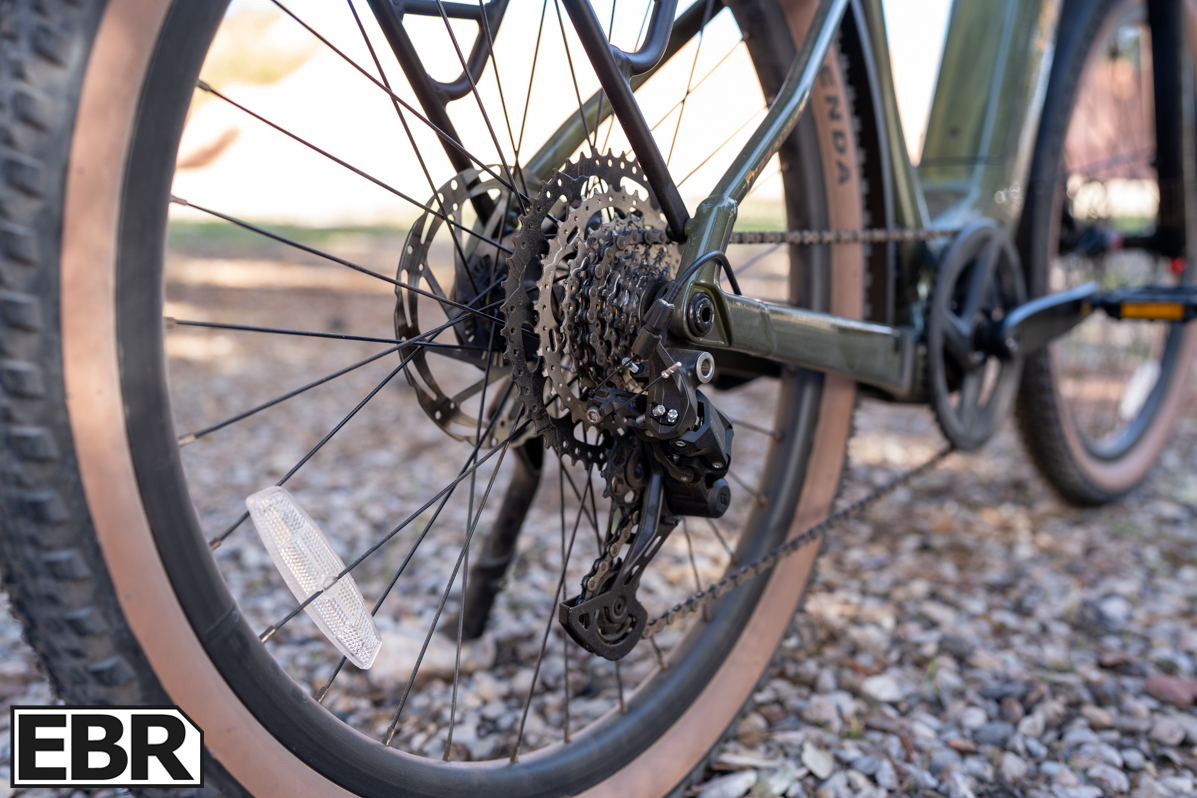
Velotric clearly put some thought into where to upgrade components and where to stick with proven, practical choices. The most notable spec bump is the drivetrain, this is the first Discover to run Shimano CUES, the brand’s relatively new e-bike-specific groupset. It’s a 9-speed system with an 11-46T cassette paired to a 46T narrow-wide chainring up front. CUES was designed from the ground up to handle the torque and chain tension that mid-drives dish out, with beefier internals and tighter tolerances than standard bike components. The range is wide enough to spin comfortably at 28 mph or grind up steep grades in the lowest gear without feeling like you’re mashing through concrete.
Braking comes via Tektro hydraulic discs with 180mm rotors front and rear. Tektro hydraulics have become a bit of a staple in most mid-tier e-bikes and it’s nothing new for the Discover series, but their hydraulic systems are solid, low-maintenance performers that offer good modulation and plenty of stopping power for a 60-pound bike. The levers are aluminum with integrated motor cutoffs, so power cuts the instant you squeeze, important when you’ve got 100Nm trying to push you forward.
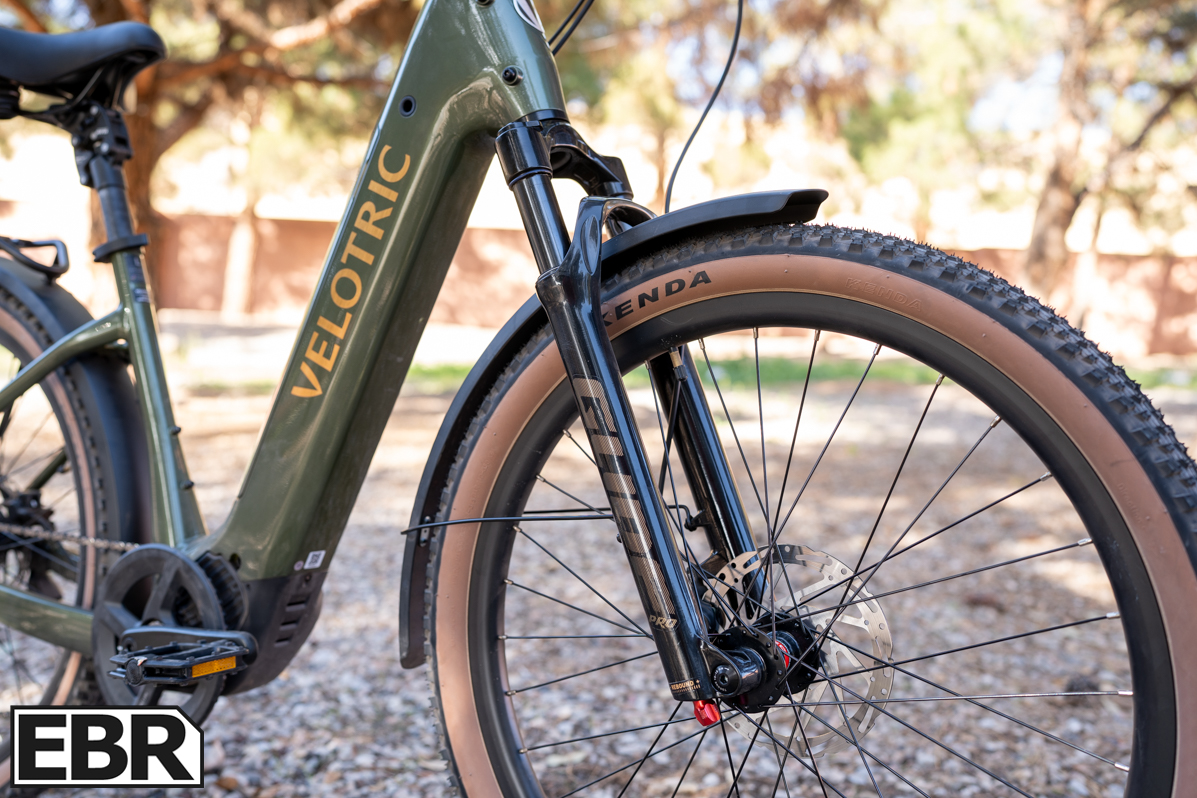
The real story here is comfort, though, and that’s where Velotric leaned in hard. The front suspension is an 80mm-travel air fork with lockout, 34mm stanchions, and adjustable rebound damping. Being air-sprung means you can tune it to your weight by adding or removing pressure with a shock pump, something you can’t do with the coil forks found on most budget e-bikes. Out back, there’s a suspension seatpost that adds another layer of cushioning between you and rough pavement. Combined with the wide 230x70mm dual-layer foam saddle (which is genuinely broad and plush), you’ve got a bike that’s clearly built for all-day comfort rather than aggressive riding.
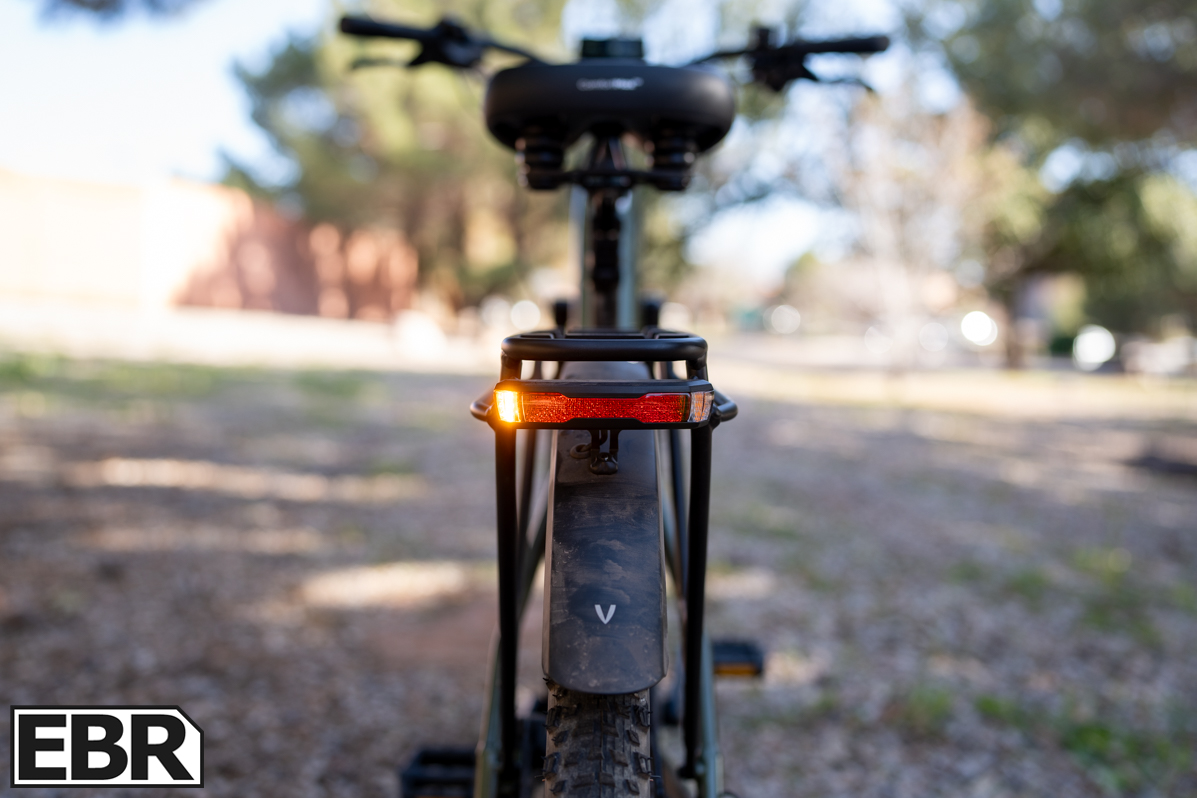
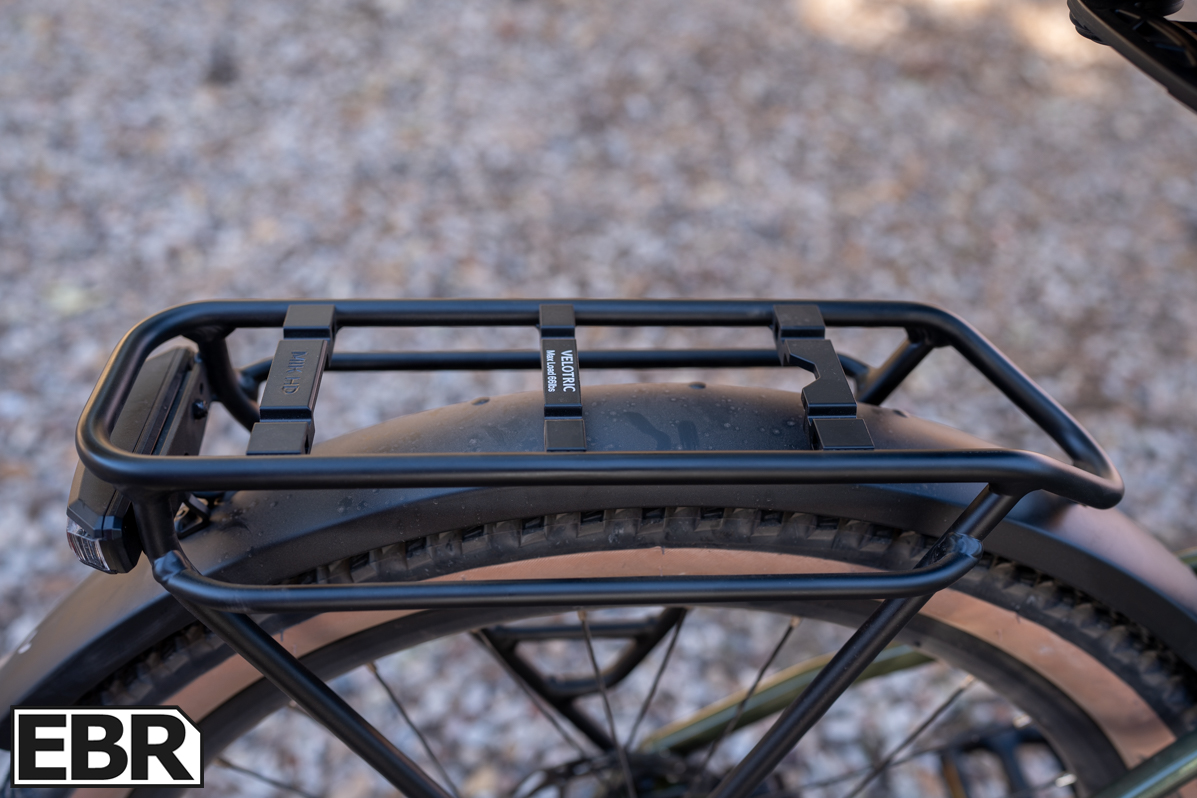
Rolling on Kenda 27.5×2.4″ puncture-resistant tires mounted to aluminum rims with a Novatec thru-axle hub up front (15x110mm). The 2.4″ width is a sweet spot, wide enough for stability and comfort, narrow enough that you’re not dragging the unneeded rotational rubber. Velotric also includes full-coverage aluminum fenders front and rear, an aluminum rear rack that’s MIK HD compatible (so you can click compatible bags directly onto it), and swept-back aluminum handlebars that come in two widths: 680mm for the regular size, 700mm for large.
The step-through frame itself is triple-butted aluminum alloy with a low 396mm standover height, making it accessible for a wide range of riders. Regular size fits 5’2″ to 5’11”, large handles 5’9″ to 6’7″ (those ranges shift down a few inches if you ditch the suspension seatpost). The adjustable stem lets you dial in handlebar height, and the whole cockpit setup, from the ergonomic locking grips to the cruiser-style bar sweep, is designed around an upright, relaxed riding position. This isn’t a bike that wants you hunched over; it wants you sitting back, taking in the scenery, and letting the motor do the heavy lifting.
Screen / User Interface / App
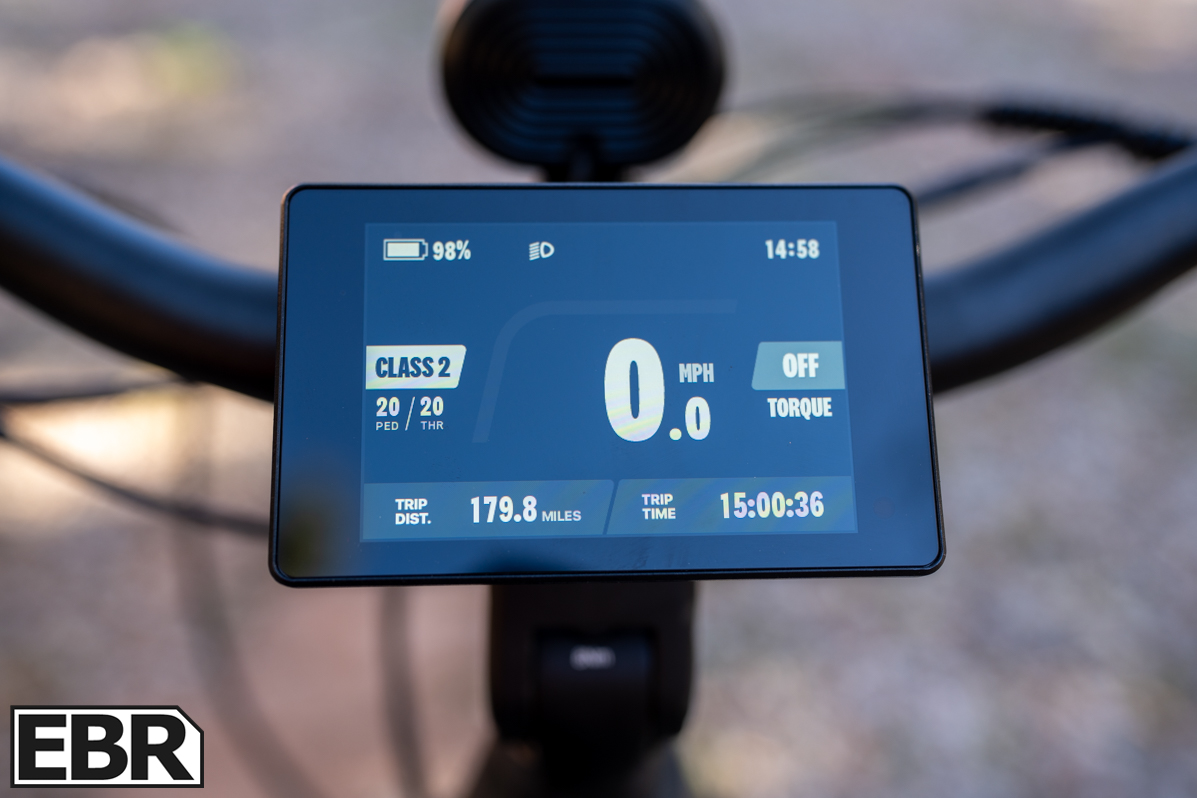
The Discover M comes with a 3.5-inch full-color display that’s genuinely readable in direct sunlight, something cheaper bikes consistently get wrong. The screen is angle-adjustable so you can tilt it to reduce glare, and it shows all the essentials: speed, battery level, assist mode, range estimate, and that motor temperature gauge I mentioned earlier. There’s also Bluetooth built in for connecting to the Velotric app, NFC for keyless unlocking (you can tap a card or phone to unlock the bike), and a USB-C port for charging your phone on the go.
The app is where things get interesting. Beyond basic firmware updates, which you’ll want to do before your first ride, the app gives you control over nearly every aspect of how the bike behaves. You can switch between Class 1, 2, and 3 modes with a tap, adjust individual PAS levels from 12 to 28 mph for both pedal assist and throttle, and fine-tune motor output percentages for each assist level.
There’s also the Smart Riding Mode feature, which asks you a few questions about your riding style and intended use, then recommends optimal settings. It’s genuinely useful for new riders who don’t want to dig through menus, though experienced riders will probably skip straight to the manual tuning.
SensorSwap, the ability to toggle between torque and cadence sensing, can be controlled through the app or directly on the display menu. The quickest method while riding is just holding down the M button on the display, which swaps modes on the fly. Velotric suggests doing this when transitioning from pavement to gravel or dirt, where cadence sensing’s smoother, more predictable power delivery can feel more confidence-inspiring than torque sensing’s responsive but sometimes twitchy behavior.
The app also integrates with Apple Find My and Android Find My networks, so if your bike gets stolen or you forget where you parked it, you can track its location through your phone. Between that and the NFC unlocking, there’s a decent security ecosystem here, though you’ll still want a proper lock.
Velotric Discover M Model Options
The Discover M comes in two frame sizes and two colors, keeping things simple. Regular size fits riders from 5’2″ to 5’11”, while Large handles 5’9″ to 6’7″, those ranges drop down about three inches if you remove the suspension seatpost. Both sizes share the same 396mm step-through height, making the bike easy to mount and dismount regardless of mobility or inseam length. The two color options are Platinum Silver and Olivine Green, both understated enough that they won’t look dated in a few years.
Velotric includes a solid lineup of accessories in the box that would normally cost a couple hundred bucks extra. You get full-coverage aluminum fenders front and rear, an aluminum rear rack rated for 66 pounds (MIK HD compatible, so bags can click directly onto it without straps or bungees), a kickstand, and a 3-amp battery charger. The bike also comes with a two-year warranty covering the frame, motor, battery, and components, pretty standard for the category, but good to have nonetheless.
As for optional accessories, the documentation doesn’t dive into specifics, but given Velotric’s existing ecosystem, you can expect the usual suspects: panniers, baskets, phone mounts, and potentially a battery insulation cover if you’re riding in cold climates (the guide mentions range can drop in temperatures below 10°C). The MIK-compatible rack opens up a world of aftermarket bags and cargo solutions without needing to jury-rig anything with zip ties.
Is The Velotric Discover M Worth Buying?
The Velotric Discover M is a solid first swing at a mid-drive e-bike from a brand that’s been steadily figuring things out over the past few years. At $2,499, it’s priced well below most mid-drive competitors while still delivering the kind of features and performance you’d expect from bikes pushing $3,500 or more. The Velocore motor is smooth and quiet, the comfort setup actually works for long rides, and the tech features, Auto Mode, SensorSwap, app tuning, NFC unlocking, give you way more control than you’d expect at this price point.
Look, this bike isn’t for everyone. If you’re just getting into e-bikes and want something simple and powerful without a learning curve, grab the Discover 3 with its rear hub motor and call it a day. But if you’ve been riding e-bikes for a while and you’re ready for something that feels more natural, more refined, and more capable when the terrain gets interesting? The M is worth a serious look. That massive battery and 95-mile range means you can actually go places without constantly worrying about charging, and even when you ride aggressively, you’ve still got plenty of juice left.
Velotric has come a long way since I started reviewing their bikes, and the Discover M feels like they’re finally hitting their stride. It’s a bike that gets better the more you mess with it, dial in the settings, figure out which sensor mode you prefer, tune the power delivery to match how you ride. Whether you’re commuting, exploring bike paths, or just cruising around on weekends, the M handles it without drama. For experienced riders looking to upgrade without dropping four grand, this is one of the better mid-drive values out there right now.
Pros
- The VeloCore Mid-Drive motor is smooth, quiet and very powerful, surprisingly good at this price point
- Real-world range actually beats manufacturer claims in Eco mode (87 miles tested vs 80 claimed)
- Five color options give you actual variety compared to most e-bikes
- Air suspension fork is adjustable to rider weight, a real upgrade over typical coil forks
- Extensive customization options (Class 1/2/3, Custom mode, torque/cadence sensing, Experience profiles) let you dial it in exactly how you want
- ComfortMax setup genuinely delivers on long rides without the usual soreness or stiffness
Cons
- Integrated headset cables look clean but can add some extra labor costs if your Local Bike Shop digs in to service or replace parts.




Reader Interactions