


Aventon dropped the Level 3 just about a year ago and it landed well. Good torque sensor, solid security tech, reasonable range, it checked most of the boxes for a commuter under two grand. But anyone who rode it regularly knew the hub motor was the one thing holding it back from being a truly great bike.
The Level 4 ADV fixes that.
Aventon’s new Ultro S mid-drive motor brings 100Nm of torque to the Level platform for the first time, and the rest of the spec sheet followed suit. You’re looking at up to 110 miles of range, a Shimano CUES 10-speed drivetrain with electronic shifting and AutoShift, a 4A charger in the box, integrated lighting front and back, fenders, a rear rack, and the full ACU smart security suite with GPS, 4G, geofencing and auto-lock all baked in.
It’s a significant step up from the Level 3, and at $2,799 it needs to be. So let’s see if it actually delivers.
My Experience Riding The Aventon Level 4 ADV E-Bike
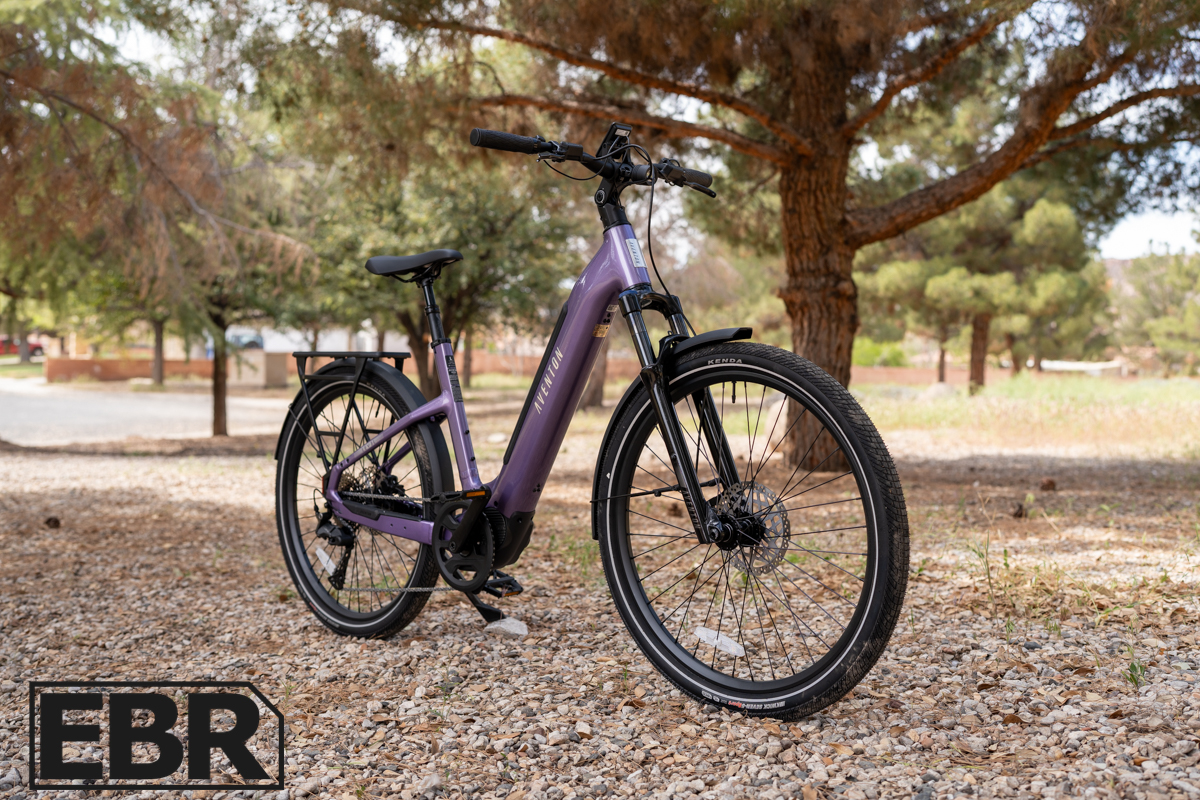
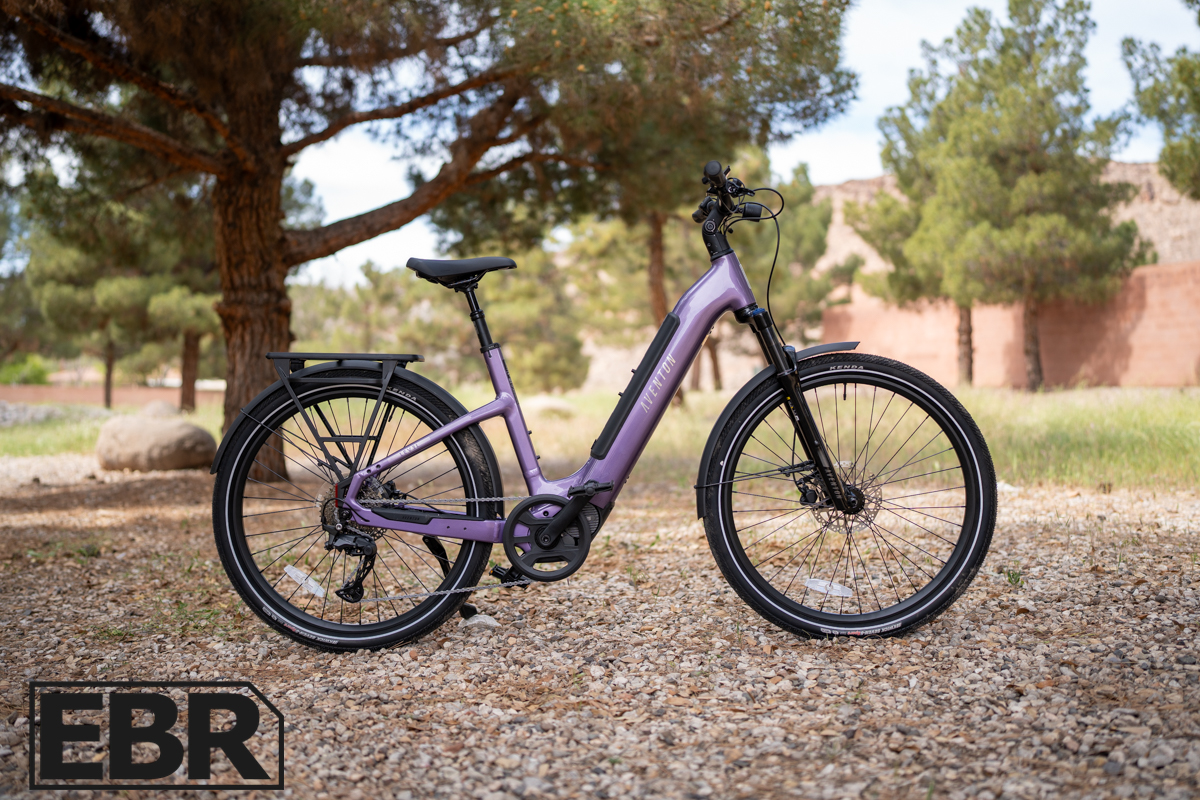
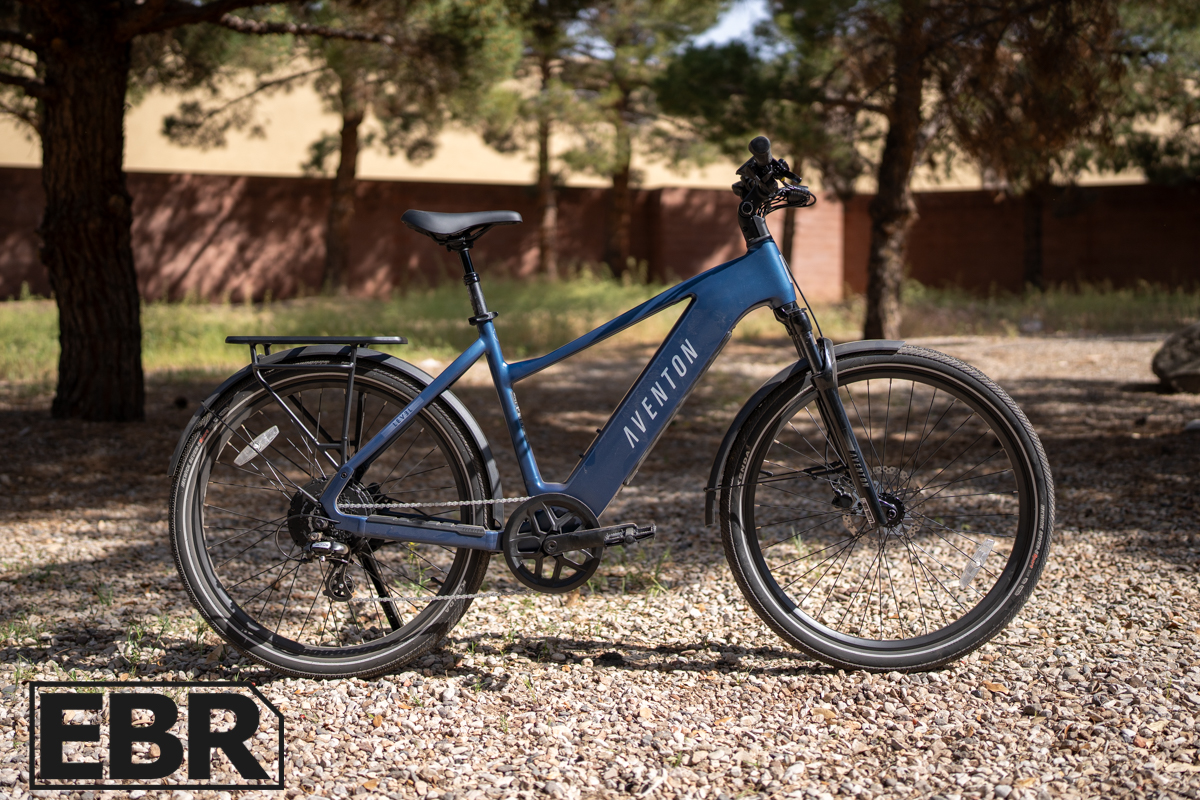
The Step-Through Regular in Haze showed up looking more subdued than I expected from a purple bike, and that turned out to be a compliment. The matte finish keeps it from reading as loud or flashy, and in person it comes across as premium rather than attention-grabbing. If you have been on the fence about a purple bike, this one might actually win you over.
From a distance, the ADV looks nearly identical to the REC, which is not a bad thing. The Level design language introduced with the Level 3 carried over well, and even without the gravity cast front triangle that gives the REC its weld-free look, the ADV frame reads clean and sharp. You would have to put them side by side to notice the difference. The step-through silhouette does give the ADV its own personality though. It has a slightly more approachable, lifestyle-forward look than the high-step, and practically speaking, the low standover makes mounting and dismounting genuinely easy. If you are commuting in work clothes or just want a bike that does not require swinging a leg over a tall top tube, the step-through earns its place here.
The riding position is relaxed and upright, with the same 90-degree adjustable stem from the REC giving you room to dial in your fit. It is a comfortable place to spend time, whether that is a quick errand run or a longer ride. The suspension seatpost and 100mm fork do their jobs quietly in the background, smoothing out the kind of road chatter that shows up on city streets.
The Ultro-S mid-drive delivers exactly what you would expect from a well-executed mid-drive motor. Power comes in smooth and natural, the torque sensor reads your effort cleanly, and the assist feels like an extension of your own pedaling rather than something layered on top of it. It climbs well, gets up to speed quickly, and has no trouble handling anything a commuter or recreational route is going to throw at it. This is Aventon’s first in-house mid-drive, and it rides like they put the time in.
On real rides, a few features stood out. Auto pedal assist mode was the one I found myself returning to most. You just pedal and the bike reads your effort dynamically, adjusting power output in the background without you touching anything. Paired with the torque sensor, it feels fluid and natural. There is no thinking about which PAS level you should be in. You just ride.
AutoShift is more interesting than I expected, and better than similar systems I tested on other bikes last year. Those earlier versions struggled with shift timing and often felt like they were guessing. This one mostly shifts when you would want it to. Heading into a climb it drops to an easier gear, and at the top it works its way back up. The one pattern worth knowing about is there’s about a 3 to 5 second window at the crest of a hill where you are spinning out before the system recognizes the grade has changed and shifts up. That makes sense when you think about it. When you are in control of your shifting, you are reading the road ahead and making the shift before you need it. AutoShift cannot see what is coming, so it reacts in real time once it feels the change. For riders who want precise, anticipatory shifting, manual control is still the better tool. But for anyone who wants to stop thinking about gearing entirely and just enjoy the ride, AutoShift delivers on that promise, especially when paired with Auto pedal assist.
What I appreciated most about both features is how Aventon handled the opt-out. Every one of these tech additions, Auto PAS, AutoShift, custom power profiles, all of it, can be turned off or tuned from the display or the app if it is not your thing. That is the right approach. Give riders the tools and let them decide what to use. Nobody wants to be stuck with a feature they do not like and no way around it.
Range
Estimated Range (from Aventon):
- Up to 110 miles
Real World Range Test Results:
- Eco Mode Real-World Range Test: 118 miles
- Turbo Mode Real-World Range Test: 55 miles
Aventon rates the Level 4 ADV at up to 110 miles, which is a bold claim. We tested it two ways.
In Turbo mode we covered 55 miles over 3 hours, averaging 17mph with over 1,300 feet of elevation gain. That’s a real world ride, not a flat parking lot loop, so 55 miles in those conditions is a solid result.
Then we ran an Eco mode test and things got interesting. 118 miles over roughly 10 hours, averaging 12mph, with over 2,000 feet of elevation on a city bike path with all the real world friction that comes with it. Other riders, joggers, kids, stop and go, the whole thing. That’s not a controlled test environment. That’s just riding.
118 miles in Eco on a commuter e-bike is one of the best range numbers we’ve ever recorded across hundreds of bikes tested over the years, across every class and style. That’s not a small statement.
What makes it more interesting is the context. We also tested the Level 4 REC from this same release, which has a 75 mile rating and a rear hub motor with regenerative braking. We got 96 miles out of that one, roughly a 25 percent overage, and we credited a good chunk of that to the regen braking doing real work on all that stop and go riding. The ADV has no regen, and we came in just slightly over the rated 110. That actually tracks pretty cleanly.
And here’s the thing worth sitting with: our Eco test had 2,000 feet of climbing and constant speed variation from sharing a path with other people. In a cleaner scenario with flat terrain and steady speed, this number could realistically go higher. We’ll never know exactly how much higher, but the headroom is clearly there.
If long range is your primary reason for shopping an e-bike right now, it’s a good time to be looking.
Power (Motor & Battery)
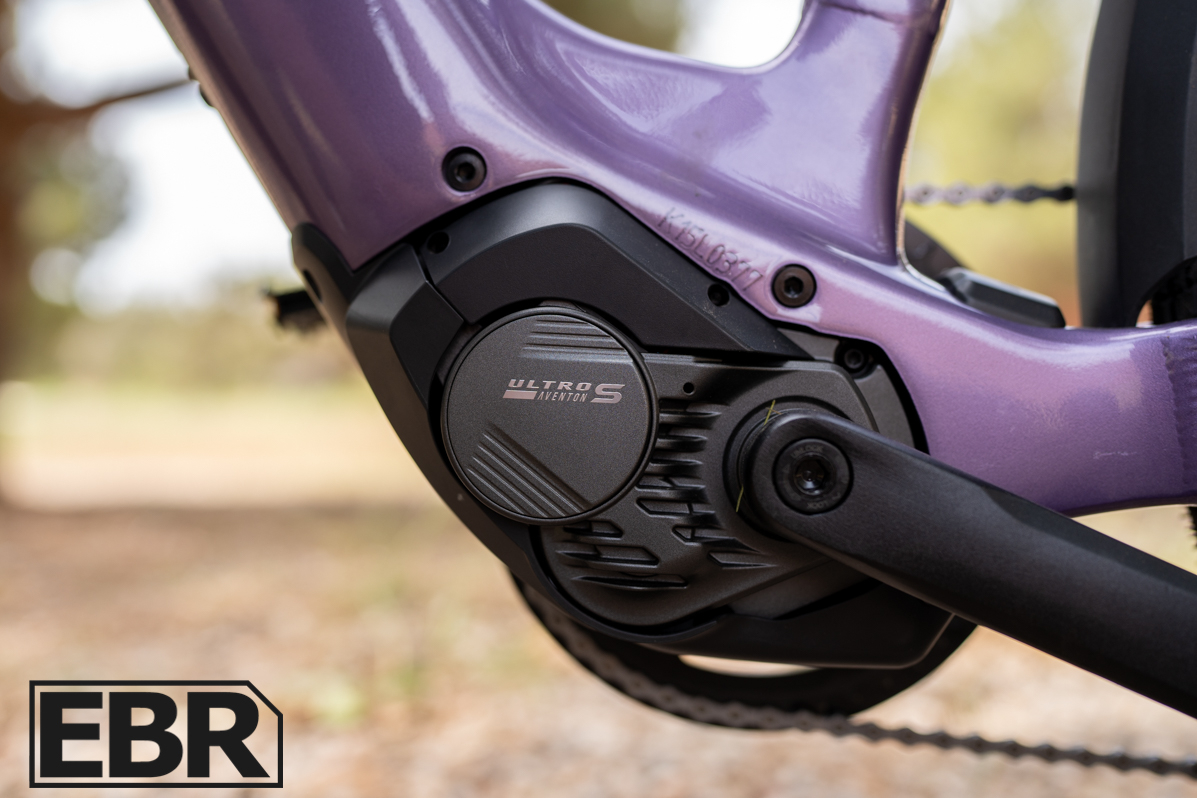
This is where a big chunk of the new appeal for the Level 4 ADV lives. The mid-drive motor. And if you are here thinking there was a rear hub version of the new Level 4, you are correct, you can check that out in my Level 4 REC review.
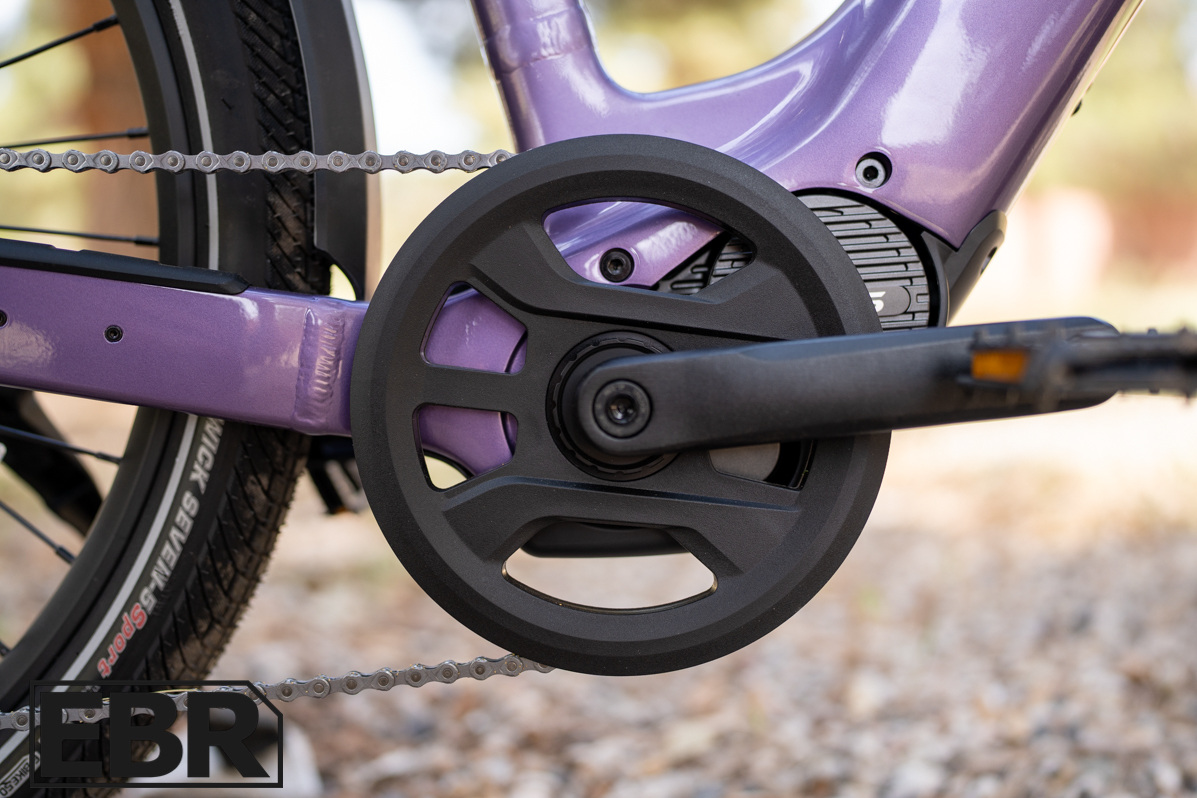
The new motor is called the Ultro S, and it is Aventon’s first in-house mid-drive. It is rated at 750W peak with 100Nm of torque and weighs just 2.8kg, or about 6.1 lbs. For context, that is a light mid-drive. It uses a dual-sided torque sensor built into the bottom bracket, and the pedal feel coming out of it is smooth and natural.
Have I said that about torque sensors before? Absolutely. But, the honest truth is that torque sensor technology keeps improving year over year, and something I called great in 2023 probably does not hold up against what is shipping today. That is just how technology works. It is not slowing down for any of us, so we might as well enjoy where it has gotten to.
Pedal assist comes in Eco, Sport and Turbo, all of which can be individually tuned through the Aventon app to build your own power profile. But the genuinely new addition here is Auto mode. In Auto you just pedal and the bike handles the rest, reading how hard and fast you are working and adjusting power output dynamically in the background. You do not have to think about it. For riders who want that control though, it is all still there. You can tune each assist level individually in the app, and the bike is convertible between Class 1, 2 and 3 with a top speed of 28mph if you unlock it.
The power on this thing is worth emphasizing. It climbs well, it moves fast on flat ground, and if you want none of that aggression, the custom power profiles let you dial it way back. You really can shape this ride however you want it.
One thing worth knowing: the ADV does not come with a throttle standard. That is a departure from the REC, which includes one out of the box. You can add a throttle to the ADV at checkout or later through Aventon, but if having a throttle from day one is important to you, the Level 4 REC is probably the one to look at.
On the battery side, the ADV runs a 36V, 22Ah system with a total capacity of 800Wh. It is fully integrated into the downtube with an electronic locking mechanism that can be released through the display or the app. When I first saw that there was no physical key to remove the battery I will admit I had a moment of concern.
What happens if the software glitches and the battery will not release? I asked Aventon directly, and they confirmed there is a manual release option for situations like that. They also pointed out that the ACU system keeps a small reserve of battery power specifically to keep the security and tech features running, which includes battery access. So even if you pedaled the bike completely dry, you would still be able to get the battery out. That is good to know and puts that concern to rest pretty quickly.
The Level 4 ADV also ships with a 4A fast charger, which cuts full charge time down to roughly half of what a standard 2A charger would take. That is included in the box, not an add-on.
Components
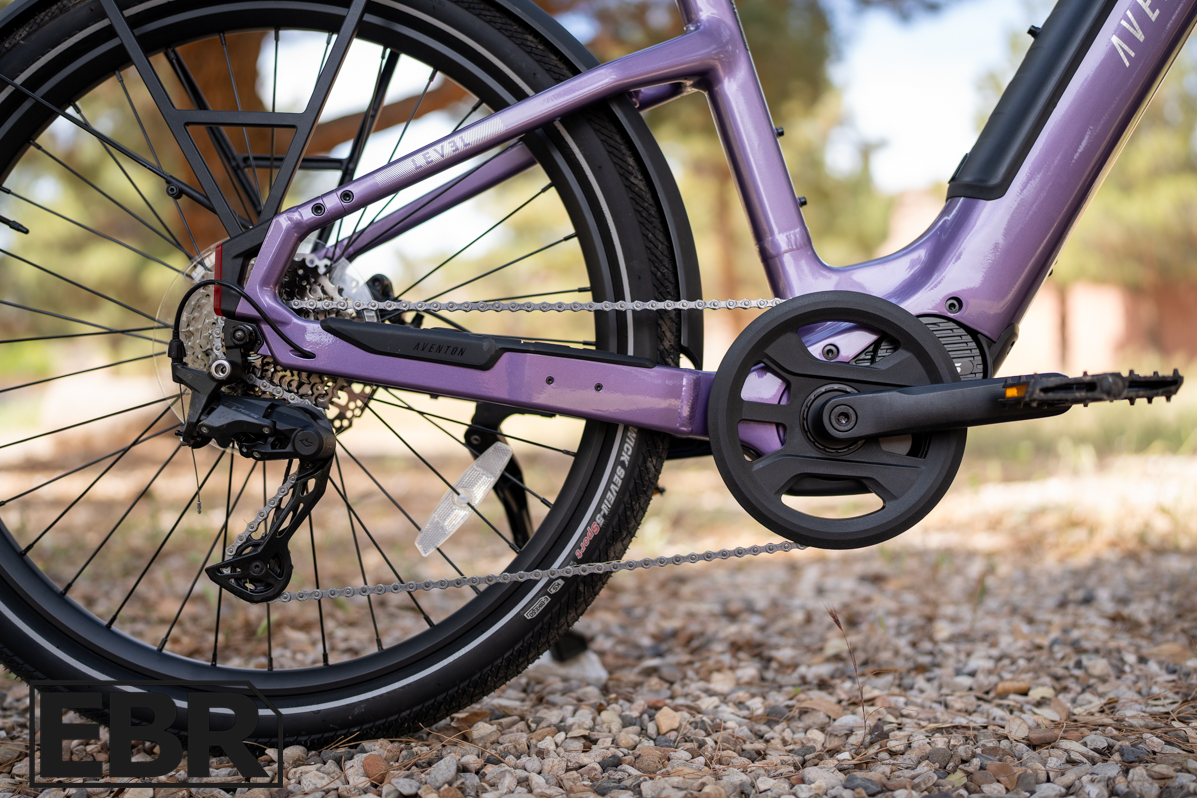
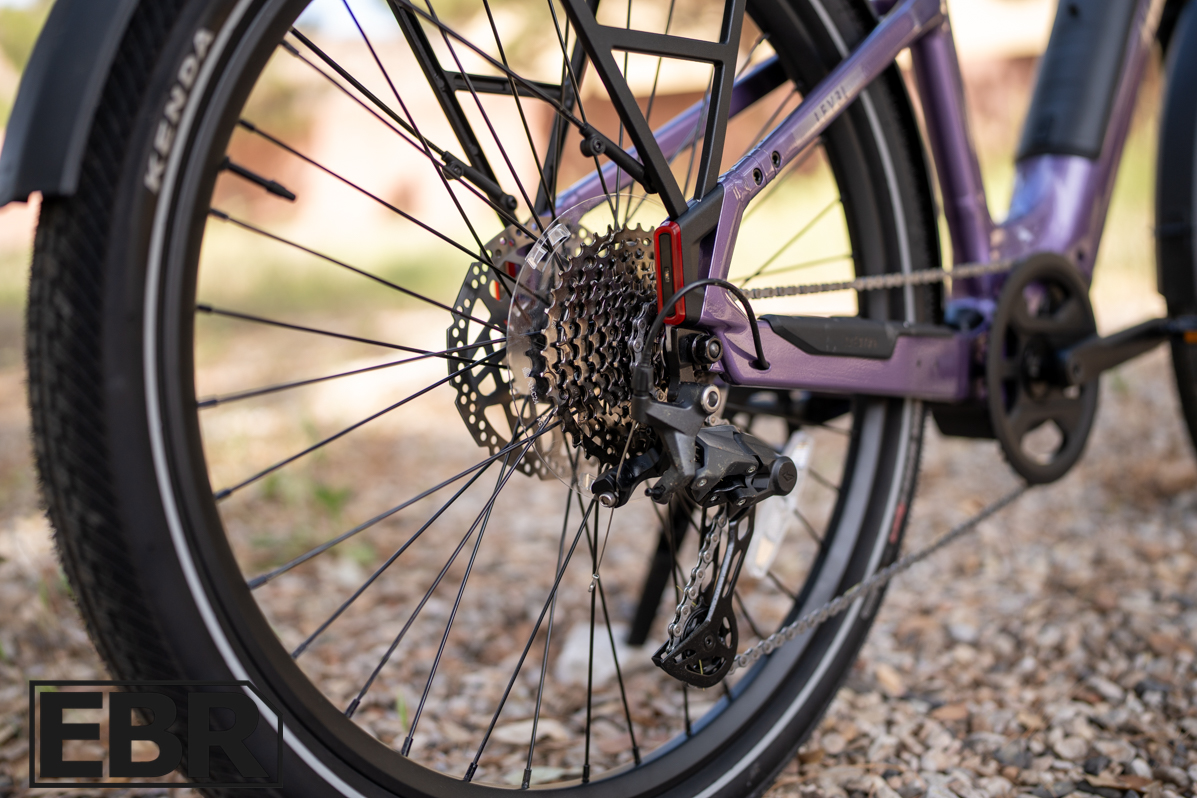
The Level 4 ADV runs a Shimano CUES 10-speed drivetrain, which sits a step above the Altus setup on the REC and brings better shift feel and a wider gear range. The 11-39T cassette gives you meaningful low-end gearing for climbs without sacrificing top-end efficiency on flat ground, and the Shimano E-glide chain is designed specifically for e-bike use with reinforced side plates to handle the additional torque load a mid-drive puts through the drivetrain.
Shifting is handled through Aventon’s proprietary E-Shifter with AutoShift capability, which feeds signals to a junction box mounted along the inside of the chainstay, using an actuator to pull the CUES derailleur cable rather than a traditional mechanical lever pull.
The crankset is a 165mm aluminum alloy interface on a square tapered sealed bottom bracket, with the double-sided torque sensor integrated at the bottom bracket area.
Wheels are 27.5 inch double wall aluminum front and rear, both laced with 36 spokes, which is on the more robust end for a commuter and contributes to a more durable, true-holding wheel over time. They are wrapped in Kenda Kwick Seven-5 Sport K1052 tires at 27.5×2.2 inches, a commuter-styled tread pattern with enough volume to absorb road buzz without the rolling resistance penalty of a knobby tire.
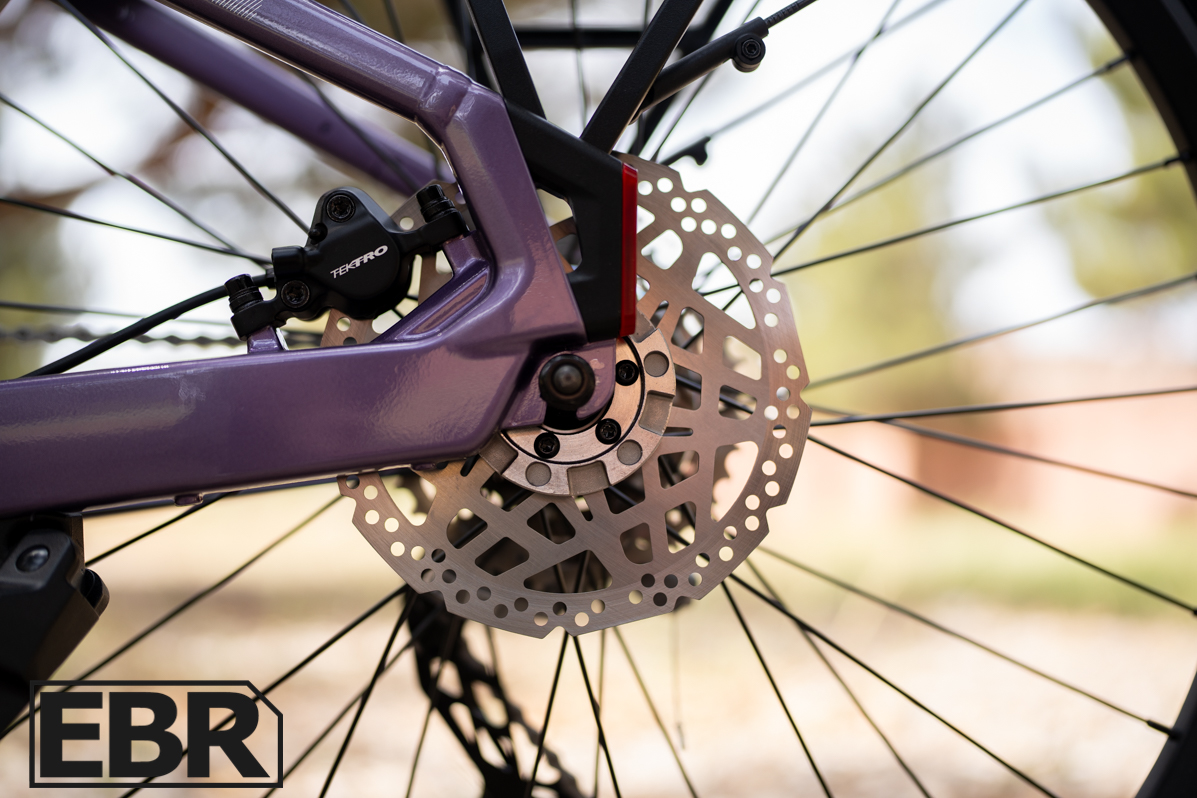
Braking is handled by Tektro HD-M3120 2-piston hydraulic disc brakes front and rear with 180mm 6-bolt rotors on both ends. The M3120 is a reliable workhorse in this price range, offering consistent modulation and enough stopping power for a bike in the 65-pound range carrying a loaded rider. The e-cutoff sensors in the brake levers cut motor power the moment you squeeze, which is standard practice but worth having confirmed on a motor with this much torque output.
Up front, the 100mm suspension fork runs a 15x100mm thru-axle, which provides more rigidity and better wheel tracking than a quick release setup, and is a step up from the 80mm fork on the REC.
Out back, the suspension seatpost runs 50mm of travel at 30.9mm diameter with a 400mm insertion length, giving taller riders enough post to work with while still delivering compliance over rough pavement.
At the cockpit, the 680mm aluminum handlebar has a 30mm rise, which combined with the step-through geometry keeps the riding position upright and comfortable without feeling slack.
The stem is 60mm at a 31.8mm clamp with 90-degree adjustability, giving riders a meaningful range of fit options. Aventon lock-on grips, a branded saddle with micro-adjust rails, and 9/16 inch composite platform pedals round out the contact points.
Screen / User Interface / App
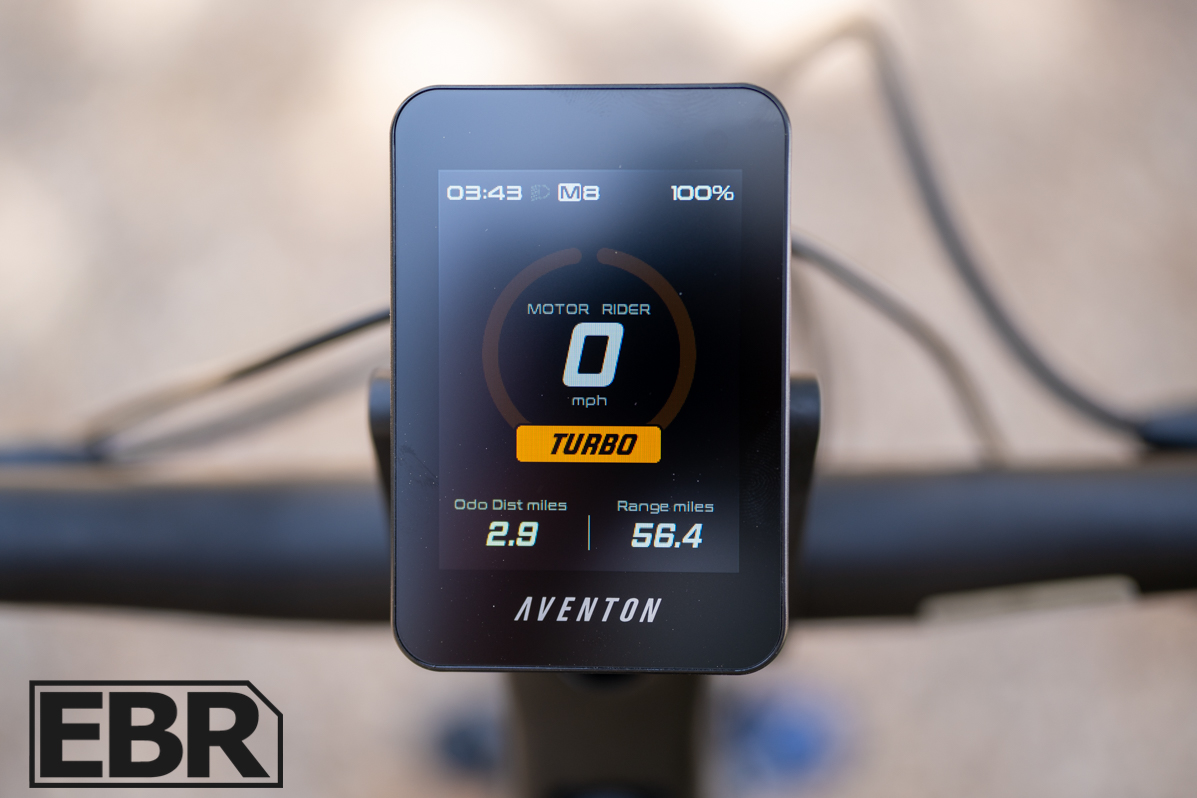
Aventon’s color display, the A280, sits front and center on the Level 4 ADV. At first glance it looked familiar, but the data screens and layout have definitely been updated, and for the better. The display includes a USB-C port with a weather-protected cover for charging devices on the go.
The home screen has a cleaner, more refined interface and an expanded set of data screens that go well beyond what you used to get. Beyond the standard odometer and trip meter, you now get a human versus motor power split so you can see exactly how much of the work you are doing versus the motor. Max speed and average speed are still in there too.
App connectivity runs through the Aventon App, available on both iOS and Android, and gives owners a solid range of features and settings to work with. From the app you can access GPS ride tracking, motor tuning, Ride Tune customization for each individual assist level, over-the-air updates and all of the security and tech features tied to the ACU. That includes geofencing, GPS and ride tracking and the rear wheel lock. The app is also where you switch between Class 1, 2 and 3 modes.
There is genuinely a lot you can do inside the Aventon App, and it is one of the more well-built ebike apps we have come across. If you want to go deep on all of it, check out the full Aventon App User Manual.
Aventon Level 4 ADV Model Options
For the first time in the Level lineup, buyers can choose between two distinct versions. The mid-drive model we are reviewing here is called the Level 4 ADV, and the other is the Level 4 REC, which runs a 750W rear hub motor.
However, the differences go beyond just the motor type. The ADV claims up to 110 miles of range, brings 100Nm of torque, an electronic shifting Shimano CUES 10-speed drivetrain, and comes in around 7 pounds lighter than the REC. It also comes in at about $800 more at $2,799, so that is worth factoring in depending on what you are looking for. If the REC sounds more like your speed, you can check out that full review here.
Both versions are available in either a high-step or step-through frame, so no matter which motor you go with you have the option to pick the frame style that suits you best.
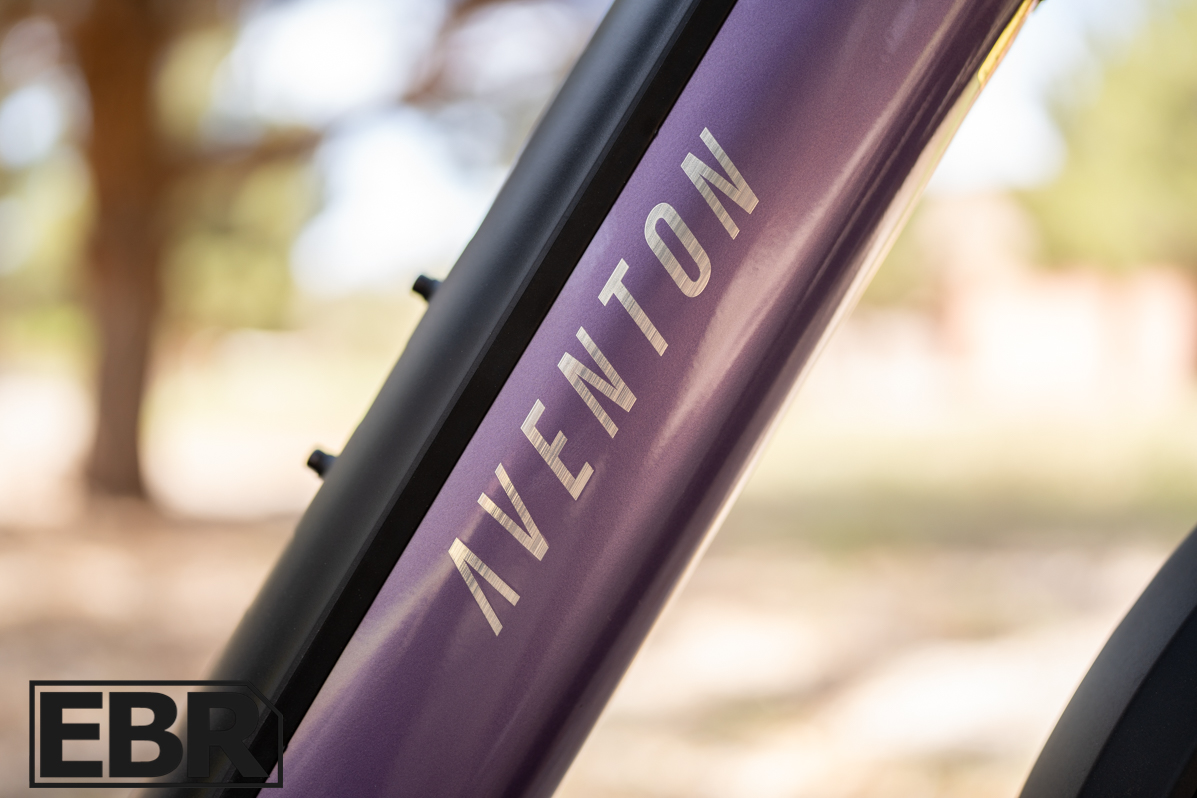
Across the full lineup there are six colorways to choose from, though not every color is available on every configuration, so you will want to pick your frame style first and then see what colors are on the table. All of them are matte finished and with the clean frame design they genuinely look sharp in person. The ADV comes in Matte Black, a camouflage green, and a matte purple called Haze. The Haze and camouflage are exclusive to the ADV and both look great in person. If those do not appeal, Matte Black is always a safe choice. The REC covers the lighter and more subdued colorways like Matte Storm Blue, Glacier Mint and Sandstone if that is more your style.
For rider fit, Aventon goes beyond the typical one-size-fits-most approach and offers each frame style in two sizes, a Medium and Large/XL for the high-step, with an XL extending up to accommodate riders over 6’3″. Across all the combinations that gives you a fit range stretching from 5’3″ on the low end of the high-step to over 6’3″ on the large, with the step-through covering 5’3″ up to 6’1″.
Included in the box you get the usual kickstand and pedals, but also front and rear LED lighting with turn signals and a braking indicator, a rear rack and full front to rear fender coverage.
I received this bike ahead of its official launch, so I do not have confirmed details on optional accessories just yet, but knowing Aventon I would expect a few to surface once the bike goes live. And if you are reading this, it already is.
Is The Aventon Level 4 ADV Worth Buying?
Pros
- Aventon introduces the Ultro S Mid-Drive motor, a new look at Aventon’s first mid-drive since the Ramblas debuted with the A100 mid-drive
- We got 118 miles of range on a single charge in Eco mode, and 55 on Turbo mode.
- Automatic riding: Aventon Auto e-shifting system with Shimano CUES 1X10 and Auto pedal assist mode for care-free rides
- The best security and tech package for e-bikes we have tested with the ACU system
- Fully equipped for commuting: front to back LED lighting, frame integrated tail/brake light with turn signals, fenders and a rear rack
- Over the Air updates to the electronics/motor/BMS, etc for easy improvements overtime
- Available in 3 colors, and 5 different frame size configs with Step-through and high-step versions
Cons
- The electronic battery release is a clean implementation, but a physical key backup would be a welcome addition. If the software ever fails, Aventon confirmed you can still get the battery out, though it requires hand tools to do it. That is not a dealbreaker, but a keyhole is a small thing to add for a lot of peace of mind.
The Level 4 ADV is not the obvious choice over the REC, and it is not supposed to be. These two bikes are built for different riders with different priorities, and Aventon was smart enough not to make one of them redundant.
The REC brings regenerative braking, a throttle standard, and a beefy rear hub motor that punched well above its rated range in our testing. The ADV brings a more refined power delivery, a higher-end drivetrain with electronic shifting, a larger battery, and a lighter overall package.
Both bikes have massive range potential. Both carry the full ACU security suite. The $800 difference between them is not about getting more bike for the buck, it is about getting a different one.
If the ADV speaks to you, it is because you want that mid-drive character, the smooth and natural feel of power that moves with your pedaling rather than behind it, paired with a drivetrain and feature set that genuinely matches the asking price.
The Auto PAS and AutoShift give you the option to just get on and ride without managing settings, and if you would rather tune everything yourself, that option is fully there too. At $2,799 with this spec sheet, this range capability, and this level of security and connectivity built in, the Level 4 ADV is a serious commuter that doesn’t require much convincing from me.





Reader Interactions