

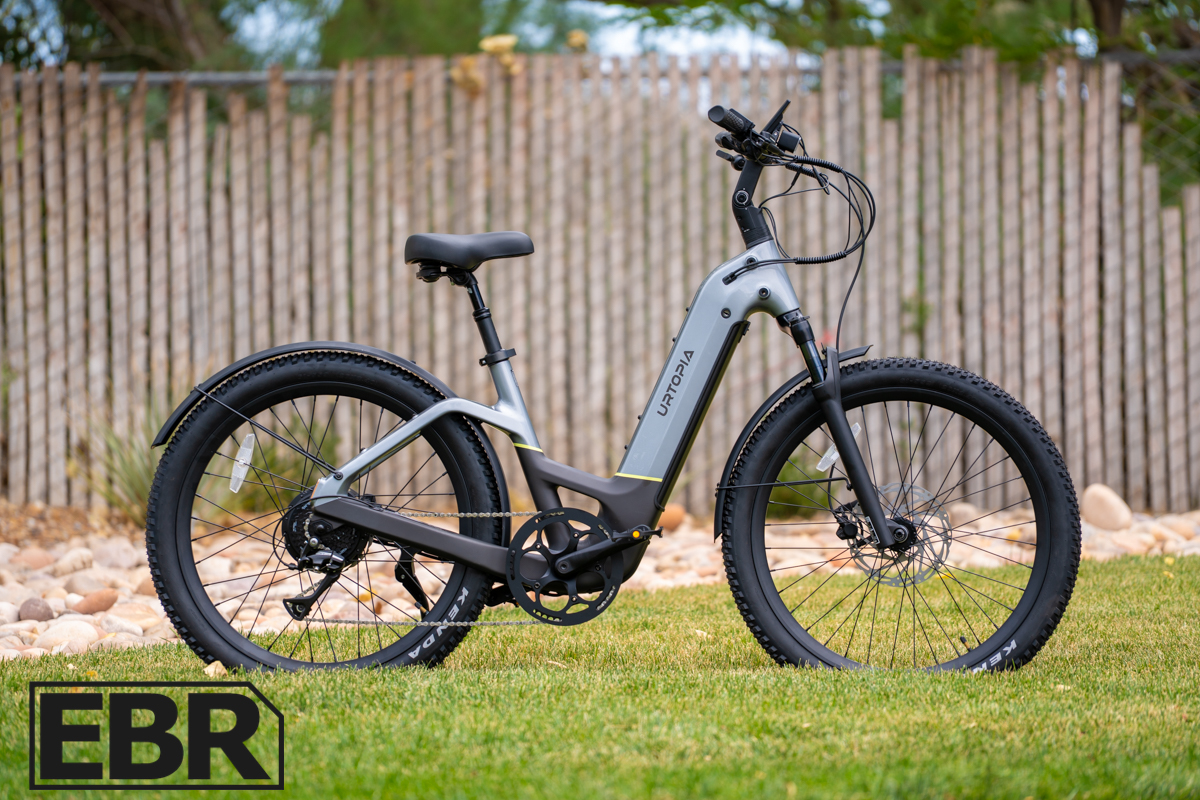
At $2,499, the Urtopia Carbon Atom is impressive. An upgrade from aluminum to a carbon fiber frame alone can cost upwards of $2,000. And this is not ‘cheap chinese carbon’ you hear about so frequently from YouTubers trying to build the best-specced bike for the least amount of money.
This is Toray carbon fiber – the same carbon used in race cars and high-end road and mountain bikes.
The carbon frame brings the weight down to about 64 pounds (Urtopia lists it at 58, but that is without the fenders or kickstand – our weight is the full bike plus slime in the tires to prevent flats), which is about 5-10 lbs lighter than most SUV e-bikes, and the stiffness it adds makes the bike feel solid and planted. The 750W rear hub motor and the zero-latency torque sensor deliver smooth, quiet, natural power, and the 802Wh battery gives you more range than most competitors in this category.
Yes, the components are entry-level if you’re comparing against $5K bikes. However, when compared against competing bikes in the same, sub $2,500 price point, the Atom impressed us even more.
My Experience Riding the Urtopia Carbon Atom
Ride Quality Score: 8 / 10
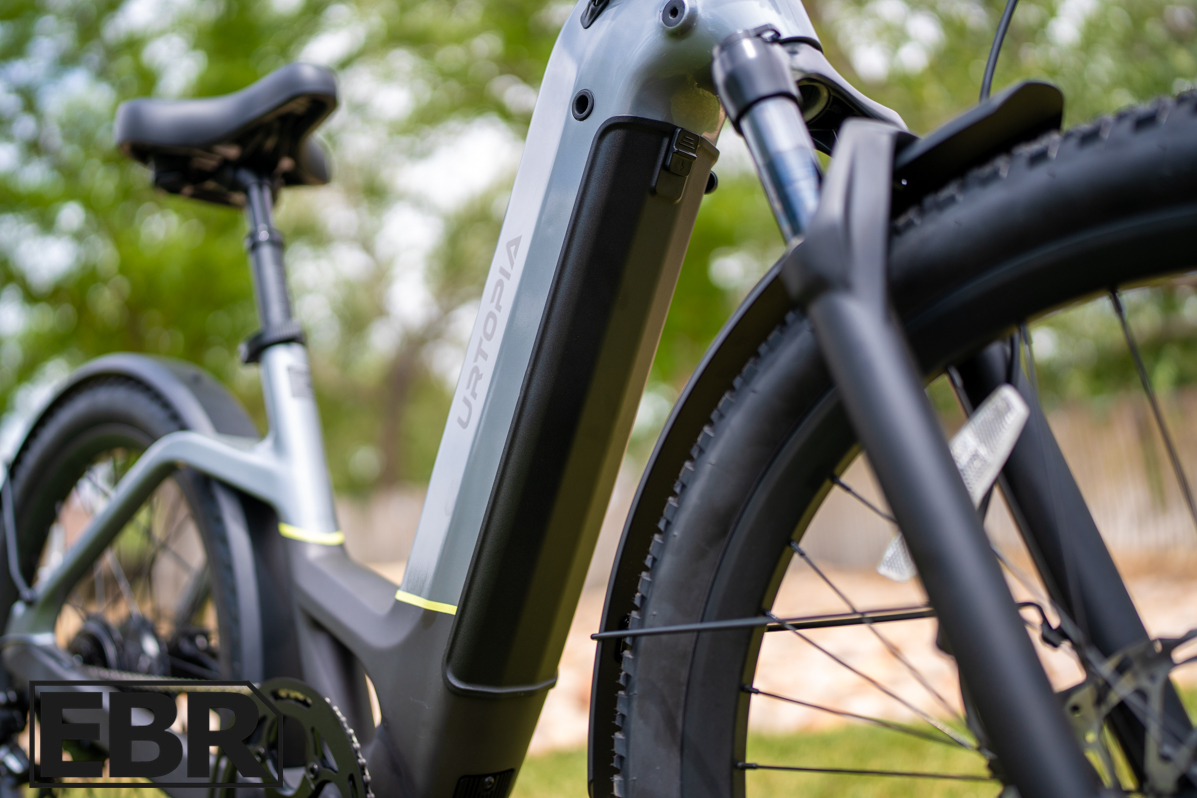
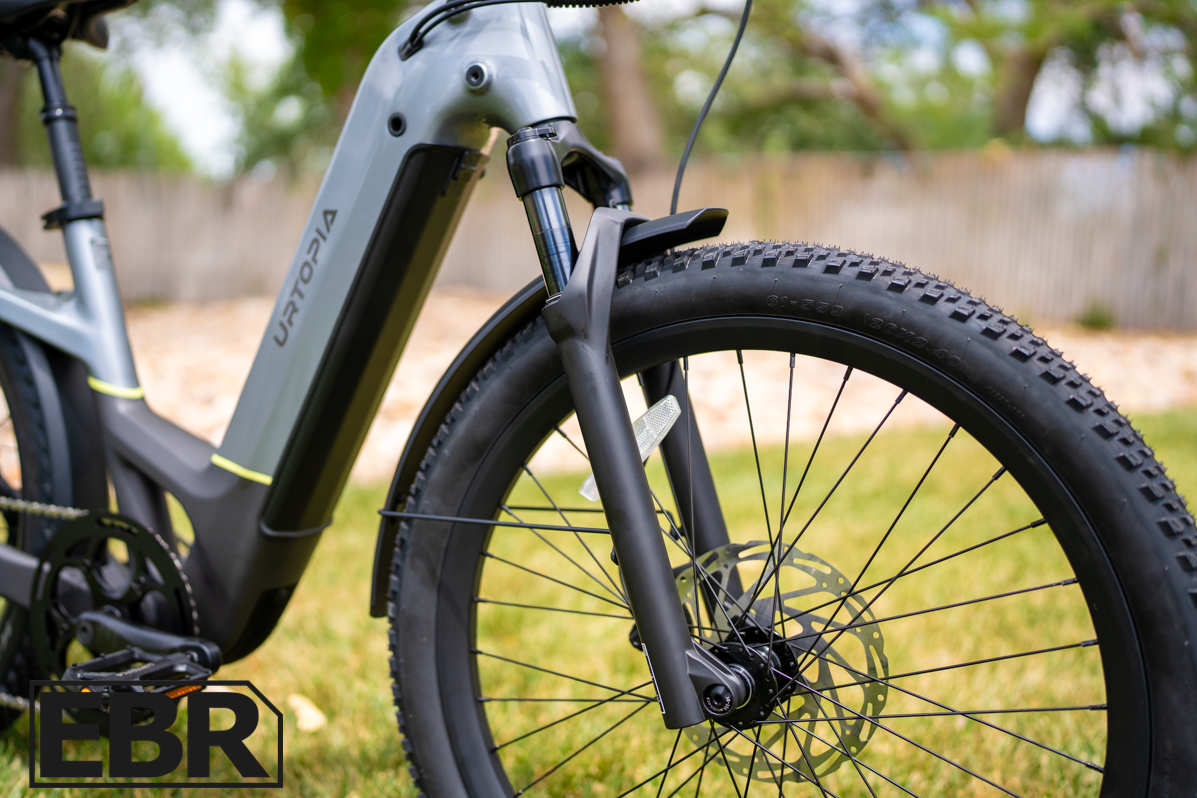
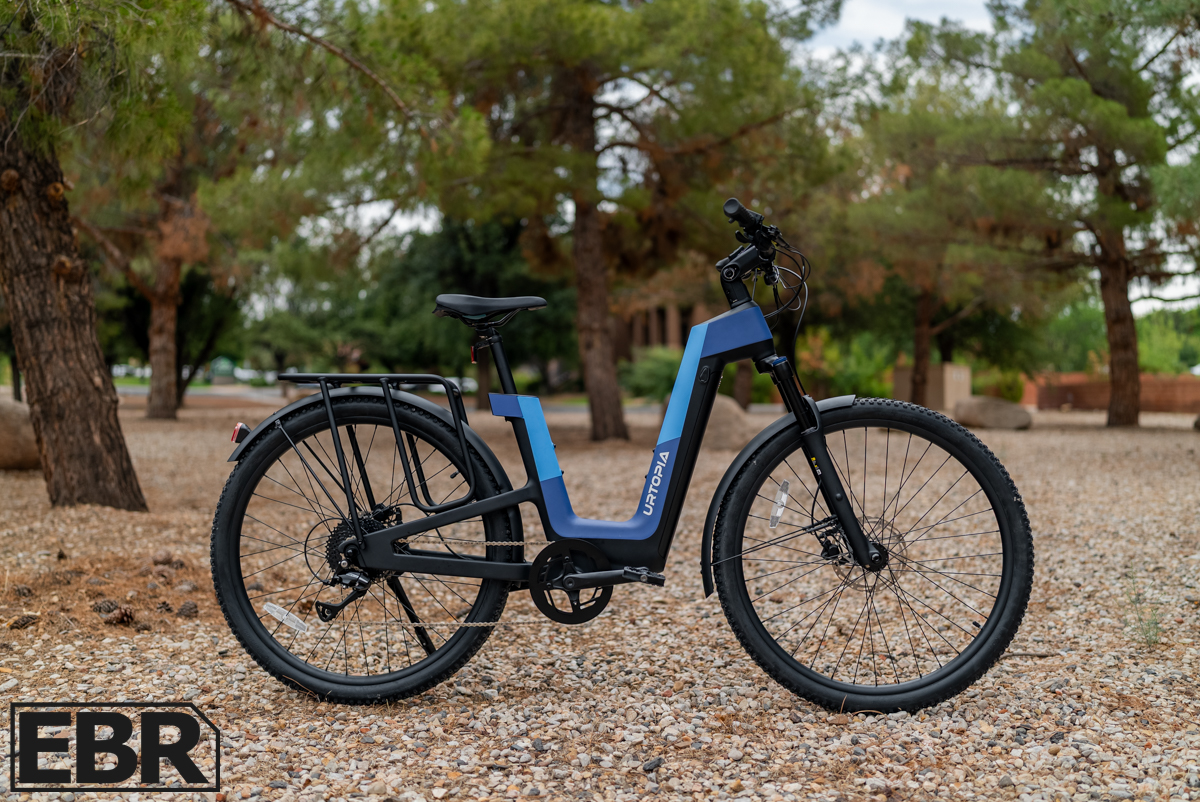
I know I’ve talked about the carbon frame a lot already, but the Toray carbon fiber also improves how the bike feels on the trail. Carbon fiber is both stiffer than aluminum, and it absorbs bumps better as well. Urtopia also added an extra support bar towards the bottom of the step-through design, making it feel sturdier than most step-through frames I’ve ridden. A lot of riders shy away from step-throughs because they expect flex or worry the bike doesn’t look bold enough.
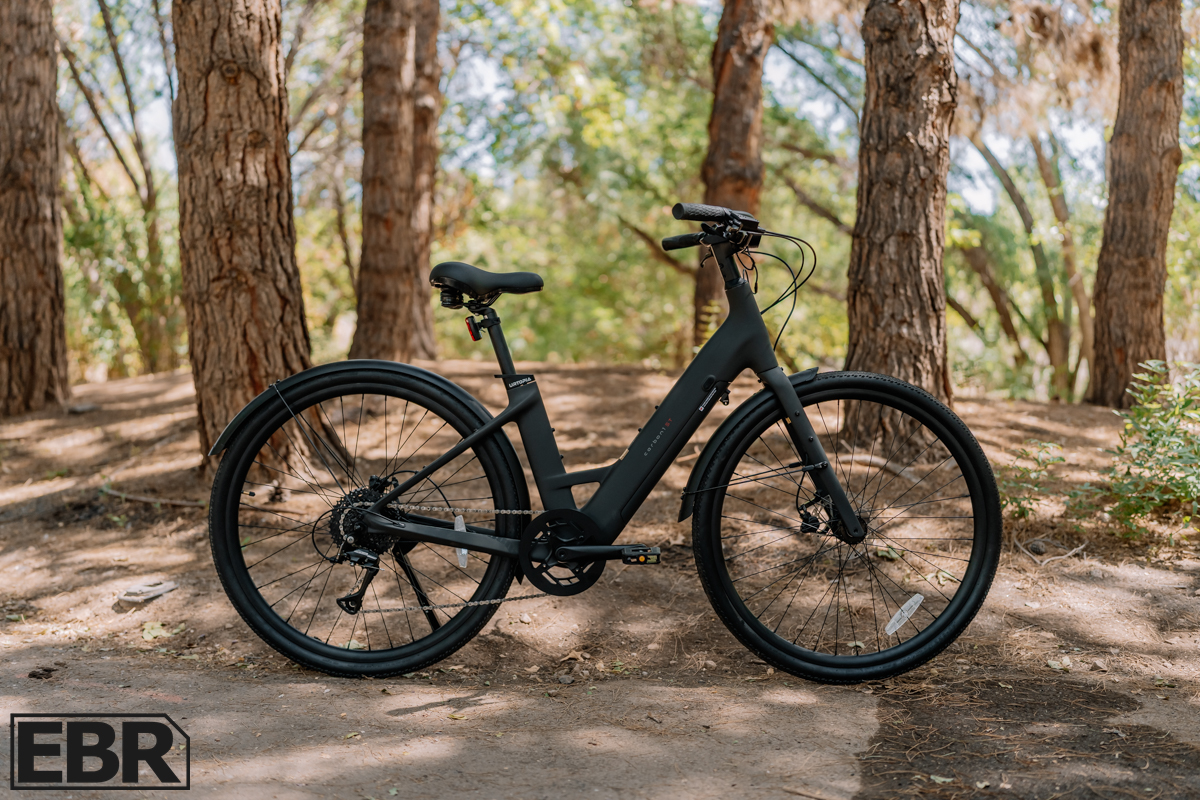
This one looks bold and feels strong while still being approachable with a low step-thru height.
Geometry-wise, the reach measures 355mm and the position is more upright than a mountain bike but not as laid-back as a beach cruiser. For my height it felt comfortable for longer rides without being either stretched out or cramped.
The bike is a one-size-fits-most frame rated for 5’3″ to 6’3″. Being honest about the edges of that range, riders near 5’3″ will likely run the seatpost close to the minimum insertion mark, and riders near 6’3″ may not get full leg extension.
However, the 90-degree adjustable stem helps here, letting shorter riders drop the bars and taller riders raise them, so the effective fit range is better than a single frame size might suggest.
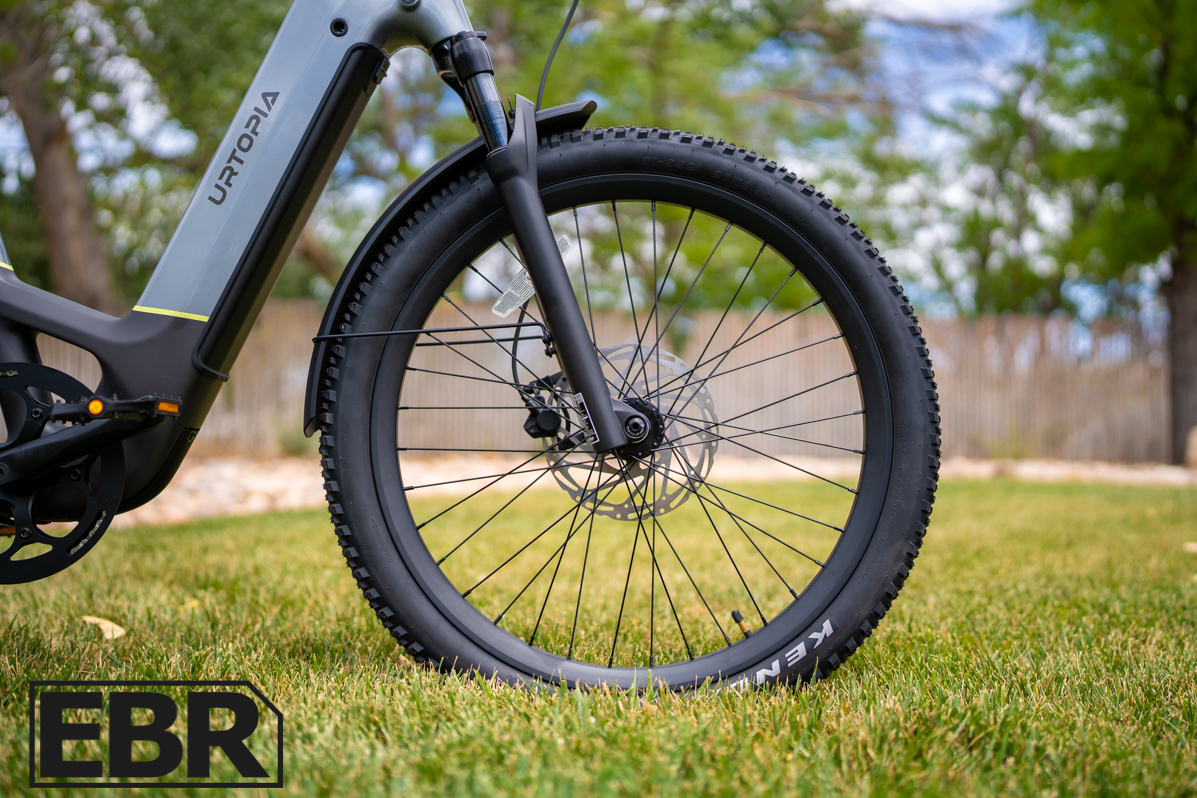
Handling is one of the bike’s strengths. At around 64 pounds it’s lighter and more nimble than most SUV bikes, easy to lean into turns and confident on the 26 x 2.4 all-terrain tires.
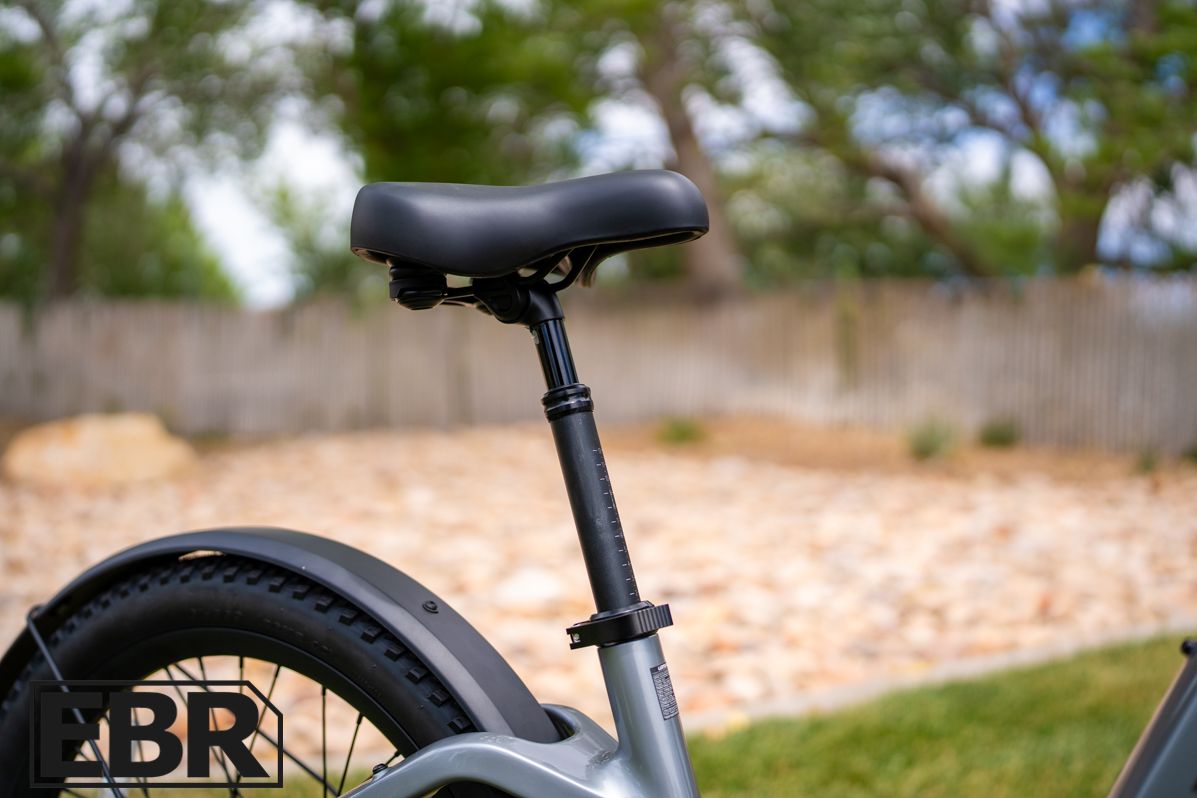
The 80mm fork with 32mm stanchions does a good job over bumps, and paired with the 30mm suspension seatpost, the bike stays comfortable over rough pavement and light trails.
One note on Urtopia’s marketing: they call this a full suspension bike. It isn’t.
There’s no rear shock. The suspension seatpost adds comfort for your backside but won’t keep the rear wheel planted on the ground the way a rear shock would. It takes the edge off, and I’m glad it’s there, just don’t expect mountain bike suspension when you hear the words ‘full suspension’.
That being said, I took the Carbon Atom off-road on some loose dirt double-track to see how the SUV bike handles that kind of terrain, and it did better than I expected. The knobby tires gripped well even on loose sections, and the front fork felt more plush than I anticipated.
This isn’t a mountain bike and I wasn’t hitting single track or jumps. But for camping trips and dirt roads around town, the Carbon Atom is a comfortable, capable ride.
Power (Motor & Battery)
Power Score: 9 / 10
 |
 |
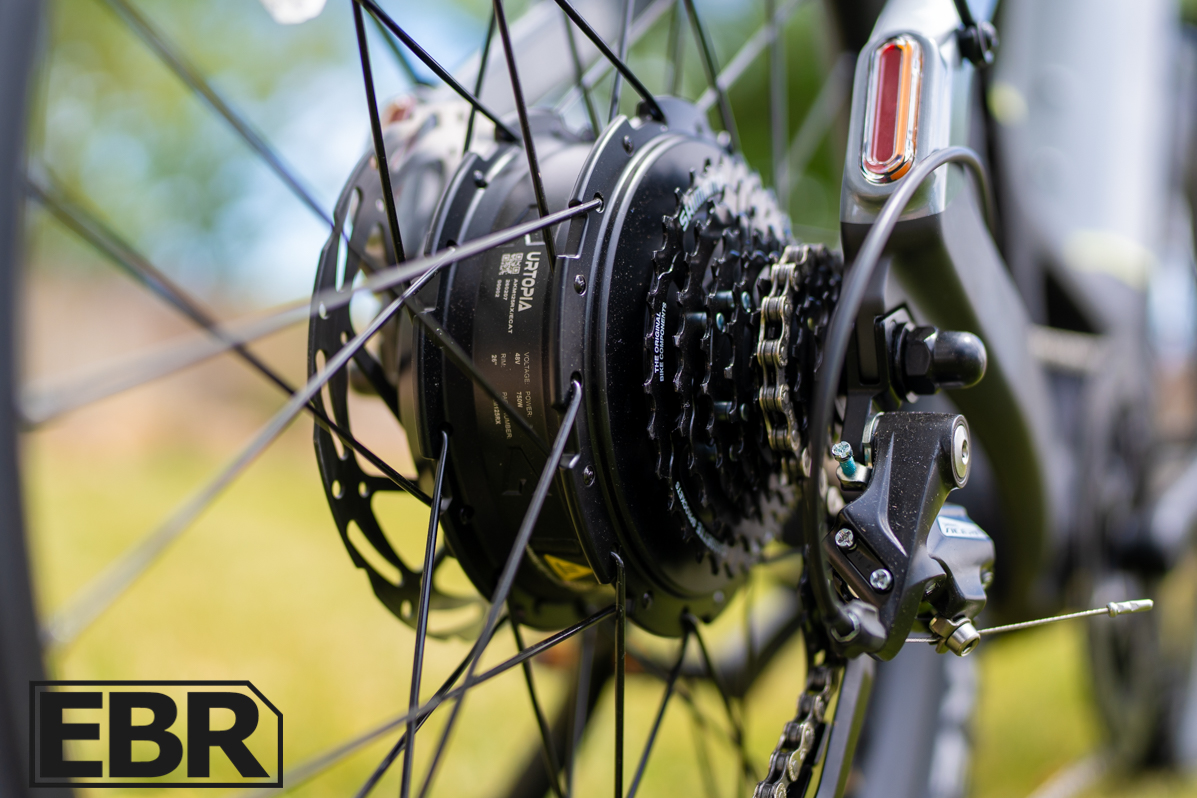
Urtopia spec’d the Carbon Atom with a 750W nominal rear hub motor (1250W max) rated at 90Nm of torque. For an SUV-style hub-drive bike, that’s the kind of power output we’d expect to see.
Where this motor stands out is the sensor.
Urtopia calls it a zero-latency torque sensor, and it lives up to the name. Power engages within a quarter turn of the pedals, scales naturally with how hard you push, and cuts off cleanly the moment you stop pedaling with no extended surge to throw you off. It’s smooth and incredibly quiet across every assist level. I love how much hub motors have improved these last two years, and Urtopia’s motors are no exception – they are very impressive.
On the hill test, I climbed our very steep and long “black hill” in 1:23 in turbo mode at a 15.1 mph average, and 1:24 in boost mode at 14.9 mph, so the two top modes perform almost identically. On throttle alone it took 1:36 at a 13 mph average.
Those are solid results, but it’s not just the time that stood out to me, but how naturally the power was delivered. No, I didn’t have to put many of my own watts into the pedals to get up the hill. A lot of bikes are programmed that way. However, the Carbon Atom climbed in such a natural manner that I could have almost forgotten I was on an e-bike and believed it was me who had He-Man leg strength.
On the battery side, Urtopia went with an 802Wh, 48V pack, which is about 10% larger than the 720-730Wh batteries common on competing SUV bikes. The battery weighs about 8.6 pounds and carries UL 2271 certification.
Urtopia could have made the bike even lighter by about 1 lb, but they chose to give you more range instead, and I like that call since the bike weight is still very manageable.
Range / Battery
Range Score: 9 / 10
Min Assist: Coming soon — minimum-assist range test in progress
Max Assist: 45 miles (full power, capped at 20 mph)
On our max-range test, running full power capped at 20 mph, we got 45 miles. Urtopia estimates about 90 miles, and based on our max-range result that figure is plausible for a rider in a lower assist setting.
We’ll be running our minimum-assist range test soon to see if we can get close to that 90-mile claim, so check back for updated results.
Two things drive the range story here.
The 802Wh battery is slightly larger than most of the competition and the torque sensor helps too, since power scales with your effort rather than surging on and off, which tends to waste less energy than a cadence-sensor setup.
The 26 x 2.4 all-terrain tires have a slightly knobby tread for off-road grip, which adds a little rolling resistance on pavement, but the larger battery appears to offset that given how far we rode on our max power test.
For a commuter sticking to lower assist levels, this should be a long-range bike. For riders who lean on boost and throttle, the 45-mile max-power result is a realistic floor.
Components
Components Score: 8.5 / 10
 |
 |
 |
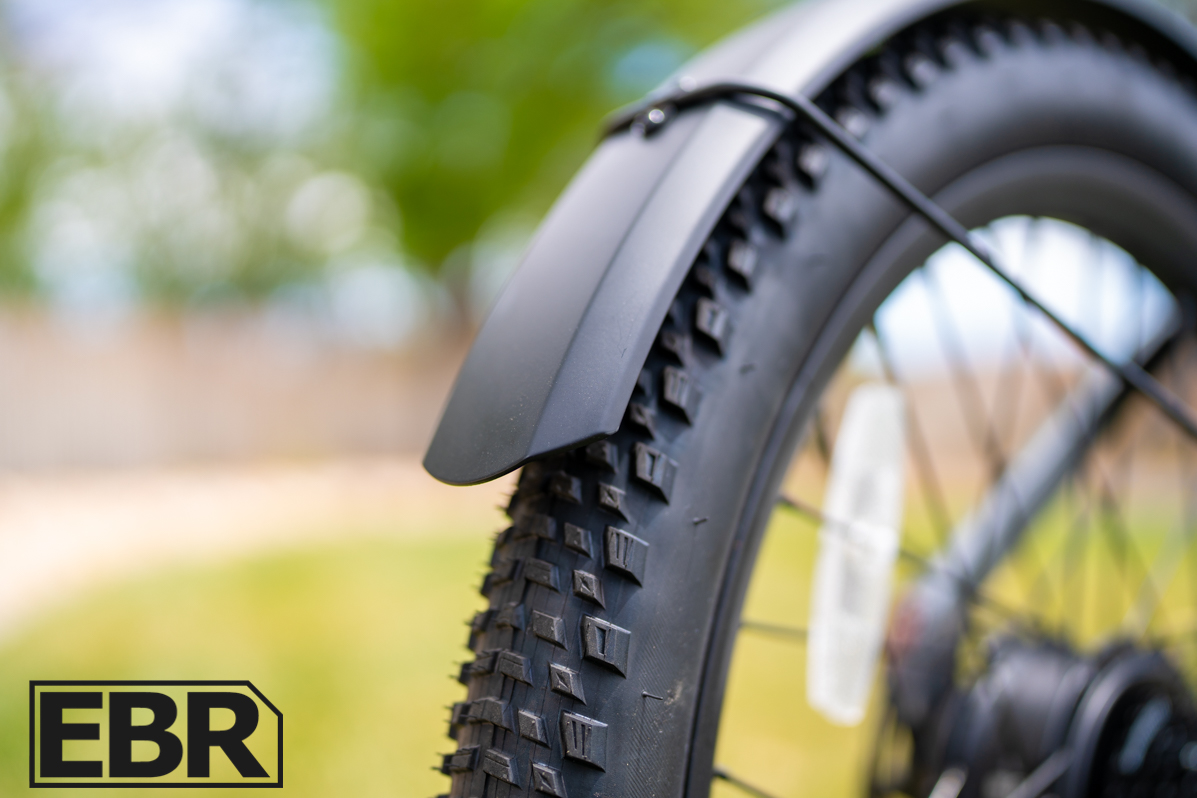 |
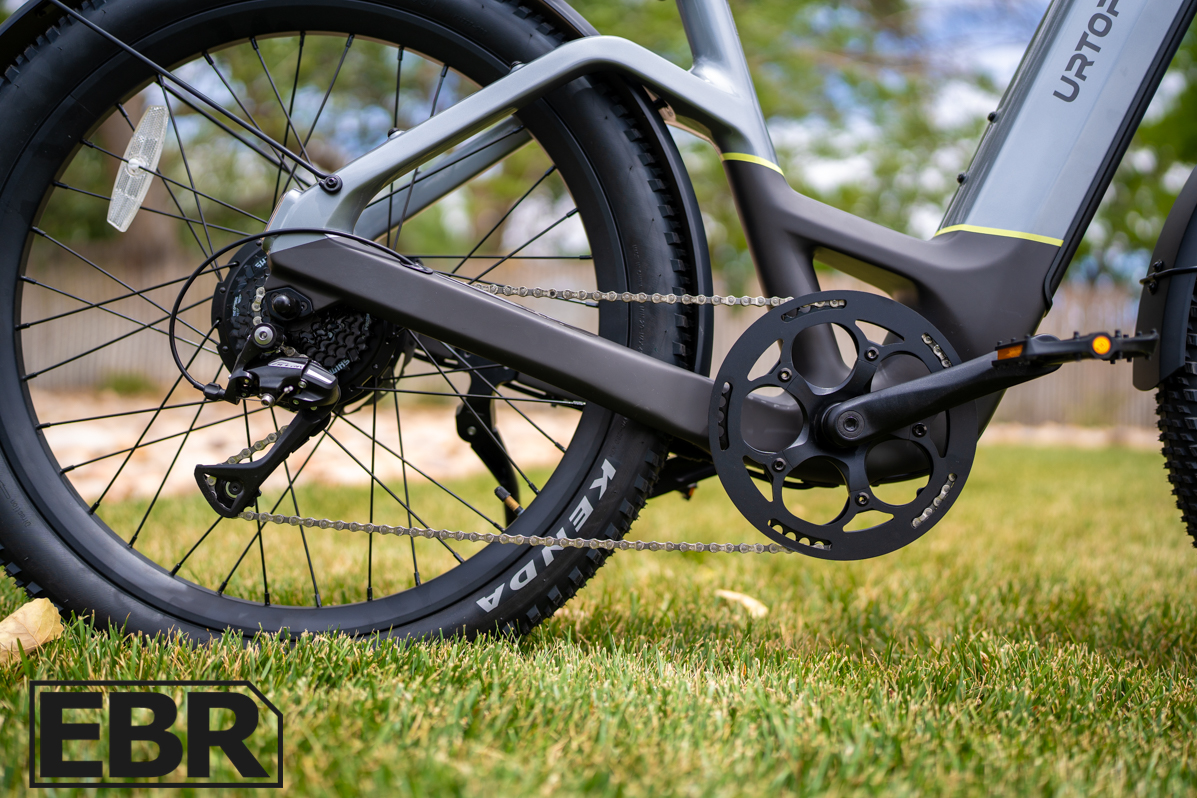
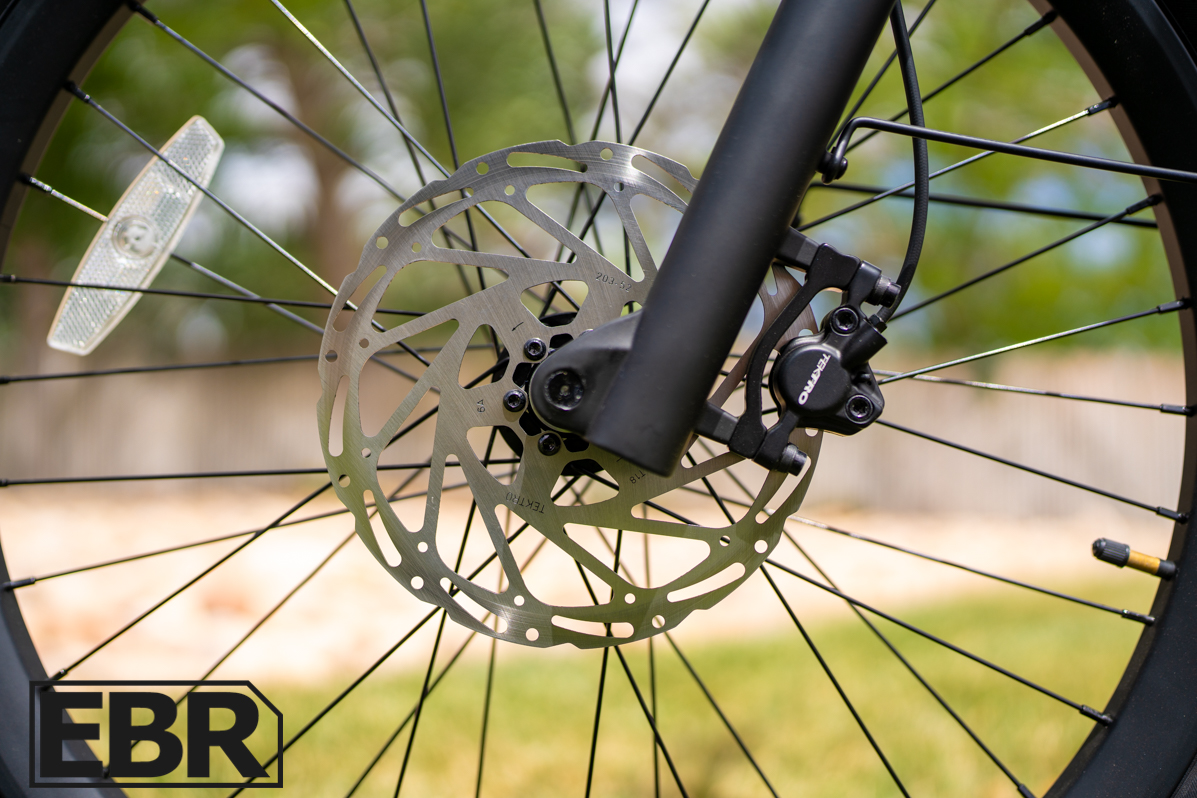
The question I kept coming back to with the Carbon Atom is whether Urtopia cut corners on components to hit $2,499 with a carbon frame. For the most part, they balanced quality and price well, with name-brand components that are also easy to service.
The drivetrain is a Shimano Acera 8-speed with a 12-32T cassette and a 52T chainring. Acera sits a step above Altus, which sits above Tourney, so you get crisp shifting that’s easy to set up and adjust. It’s still somewhat entry-level, and on most carbon fiber bikes you’d expect to see Deore or higher, but those bikes also carry $4,000-plus price tags. At $2,499 with a carbon frame, Acera is better than expected.
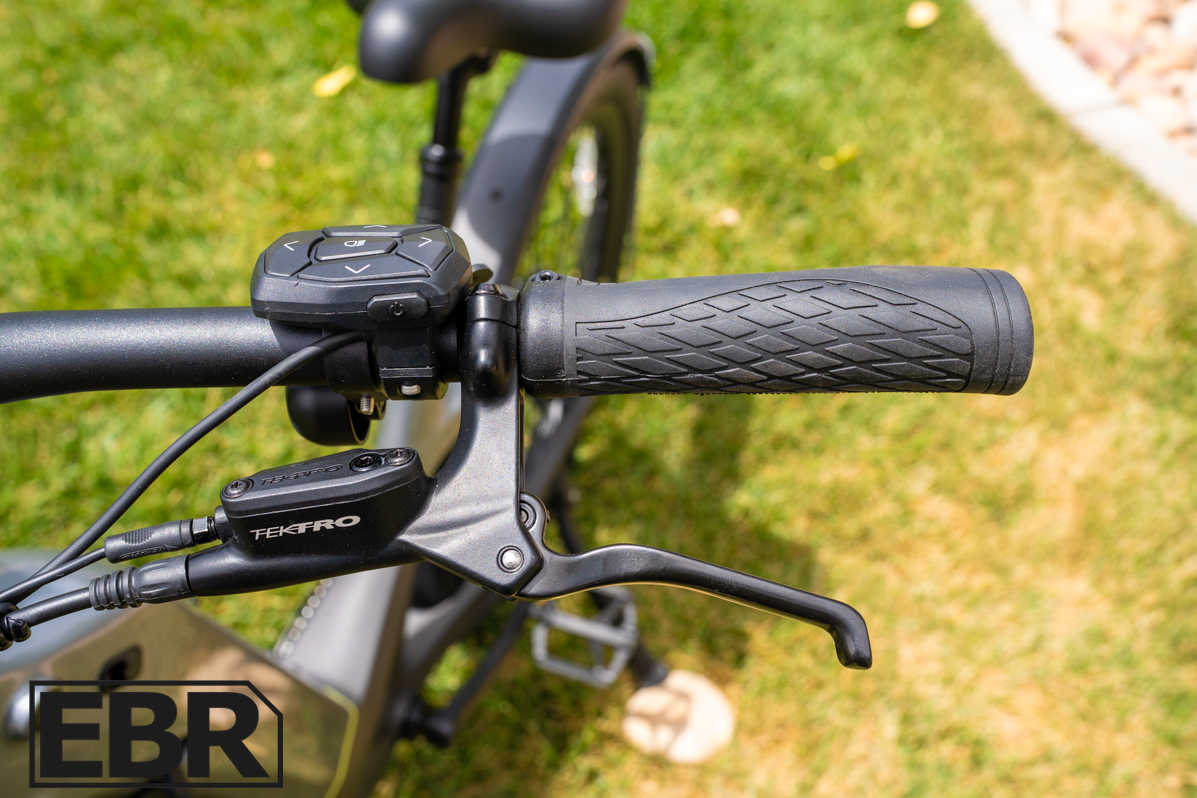
Braking comes from Tektro HD-E3520 hydraulic disc brakes with a large 203mm rotor up front and a 180mm rotor in the rear, both 1.8mm thick. We did our brake test down the Black Hill, hitting speeds of 25 to 28 mph and braking repeatedly seven times, and felt no fade at all. Strong, confident stopping power, and the levers are easy to reach and pull with two fingers.
Up front is an 80mm suspension fork with 32mm stanchions, with preload adjustment and a full lockout. The preload doesn’t do a lot, but the lockout works well, and heavier riders can firm things up if the fork feels soft. The fork is paired with a 30mm suspension seatpost for added comfort. Again, this is a comfort feature, not a full rear suspension shock.
The cockpit has ergonomic lockable rubber grips that are comfortable, Tektro brake levers with good feel, and a 90-degree adjustable stem that extends the fit range nicely. The stem uses a custom headset assembly that’s a little harder to work with, and you can swap the handlebars if you want.
The right-side throttle requires a double-tap to engage from a standstill, a smart safety feature that prevents accidental “whiskey throttle” takeoffs. There’s also a loud, crisp bell mounted on the left, which is useful for alerting people on shared paths. I know it’s a small thing, but I really appreciate how loud the bell is without being annoying. Runners with airpods in still heard me – which doesn’t usually happen.
The one component note worth flagging is the cable routing, which runs partly internally through the headset and partly through the downtube. The downtube routing is easier to service, and I’m not quite sure why they would run ½ of the cables through the headset and the other ½ through the downtube. Either way, I would like to see Urtopia run all cables through the downtube in the future.
Overall, this is a strong component package for the price. You’re not getting carbon wheels, carbon bars, or a high-end drivetrain, but a build like this on a carbon frame would normally run $1,000 to $1,500 more than it’s priced now.
Screen / User Interface
Screen / App Score: 7 / 10
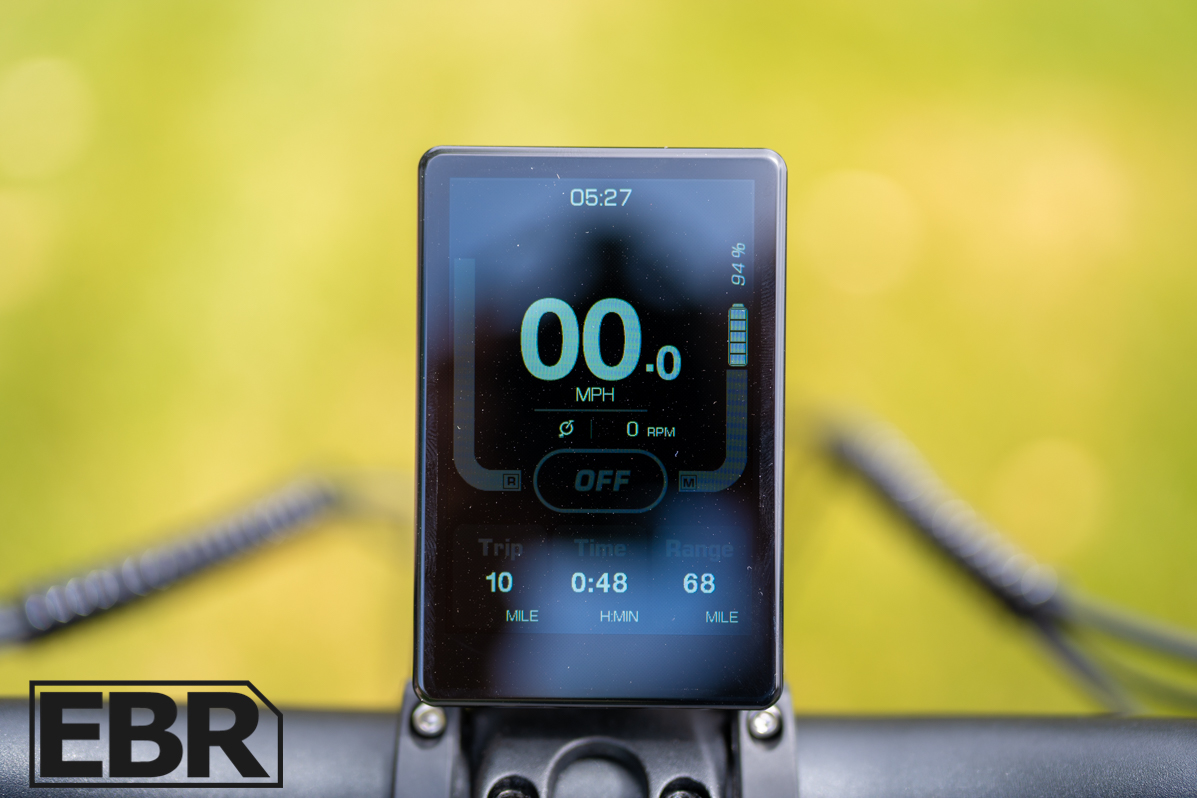
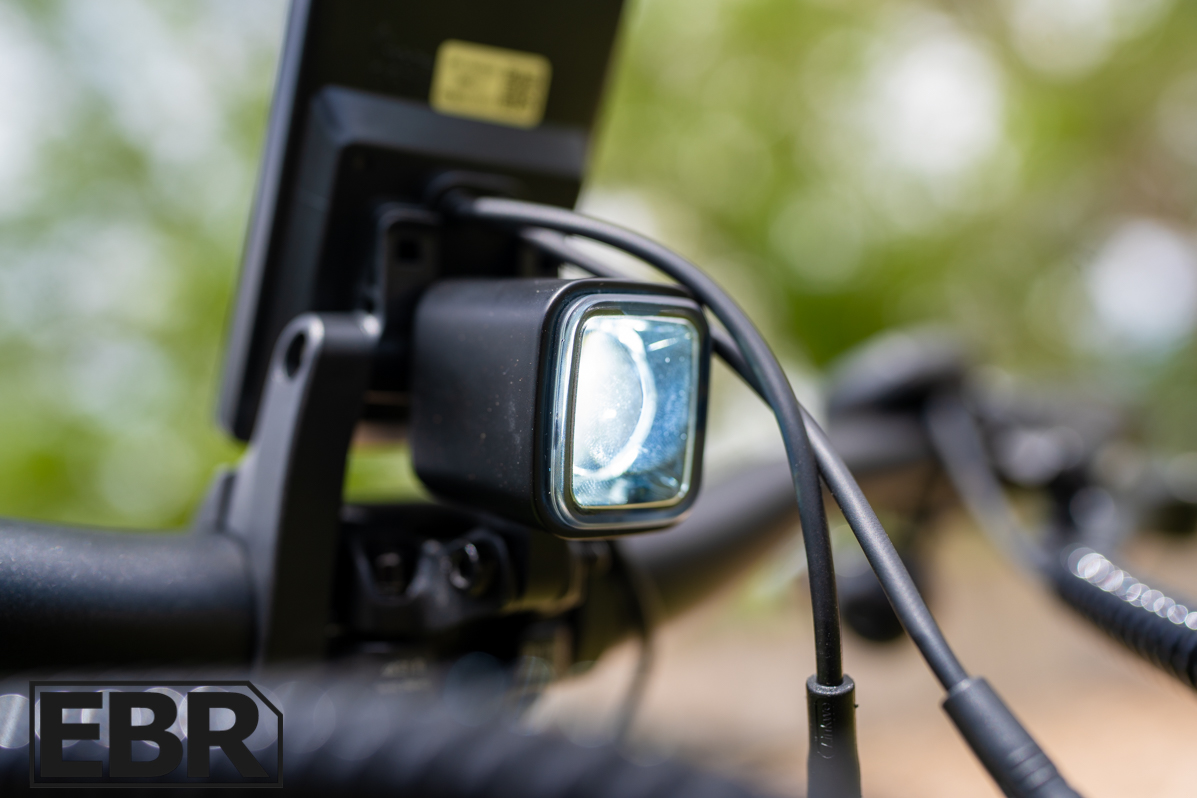
Urtopia gave the Carbon Atom a 3.5″ color display, and the location is one of my favorite things about it.
It’s raised up above the handlebars so you don’t have to look far down to read it, and it’s large enough to take in everything at a glance. The main screen shows the time, battery readout in both percentage and bar form, speed, RPM, and your current assist level.
The battery readout is a true percentage rather than 10% increments, so it’s more accurate than a standard bar display, which I appreciate.
Press the select button and you get into trip data, odometer, average and max speed, and a power analysis showing average and max wattage plus the split between rider and motor effort.
The one thing I’d add is a real-time wattage readout. Right now you only get average and max, not live output while riding, and that would be a useful addition.
What stands out most is that you can do all your tuning right from the display without an app.
Hold the select button and you’re into advanced settings, where you can adjust the speed limit anywhere up to 28 mph (it won’t let you exceed that, which keeps it legal, and you can password-protect the limit), set walk-assist speed, configure auto-sleep, enable OTA updates, and tune the output of each assist level (Eco, Tour, Boost) to your liking.
Being able to tune assist levels directly from the screen, without needing a phone, is something I’d like to see on every bike.
Note: in the video review I mentioned that Urtopia has a “Smart Mode” that is essentially an auto mode for motor output. Since we shot that video, I have been told that Urtopia has chosen to discontinue this feature.
Bike Model Options
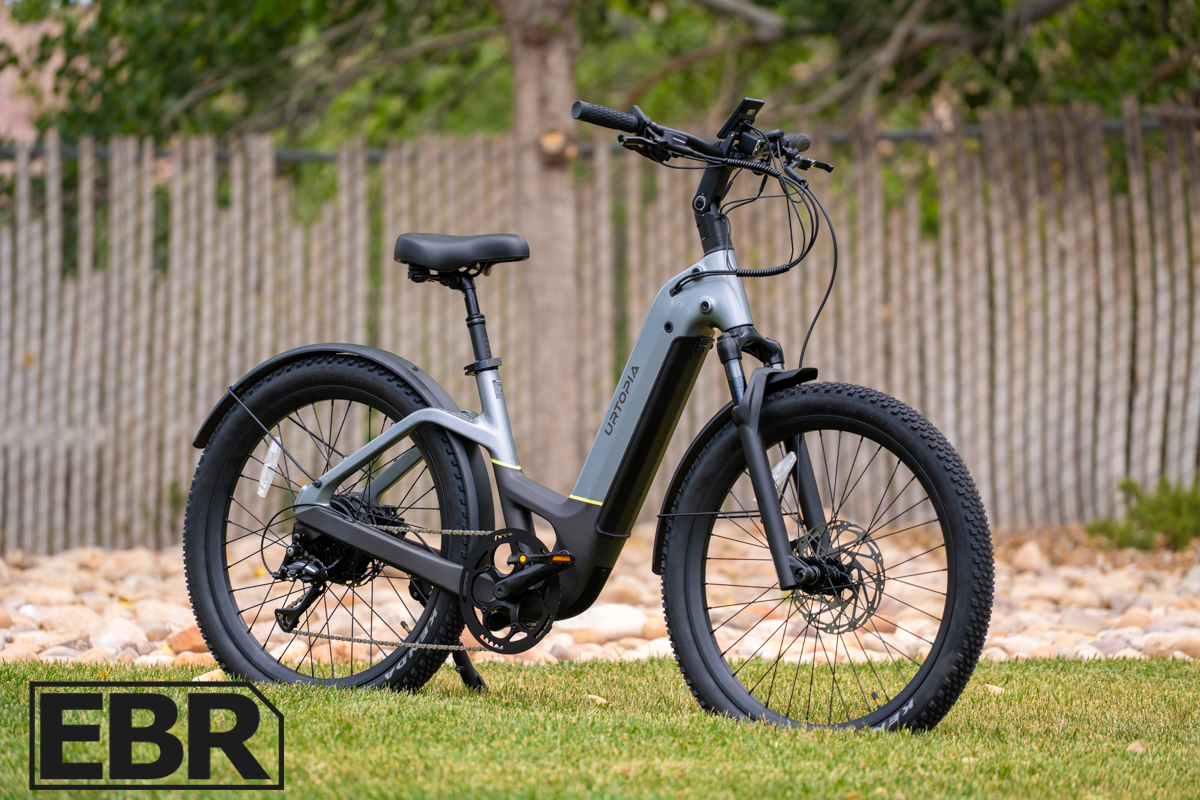
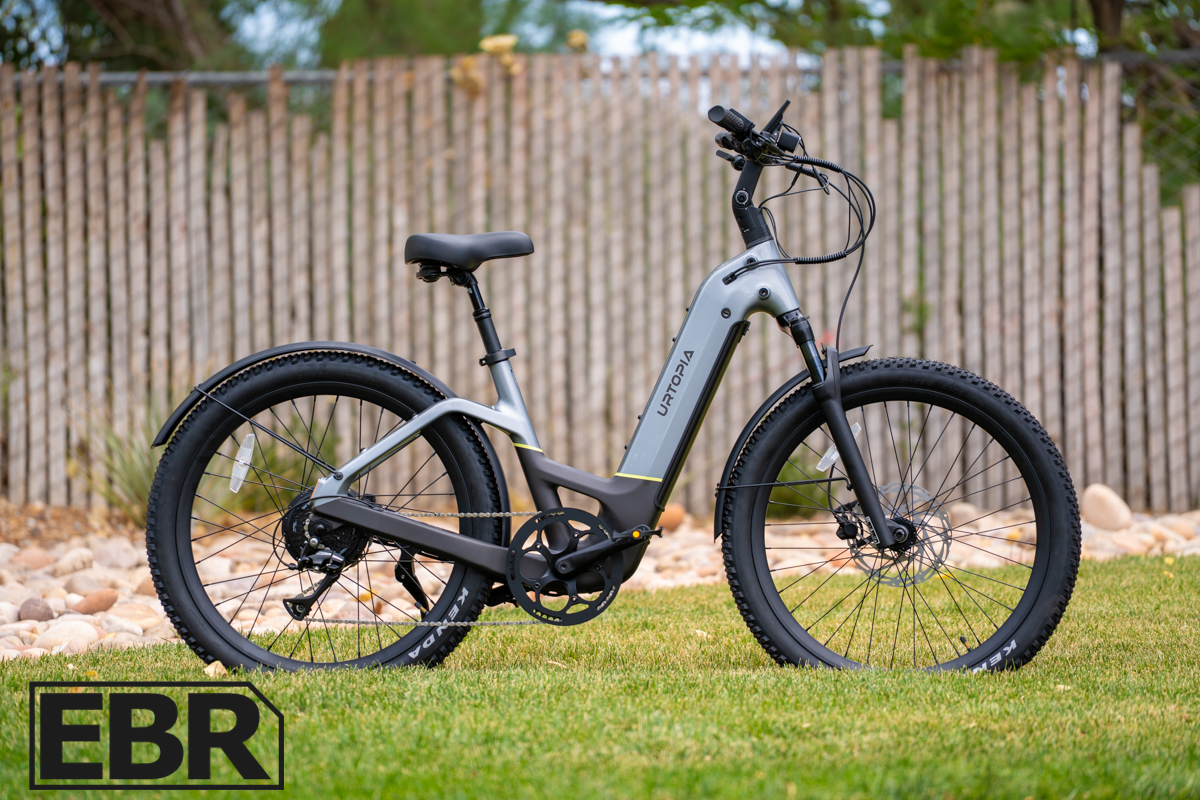
The Carbon Atom comes in three colors: Moonlight, Copper, and Olive. The Moonlight finish on our test bike looks clean and classic.
On frame sizing, Urtopia offers a single one-size-fits-most frame in a step-through style only, rated for riders from 5’3″ to 6’3″. A single frame size keeps costs down, which I think is part of how Urtopia hits this price with a carbon frame, and the 90-degree adjustable stem gives you a solid range of fit adjustment.
That said, at the $2,499 level I could see Urtopia eventually offering a two-size setup, something like a small/medium and a medium/large, to better fit riders at the ends of that height range. For most riders in the middle, the one-size approach works well.
If you want to carry cargo, Urtopia offers an optional MIK front rack and MIK HD rear rack, plus a water bottle cage, so you can set the bike up for commuting and errands.
Is the Bike Worth Buying?
Yes, 100%
The Urtopia Carbon Atom is one of the more compelling value stories we’ve seen in the SUV category.
A Toray carbon fiber frame, the same material grade found on high-end race and mountain bikes, normally pushes a bike well past $4,000. Urtopia brought it to $2,499 without gutting the rest of the build.
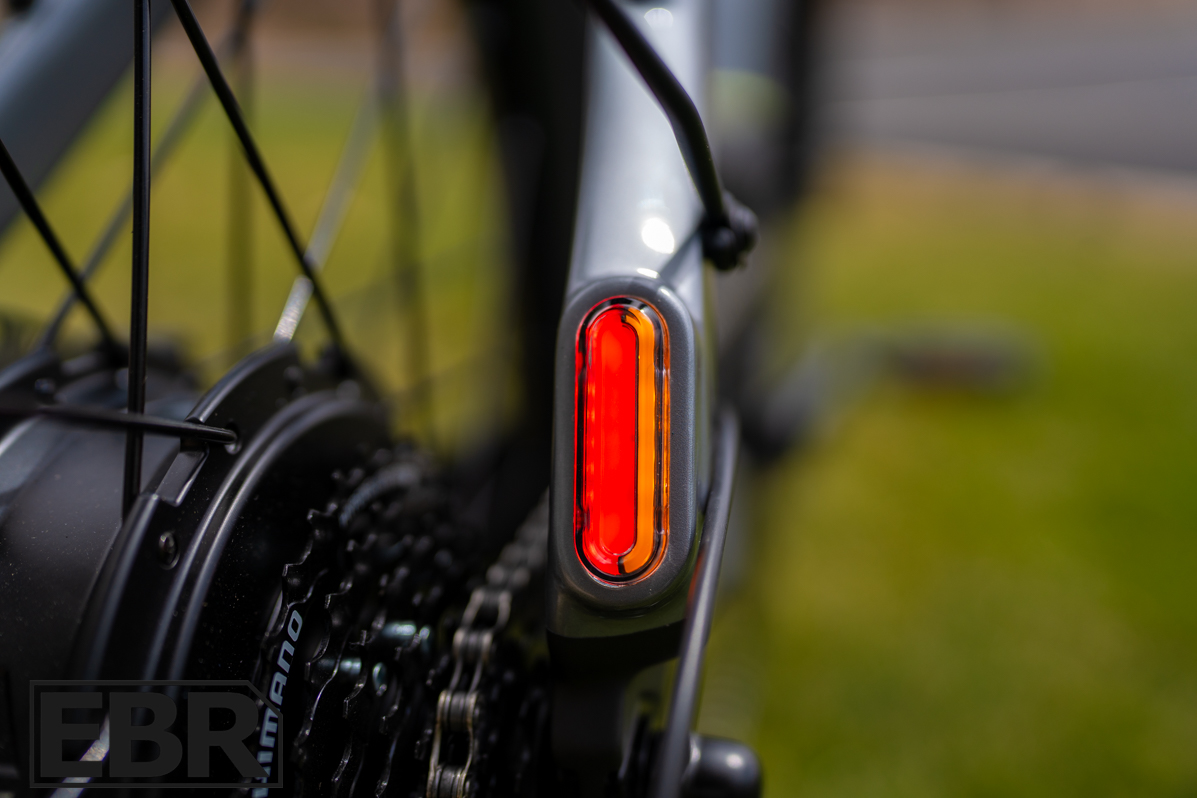
A bike with this spec: carbon frame, 802Wh battery, large-rotor hydraulic brakes, a smooth torque sensor, full lighting with turn signals, and UL 2849 and UL 2271 certification, would typically cost $1,000 to $1,500 more.
This bike is for the rider who wants one do-it-all machine. Commute to work, run to the grocery store with a rack and a gallon of milk, then take it camping and ride a dirt or gravel road on the weekend.
The light weight makes it easy to handle on the trail and easy to move around your garage or lift onto a rack.
The aggressive step-through frame makes it approachable for riders with hip limitations or anyone who’d rather not swing a leg over a high top tube, without the flexy feel step-throughs sometimes have.
It’s also worth pointing out Urtopia’s parent company’s acquisition of Pedego, which gives the brand access to a service dealer network across the country. Pedego built its reputation on customer service, and that local support adds a lot of value to the Urtopia brand and lineup.
A couple of caveats remain. The one-size-fits-most frame won’t fit everyone at the edges of the height range perfectly, and we’re still finishing our range testing, so check back for those numbers.
But on the whole, Urtopia took a real swing at making carbon fiber accessible, and they built a good bike doing it. If a carbon SUV e-bike at this price fits what you’re looking for, the Carbon Atom is an easy one to recommend.




Reader Interactions