

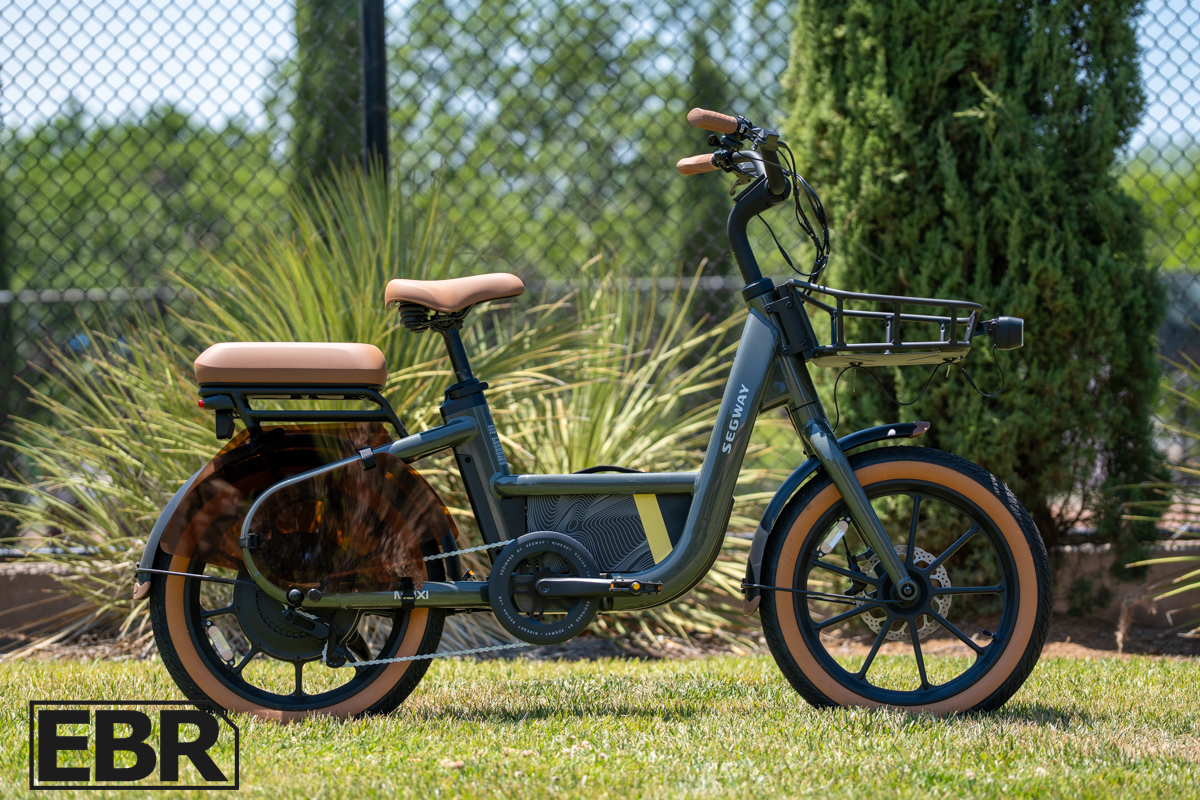
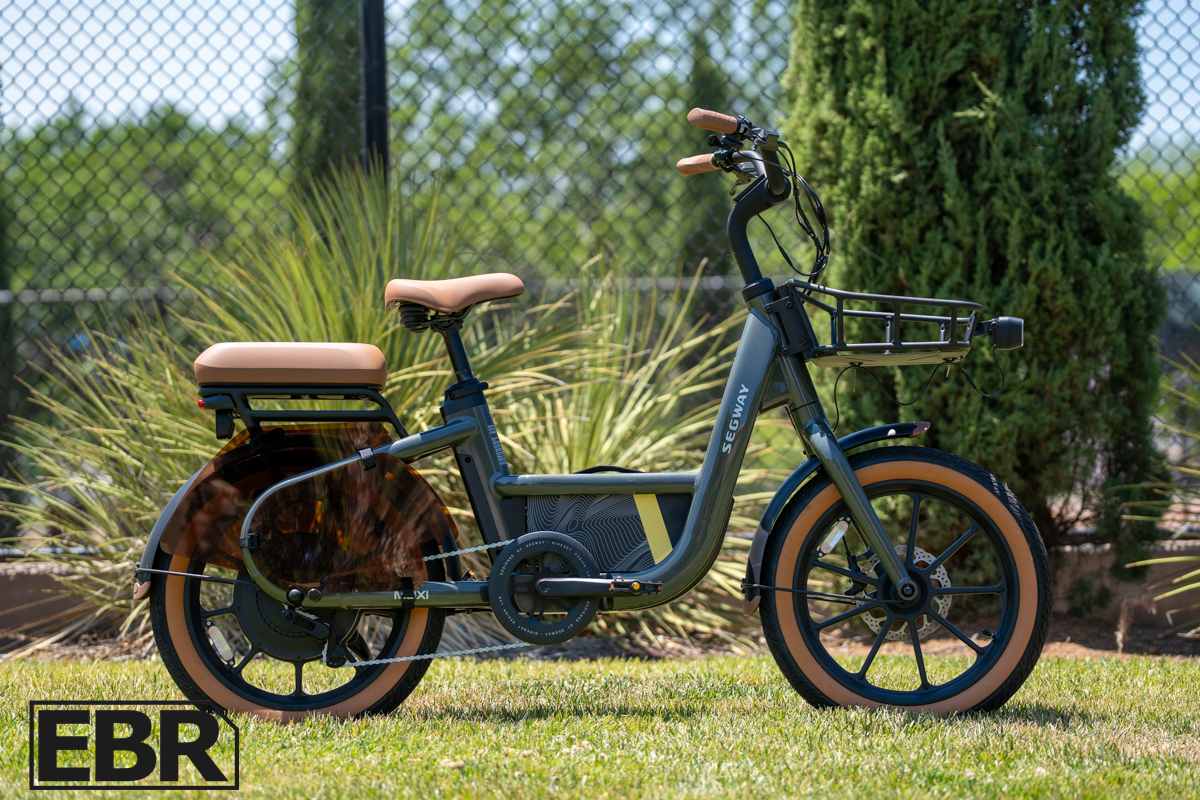
Segway calls the Muxi a beach cruiser with the stability of a Dutch cargo bike, which is an interesting combination – but one that I absolutely love!
Technically, the Muxi is a short-tail utility bike priced at $1,699.99 and has a ton of tech built into it – which is what I was expecting going into this review given that Segway wasn’t a bike company first. Segway has always been a tech mobility device company, and it shows in the Muxi.
What did surprise me is how tech-savvy Segway was able to nail the geometry and create a very fun cargo bike. With a few small tweaks, the Muxi could be a contender as one of the best cargo bikes available.
My Experience Riding the Segway Muxi
Ride Quality Score: 7.5 / 10
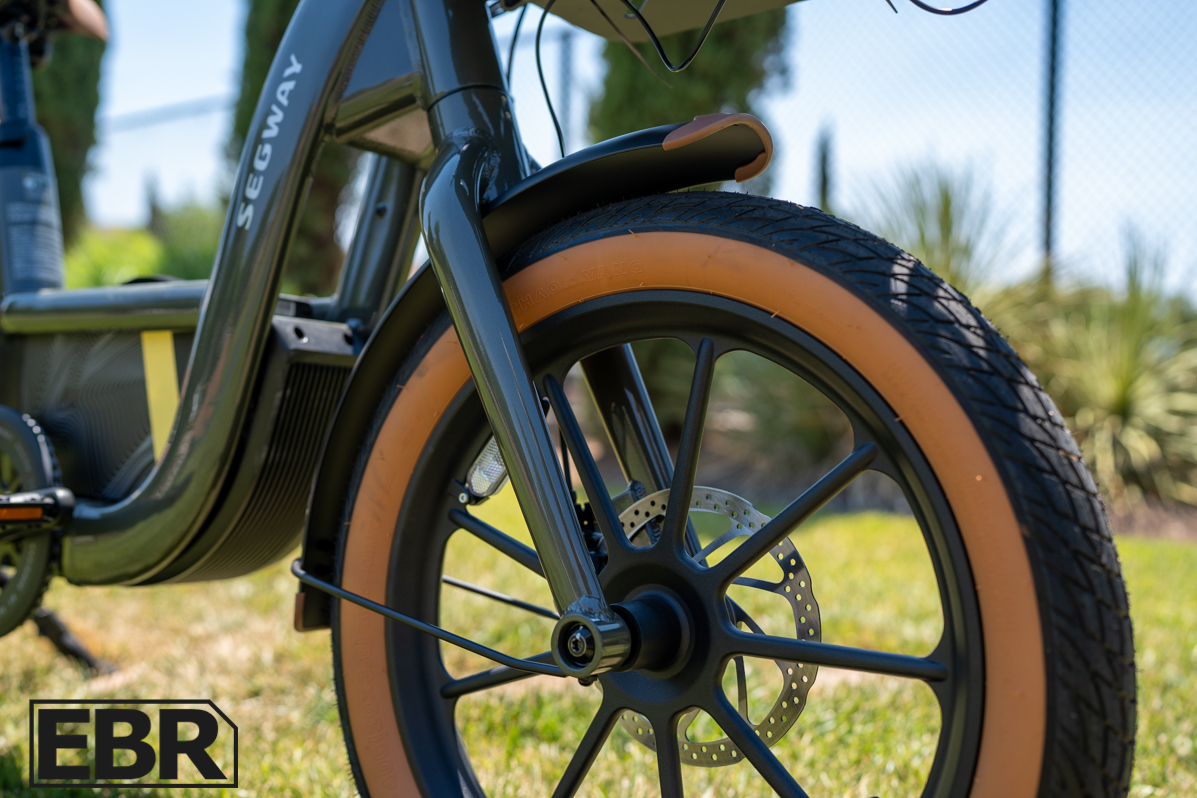
The first thing that stood out to me, before I ever turned the motor on, was how sturdy this bike feels. It has a 418 lb payload capacity (including 120lb capacity on the rear rack), which is a lot – and is a weight that requires a solid frame, low center of gravity, and precise engineering.
Segway did great with all three. Its incredibly stiff frame is well-built, with a 44.75″ wheelbase and 11″ bottom bracket height the bike’s center of gravity is nice and low to the ground – making me feel very comfortable riding loaded up with cargo.
Segway then “went Dutch” with the cockpit, making the bike very comfortable from a geo perspective. The handlebar is swept back far enough that I sit upright with my shoulders relaxed, and at 28.75 inches wide it gives good leverage without feeling too wide.
The quill stem has 3 inches of height adjustment. It is not a quick-adjust stem, but you can dial it in once and forget about it. Standover is 20 inches, so getting on and off is easy. Segway lists a fit range of 4’8″ to 6’0″, and I think they are being conservative on the top end. The seat post gives 6 inches of adjustment and I ride about an inch below the max insertion line, so riders around 6’1″ should be fine. Taller than that and you will be short on leg extension, though the cadence sensor takes some of the sting out of that. On the low end, note that Segway publishes a 28 inch minimum inseam, so shorter riders should measure before ordering.
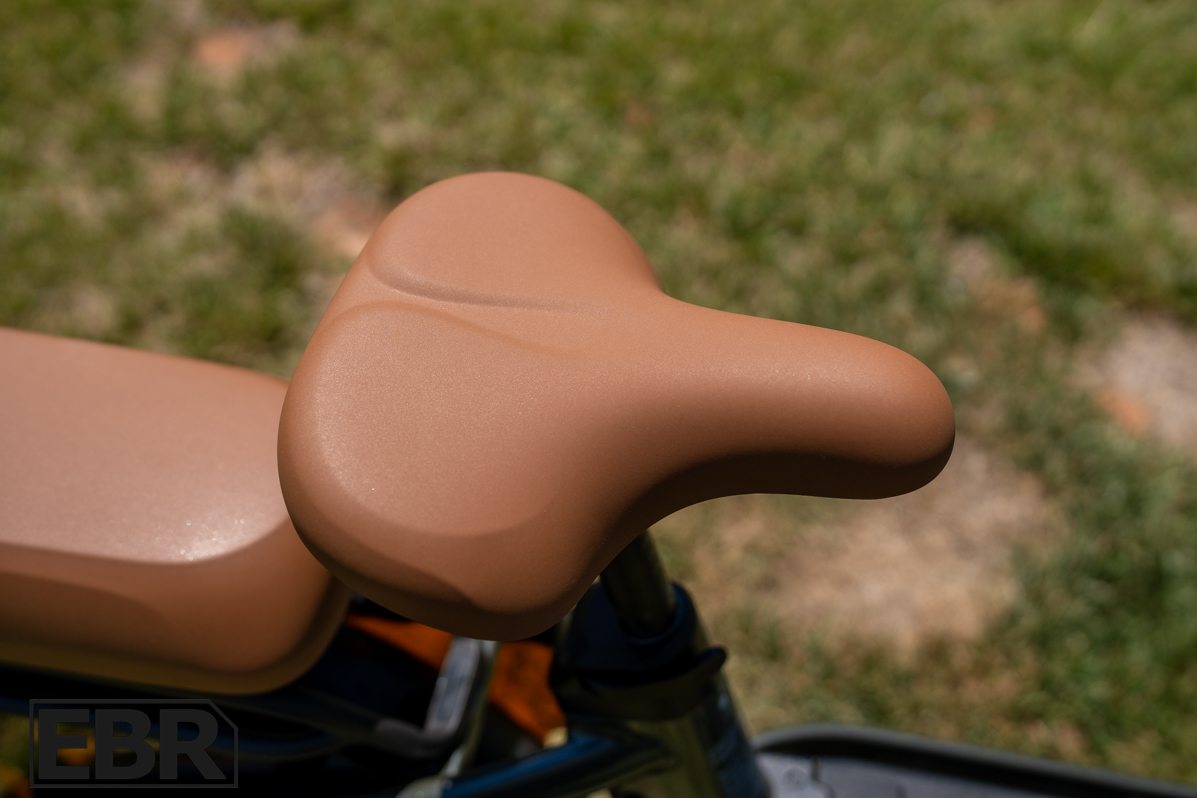
Comfort is better than the spec sheet suggests it should be. There is no front fork and no suspension seat post, so on paper this bike looks like it could beat you up. In practice the 20 x 3.0 tires absorb most of what a city throws at you, and the saddle is more padded than what I usually find at this price. Yes, you will still feel large bumps, but because the frame is so stiff, those hits feel more controlled.
The Muxi also has several tech features that made me think the bike was going to be priced around $2,500:
Hill Start Assist, which automatically locks the bike in place when stopped on an incline to prevent the bike from rolling backwards, making it so you don’t roll backwards (which is a huge help when carrying cargo). I was a little confused by Segway naming this feature ‘Hill Start’ instead of ‘Hill Stop Assist’, but by not rolling backwards when stopped, it does make starting on a hill easier as well.
Hill Descent Control. This feature uses regenerative braking to significantly slow you down as you coast down a hill, which helps keep you in control while also reducing wear and tear on your brake pads and rotors. It took me a few times to get used to, and I ended up tapping the brakes a few times to disengage it so I could cruise down the hill faster.
Kinetic Energy Recovery (i.e. regenerative braking) transforms kinetic energy into power at a rate of approximately 6-10Wh/minute. Not sure if I’m just searching for some math to back up my original estimate of 50-55 miles on min power (see range test results below), but I think it was likely the regenerative braking that enabled the bike to get almost 60 miles in our test.
Doing the math (and sorry for the e-bike geek math here), if you take 717wh and divide that by 50 miles you get 14.34Wh per mile. If you then assume 10 minutes of downhill braking during that test, that means the bike would ‘recover’ between 60 – 100Wh of energy capacity.
- 60wh divided by 14.35 = 4.18 additional miles
- 100Wh divided by 14.35 = 6.97 additional miles
Those numbers put the 58 miles we got in our range test right in-line with my original 50-55 mile projection.
Moving on from my e-bike geek-out, my only complaint while riding the Muxi is with the gearing. Riding around town in the fourth assist level at 16 or 17 mph felt great, and I could pedal there all day. However, past 20 mph I started to ghost pedal so I would switch over to the throttle to instead cruise at 20.
Power / Motor
Hill Climbing Score: 8.0 / 10
 |
 |
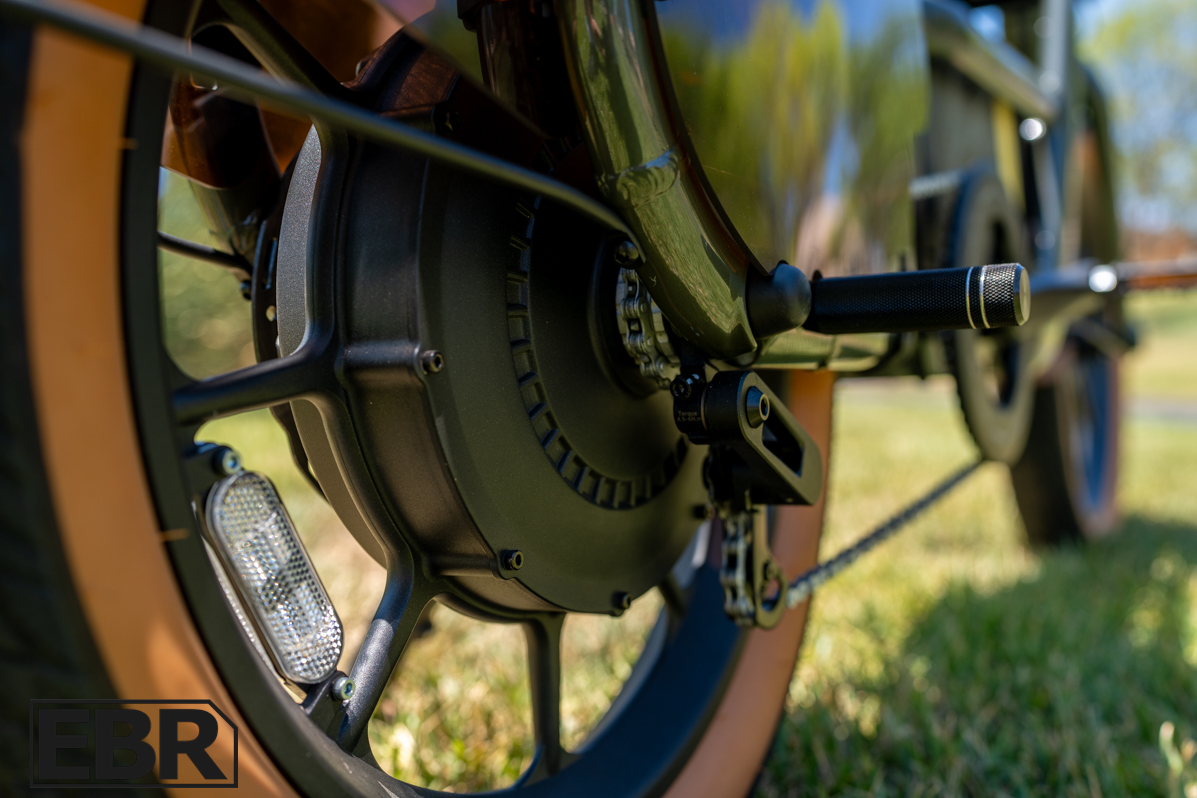
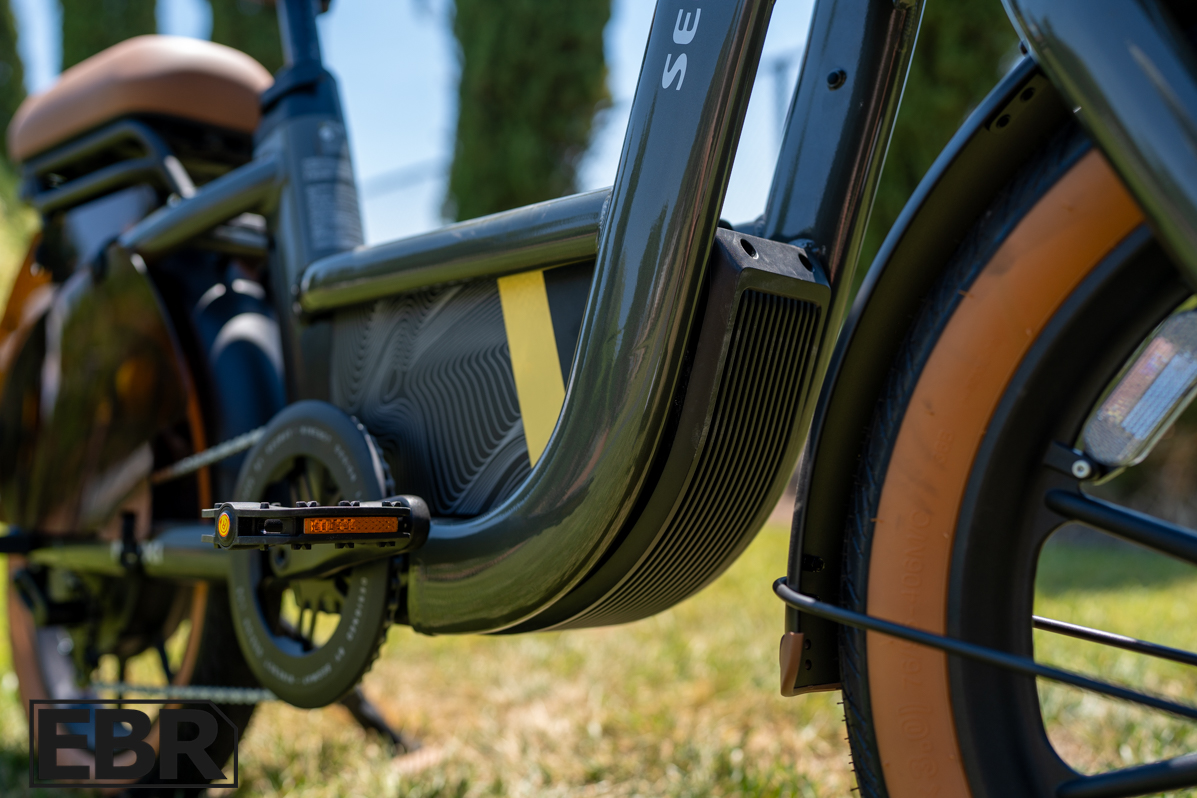
The Muxi has a 750W nominal, 1,500W peak direct drive rear hub motor with 80Nm of max torque. Direct drive is the choice that makes the rest of this bike possible, because it is what allows kinetic energy recovery, which is Segway’s name for regenerative braking.
On paper, that’s a lot of power – which was backed up by our hill test results:
Hill Climb Test Results
- Throttle Only: 1:19, 15.8 mph
- Pedal (max power assist): 1:27, 14.4 mph
Throttle-only power beating pedal assist on the Black Hill is a rare result, and is partly the result of Segway speccing the Muxi with a single gear and balancing as best they could hill climbing gearing and gearing for pedaling on flats. To fix this, I think Segway could program max assist to give you a little more power, as the throttle test proved the motor has power to spare.
On flats the bike accelerates in a controlled, moderate manner. On throttle alone it took about 11 to 12 seconds to reach 20 mph. Pedaling, it took about 9.5 seconds to reach 20 mph and 14 to 15 seconds to reach 23 mph. This is not a rocket ship, and on a short-tail utility bike carrying a passenger or a load of groceries, that’s probably a good thing and a purpose-driven decision that Segway made.
A motor that jerks you backward the moment you touch the throttle is not a good thing when there is weight on the back – especially if that weight is your child.
Range / Battery
Range Score: 8.5 / 10
Min Assist: 58.77 Miles
Max Assist: 37.77 Miles
Segway claims up to 80 miles on the Muxi, which is a number I don’t think most riders are going to see. Segway’s estimation comes from lab testing on flat roads in good weather, which is at least transparent – but not very ‘real-world’ like.
On a 717Wh battery paired with a 750W motor moving an 84 lb bike, I would have estimated 50 to 55 miles before we started testing – so even though our 58 mile range test is less than what Segway estimates, I still think it’s a good result. Especially when you take into account that we were able to get 37.77 miles on full power.
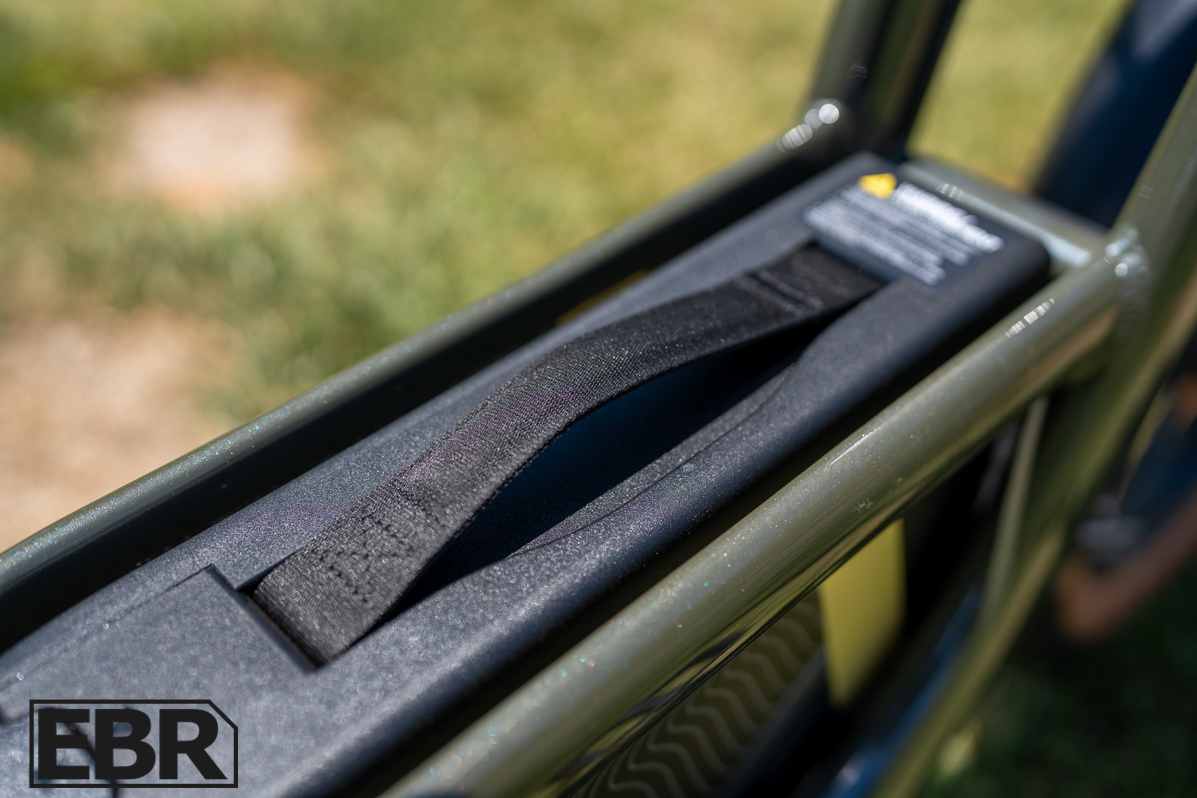
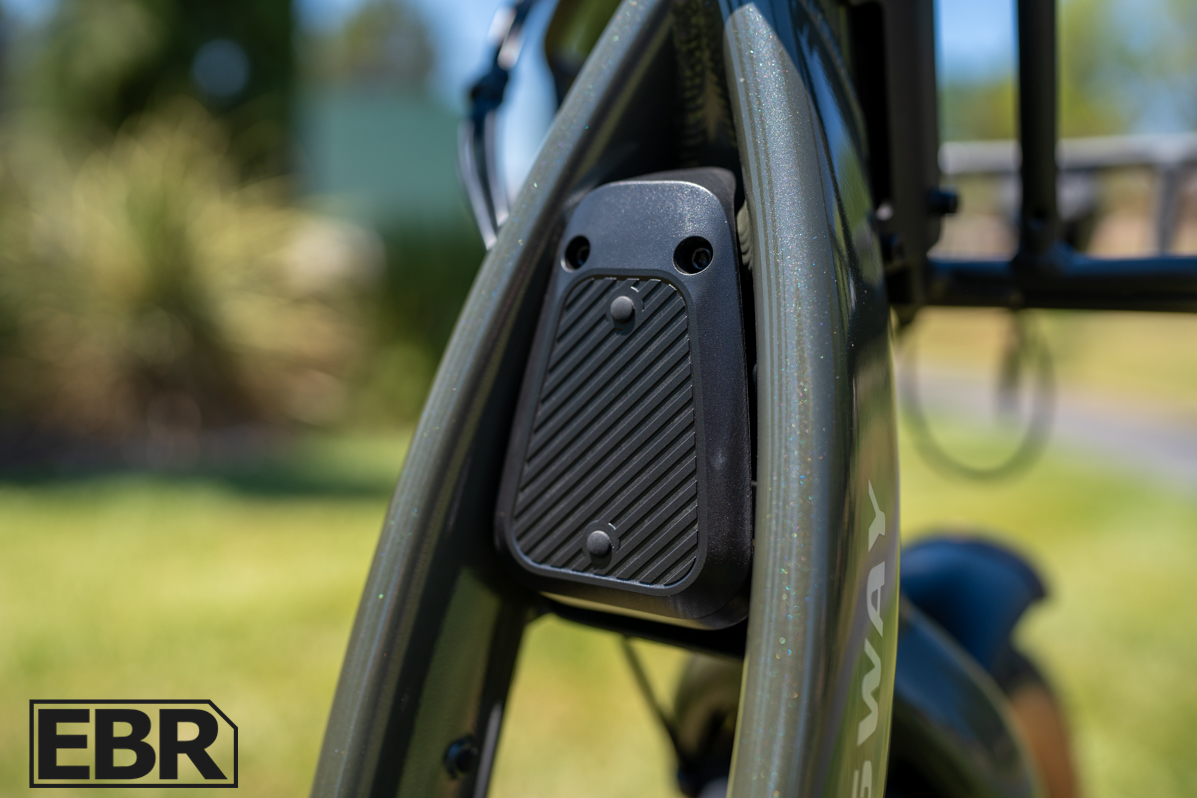
The battery is a 48V, 15Ah pack rated at 720Wh. It is UL 2271 certified, it is removable, and it lifts out of the frame without any wrestling. It charges at 3.9A for a full charge in about 5.5 hours.
Components
Components Score: 8.5 / 10
 |
 |
 |
 |
The Muxi comes fairly loaded with quality components that give the bike a high-end feel, even though none of the core components necessarily jump off the page.
Drivetrain: there is no derailleur here. The Muxi is a single-speed with a 48T front chainring and a 13T rear freewheel cog.
Single-speed drivetrains are hard to get right because brands have to balance a gear low enough to climb against a gear tall enough to not ghost pedal above 20 mph. With the Muxi, Segway leaned more towards the climbing side of things, which makes sense on a cargo bike IF you have to choose between the two. The downside is that the bike starts to ghost pedal around 20 mph. It’s not overly bad, but it is my one complaint about the bike. I love having a single gear drivetrain, but Segway either needs to:
- Increase the power output of the motor so they can increase the gearing (i.e. make it harder to pedal so you don’t ghost pedal after 20 mph) and not hurt the hill climbing capabilities, or
- Put either an internal gear hub or rear cassette to increase the gear range.
I actually think that the single gearing is one of the reasons the Muxi is rated at Class 3 but only 23 mph max instead of Class 3 and 28 mph max.
Brakes:
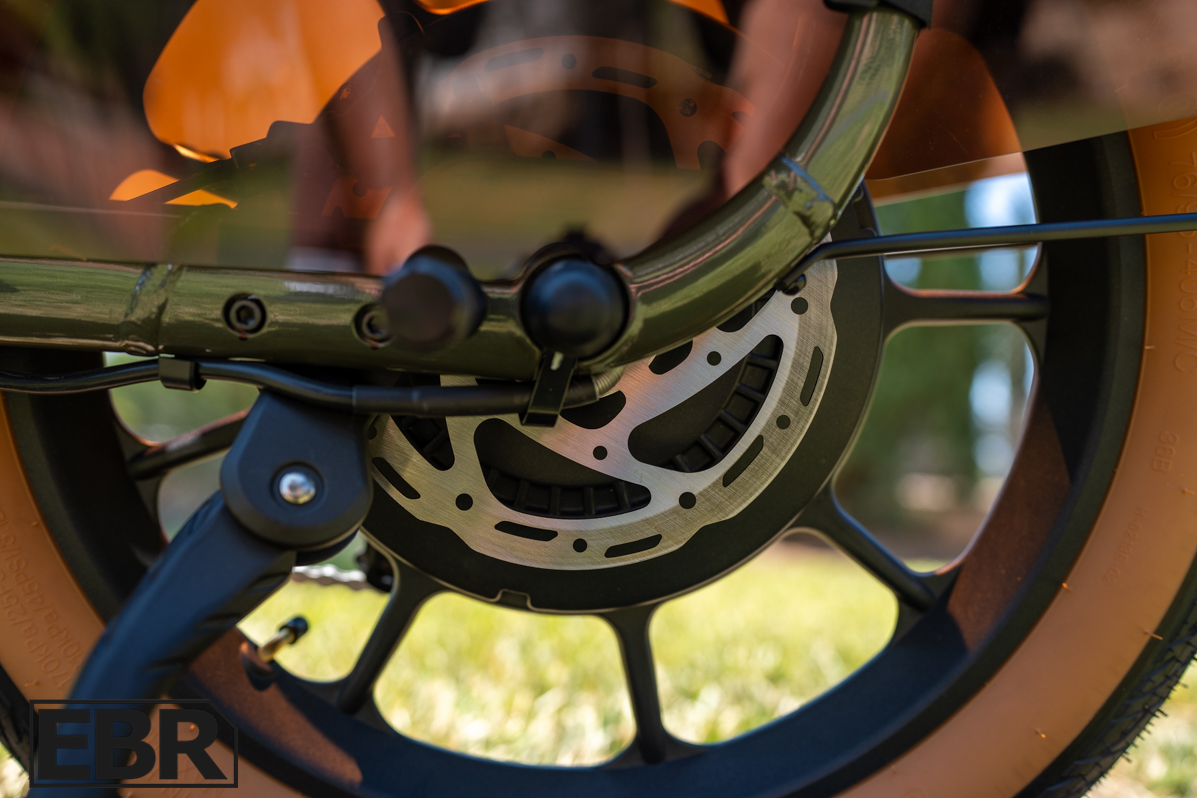
- 2-piston hydraulic disc brakes
- 180mm rotors
- 1.8mm thick
I was a little worried going in, because 2-piston calipers and 1.8mm rotors on an 84 lb bike that can carry another 330 lbs is asking a lot. However, the Muxi did great in our hill testing – the regenerative braking increased the braking capabilities of the bike.
Suspension: there isn’t any, and I am putting that in the plus column. Getting suspension right on a cargo bike is hard, because the load on the bike is constantly changing. Cheap suspension forks on cargo bikes tend to be divey and unstable once there is weight over the front wheel. A quality air fork solves the diving, but then the rider has to change the air pressure every time the cargo changes, and nobody is going to do that on the way to the grocery store. A rigid front end sidesteps the whole problem. You give up some comfort, and you can add a suspension seat post if you want some of it back, but for what this bike is built to do, rigid is the more capable setup.
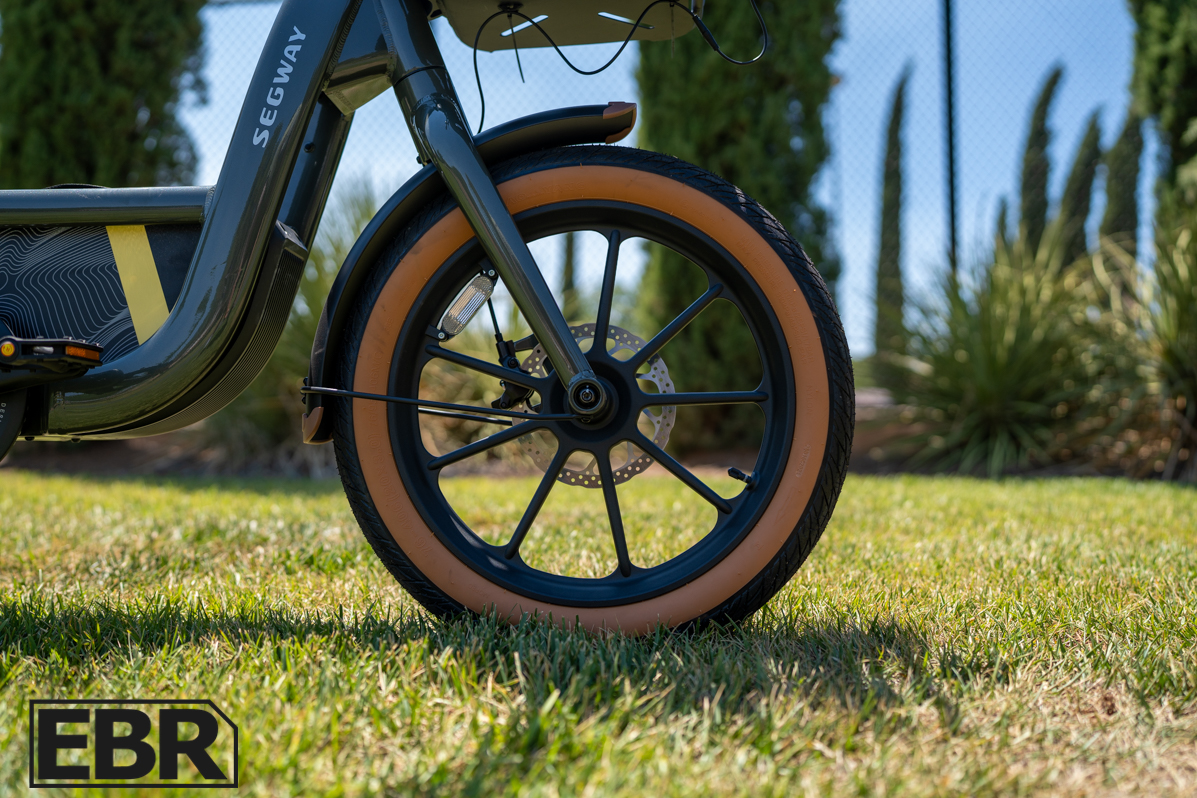
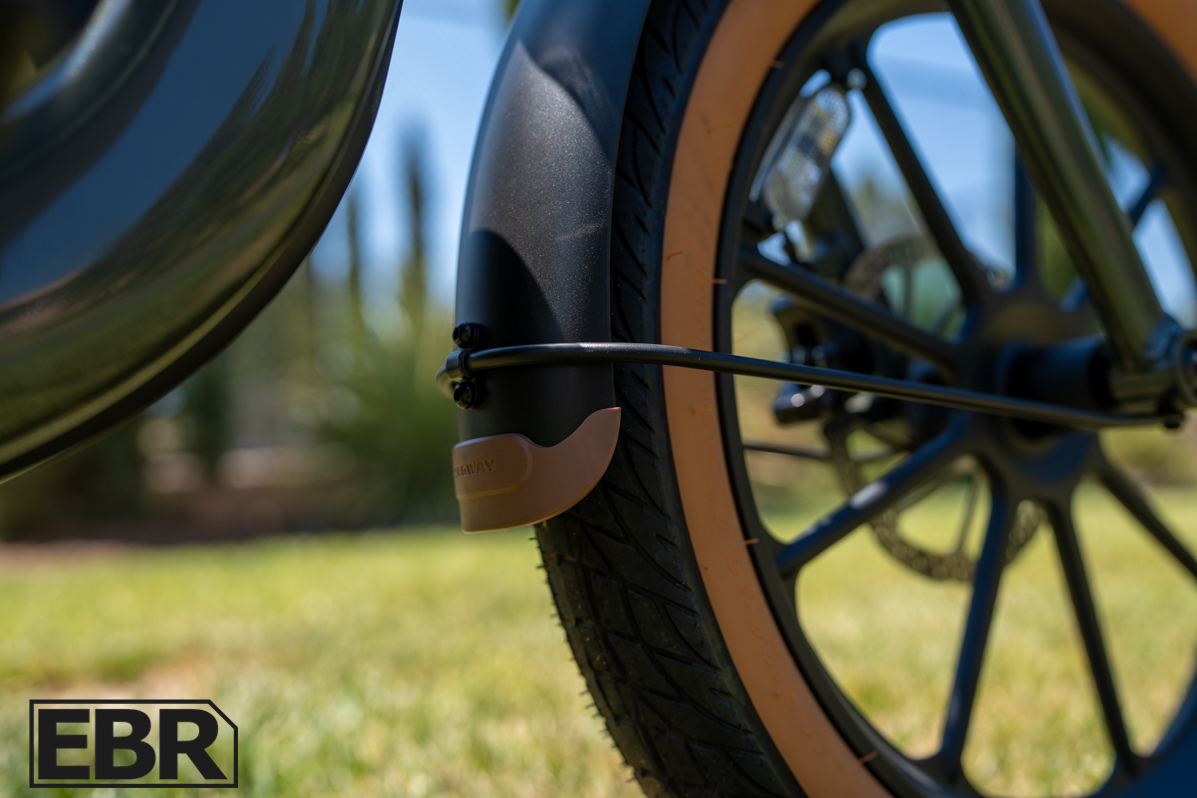
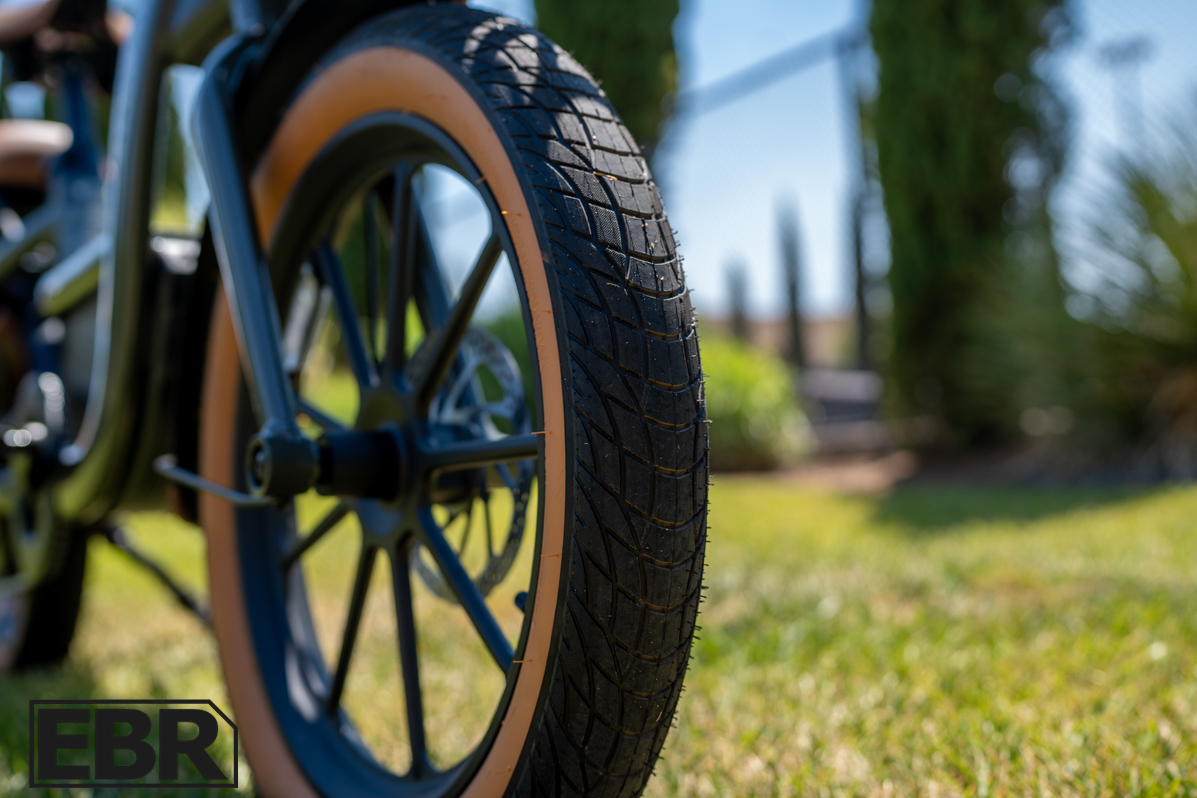
Tires, saddle, and cockpit: the 20 x 3.0 multi-surface tires do most of the comfort work, and they roll well on pavement. The saddle is more padded than what I usually find at this price and has springs at the rear for a bit more give. The locking ergonomic grips have a slight butterfly shape and my hands did not slip on them even when it was hot and sweaty out. The swept-back Dutch handlebar measures 28.75 inches wide and pairs with a quill stem that has 3 inches of adjustment. The left control pod handles power, horn, a five-way navigation button, and assist levels; the right side has a mechanical bell and the thumb throttle. Cable routing is tidy and runs into the top tube rather than through the headset, which I prefer.
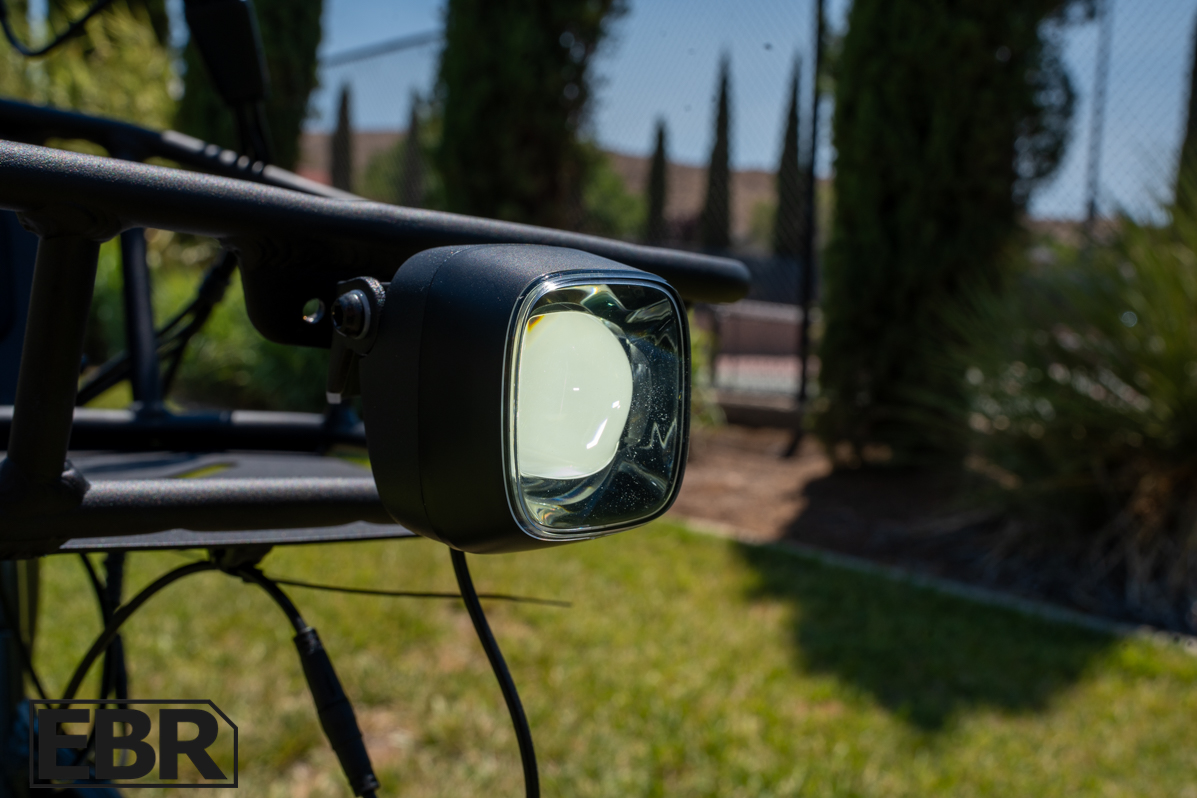
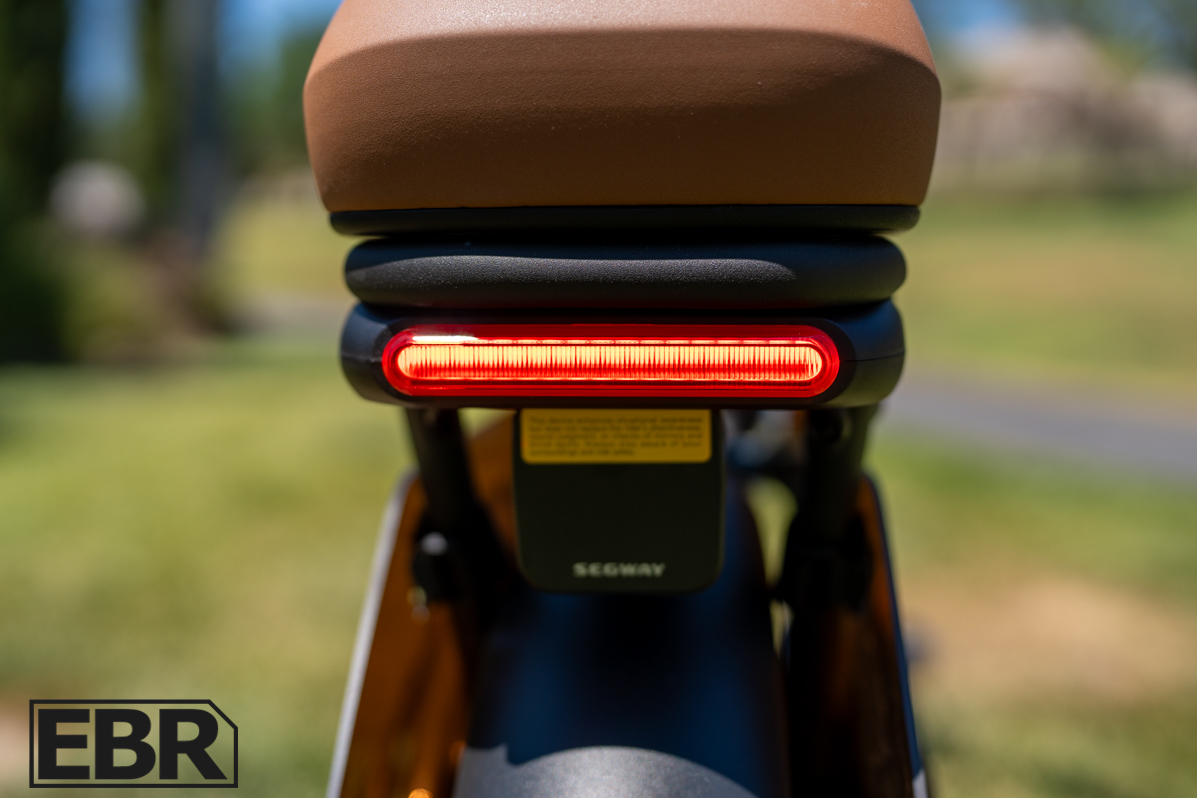
Lighting: a 600-lumen automatic headlight up front with high and low beams, which mounts to the front basket when you have one fitted, plus a taillight that activates under braking and flashes if the Rearview Radar detects a car closing in. There are no turn signals on this bike.
Where you can spend more on the Muxi is with accessories (which is kind of the classic problem all electric cargo bikes have), and there are quite a few options there:
- Fender set ($79.99)
- Front basket ($99.99)
- Middle basket ($129.99)
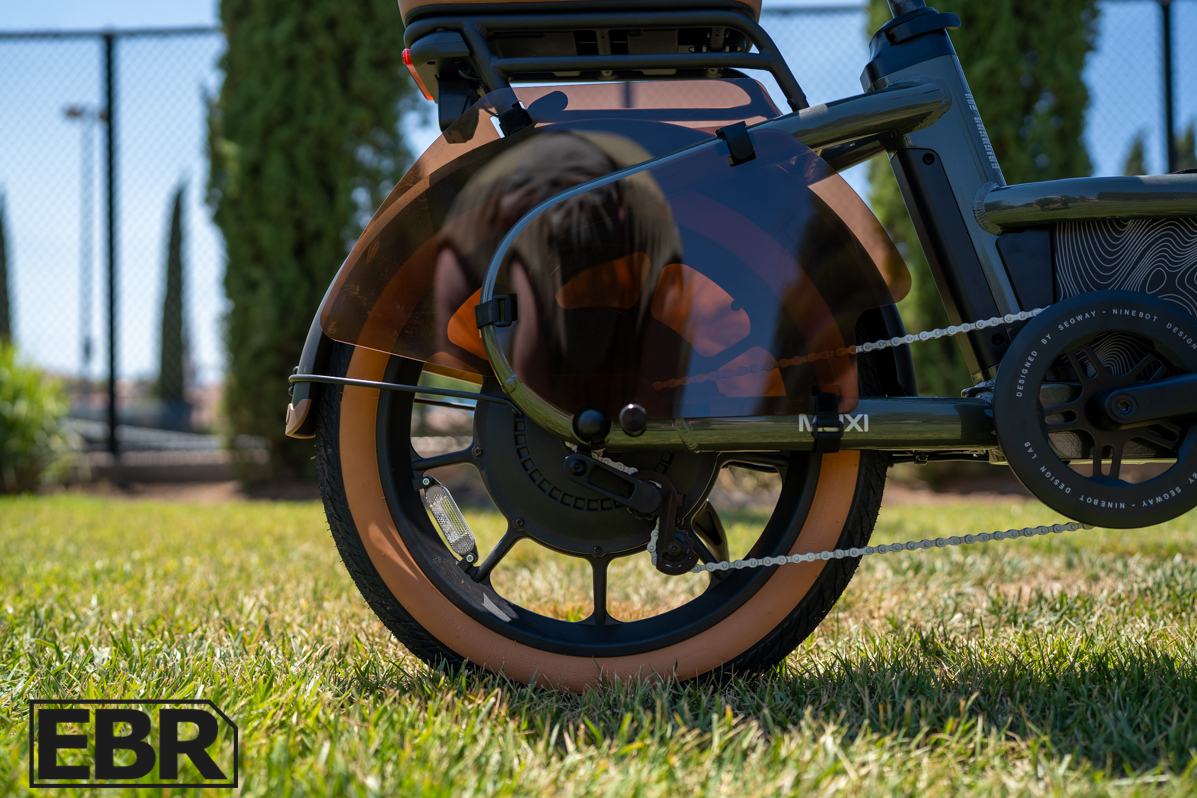
- Passenger kit with the cushioned seat, foot pegs, and wheel guards is $119.99.
- Segway Xiro dropper post ($229.99)
The accessory I recommend the most, especially for those who commute on the road with cars, is the rearview radar ($99.99). One of the most dangerous parts of riding on the road (at least in the USA) is that cars are allowed to turn right on green lights. While that might sound obvious to a car driver, the issue is that a person driving a car doesn’t often check their blind spot on their right before making a right hand turn – meaning a car can easily come up from behind you at an intersection and turn into you.
The rearview radar alerts you so you don’t have to keep turning your head around and checking at every single intersection.
Screen / User Interface / App
Screen / App Score: 8.5 / 10
There is a lot going on with the display and app, and is another place where Segway shows that it’s a micromobility company who is now making an e-bike.
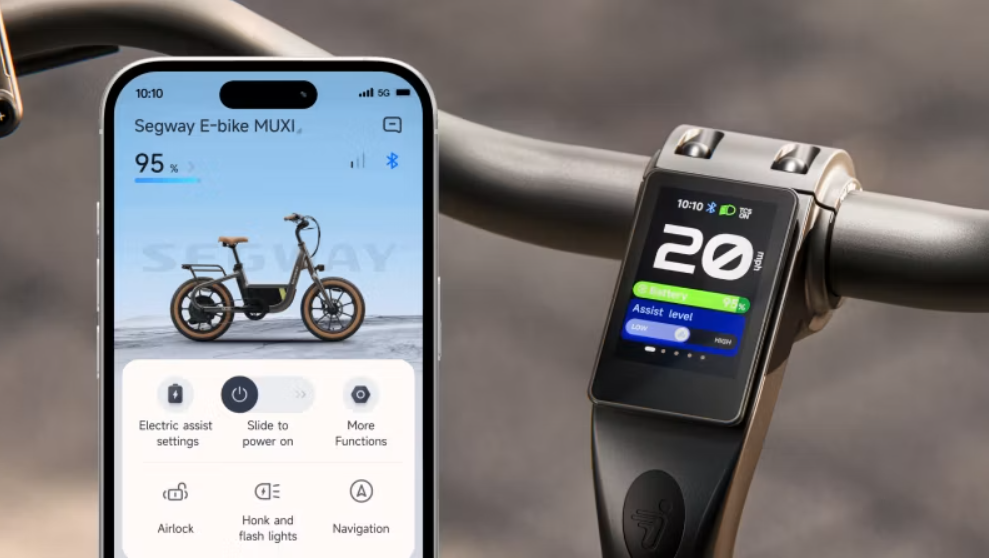
The display is a 2.4 inch color TFT that adjusts brightness on its own. I had it at 60 percent and pushed it to 100, and it gets very bright. The home screen shows the clock, Bluetooth status, light status, traction control status, and the battery in a true percentage alongside a bar. I like that Segway went with a percentage readout and that it tracked accurately through our testing. Assist levels are named rather than numbered, running from low through mild low, mid, and high, with six steps total. Arrow to the right and you get trip distance, remaining battery mileage, calorie count, and cadence. Keep going and you reach turn-by-turn navigation, which you set in the app and then follow on the screen, plus music controls for whatever is playing on your phone.
The settings menu is where you enable walk mode, switch between Class 1, 2, 3, and the hybrid setting, adjust screen brightness, pick a horn sound, set the alarm volume, and turn on quiet mode so the bike does not yell at a mechanic who moves it. On the horn sounds: there are three, and I would skip the train. It startles people on a shared path. The bell is the most natural of the three.
The Segway Mobility app goes deeper.
You can set pedal assist sensitivity to high or standard, toggle adaptive power, adjust how close you need to be for AirLock to unlock the bike, turn kinetic energy recovery on and off, and toggle traction control and hill descent control. The security section covers motion alert volume, motor lock, timeout shutdown, and lost mode, and the alarm is loud.
Battery settings show voltage, temperature, cycle count, and the charge level of that backup battery, and there is a low battery smart alert that pings your phone if a stored bike drops below 10 percent. There is also a maintenance guide in there that I would tell every owner to read. The Segway Mobility Lab holds beta features, currently vehicle location, pedal assist calibration, class switching, and hill start assist, and because the bike supports over-the-air updates, Segway can keep adding to it.
Two things to flag. GPS tracking and the network-dependent features like navigation are free for the first year and then cost $19.99 per year. I would rather they were free, but Segway is paying carriers for that data connection, so I understand it.
Riders should also know that AirLock, Apple Find My, adaptive power, music control, and quiet mode stay free with no subscription, so the bike does not lose its core functions when the year is up. And six assist levels is more than this bike needs. Four or five would cover the same ground with less clicking. I am looking forward to seeing where Segway takes this system over the next couple of years.
Bike Model Options
There is one Muxi. One frame, one size, one motor, and one battery. Your only build choice at checkout is color, and you get two: Olive Rush and Dusty Sage. Both use the same tan-wall tires and brown saddle and grips, and both look good in person.
I would normally push a brand to offer more frame sizes, but the low 20 inch standover and 6 inches of seat post adjustment cover a wide range of riders. Segway lists a fit range of 4’8″ to 6’0″, and based on where my seat post sits I think riders up to about 6’1″ will be comfortable. Shorter riders should check the 28 inch minimum inseam Segway publishes before ordering – but I really think anyone over 5’1 or 5’2 will be very comfortable on the bike.
Is the Segway Muxi Worth Buying?
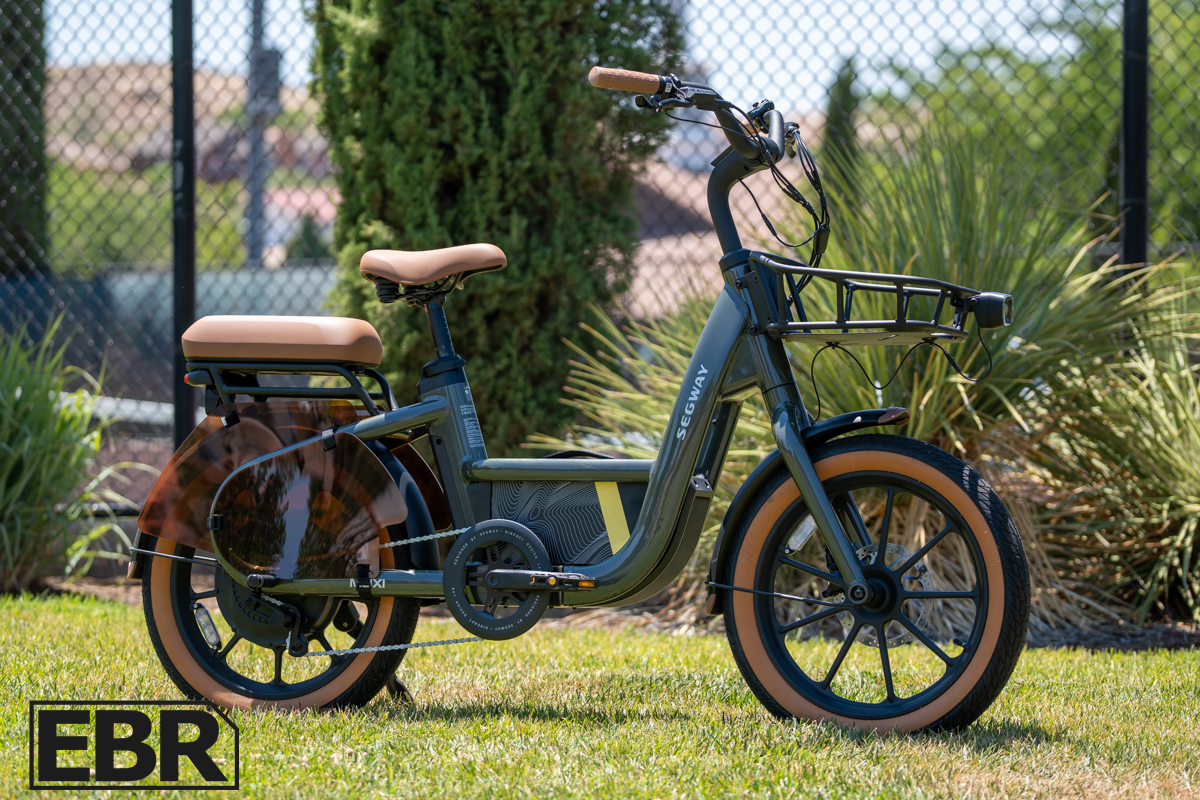
I am a big fan of the Muxi.
Segway set out to build a Dutch style cruiser with the capability of a cargo utility bike, and they did it. This is an easy bike to pedal around the neighborhood when you just want to ride. Then you turn around, put a kid on the back deck, load up the baskets, or ride it to the office, and it handles that just as well. That versatility is what a utility bike is supposed to deliver, and the Muxi is one of the more comfortable and easily one of the most tech forward ones we have tested to date.
Segway is not a bike company by origin, and you can see it in the best possible way. Traction control that cuts power instead of letting you skid, hill descent control that holds you at a controlled speed down an 8 percent grade without touching the levers, hill start assist you activate by squeezing both brake levers, AirLock that unlocks the bike as you walk up to it, turn-by-turn navigation on the display.
I do not see this stuff on most bikes, and here it is on a $1,699.99 utility bike. The base hardware backs it up too: a quiet motor with good climbing power, brakes that would not fade, a 717Wh battery that gave us nearly 60 miles, and full UL 2271 and UL 2849 certification.
This bike is for the rider who wants one city bike that does it all. The commuter who also runs errands. The parent hauling a kid to the park. If that is you, the Muxi is an easy recommendation.
Who should think twice? If your commute puts you on open roads with car traffic, I want a bike that will pedal closer to the 28 mph the Class 3 category allows, and the Muxi assists to 23. If you need to carry the bike up stairs in an apartment, 84 lbs is going to be too much. And if you want to ride trails, this is not that bike, and it was never meant to be.
A couple of small tweaks and this thing gets even better. Give me an internal gear hub to fix the gearing and take some weight out of the frame if it is possible without giving up the 418 lb payload. Short of that, well done, Segway. This is a well-built, well-sorted utility bike and I had a lot of fun on it.




Reader Interactions