

Most folding e-bikes are a unique combination of portable because they fold, but also surprisingly heavy due to budget-level components and suspension.
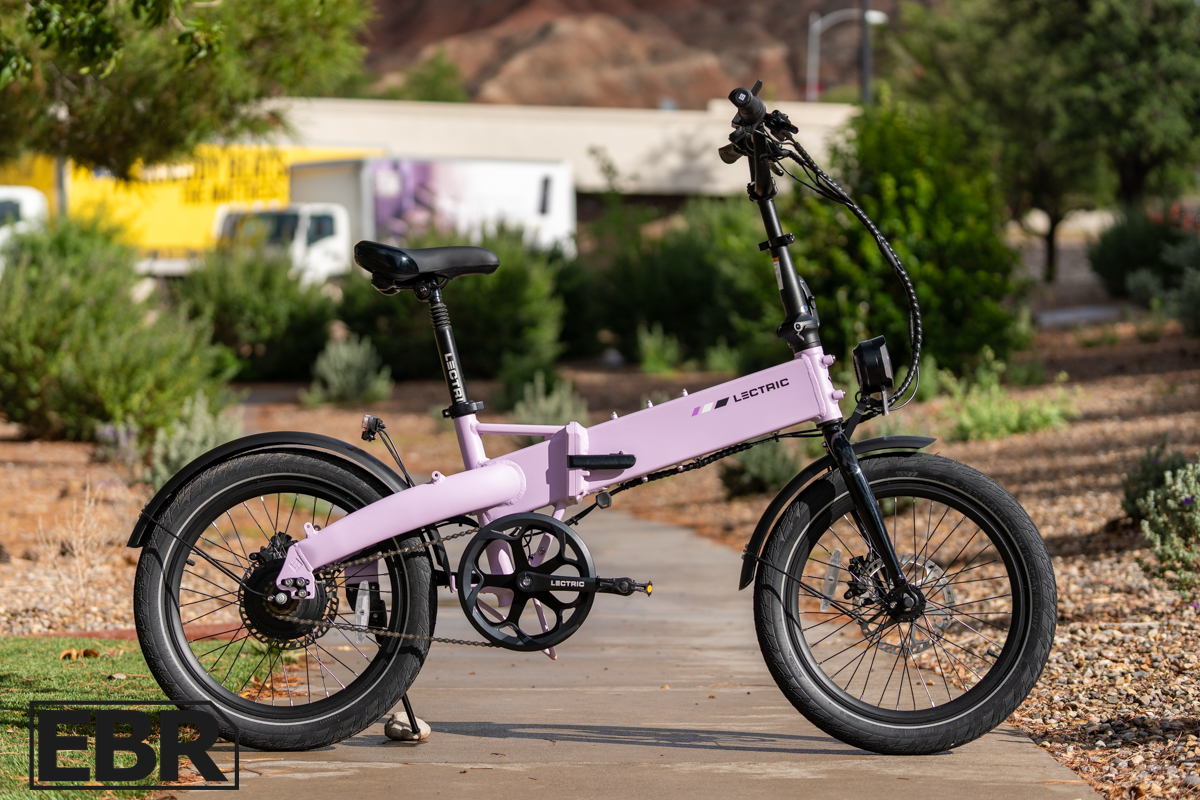
The XP Lite 3 takes a lighter-weight approach. A lighter frame, no front or rear suspension fork, and a smaller motor add up to around 20 lbs of weight savings compared to Lectric’s flagship XP 4 folder.
Starting at $799, Lectric did everything they could to keep costs low while still improving on the Lite 2—and they largely succeeded. The version 3 comes with a stiffer frame, better brakes, and an overall ride feel that I think a lot of riders (myself included) can get genuinely excited about.
My Experience Riding the Lectric XP Lite 3
Ride Quality Score: 7 / 10
A lot of folding e-bikes are convenient because you don’t need a vehicle rack to transport them, but you give up ride quality in exchange. Oftentimes these bikes creak, the frame flexes when you pedal hard, and they just aren’t a lot of fun to ride.
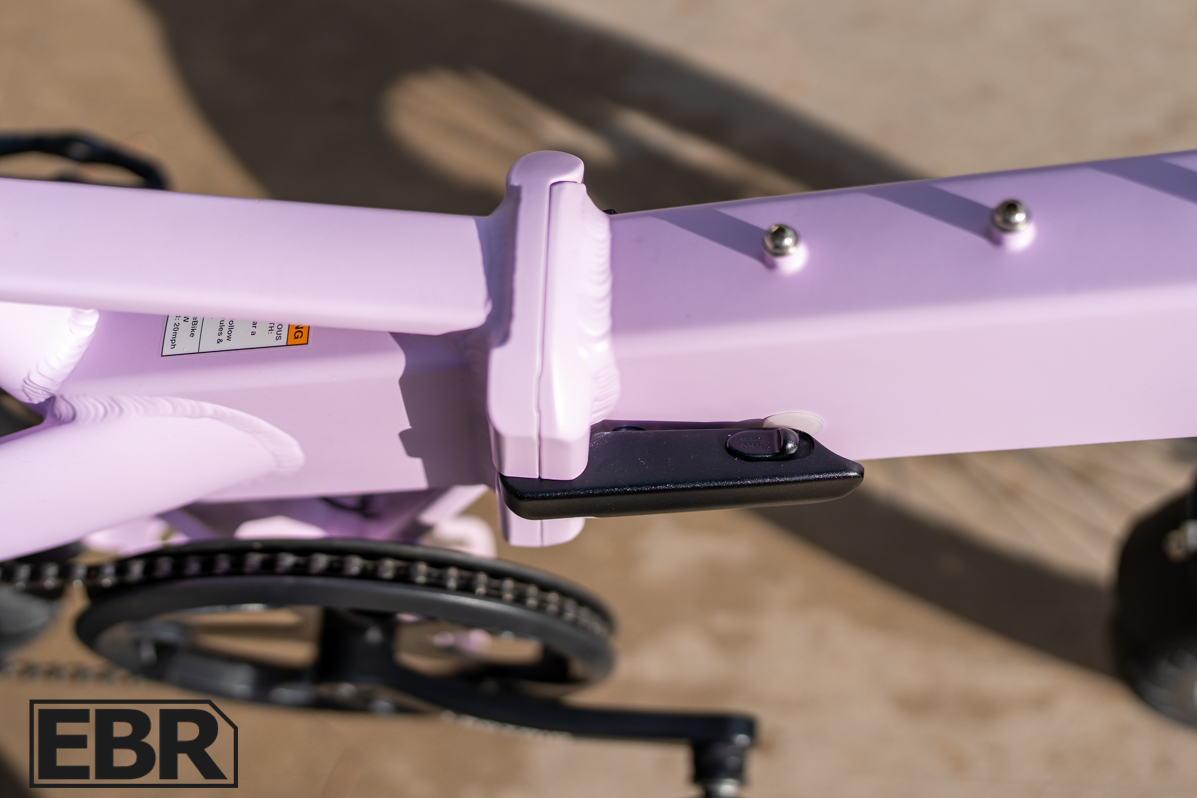
The XP Lite 3 is the complete opposite. It’s easily one of the better-riding folding e-bikes on the market thanks to a couple of smart upgrades from Lectric. First, they reinforced the center locking mechanism, significantly improving the overall rigidity of the frame.
Second, they slackened the stem angle, aligning it naturally with the front fork instead of having it cant forward slightly.
While those two updates don’t sound like much on paper, they take a folder we already liked quite a bit and noticeably improve its handling and road feel—making it even easier to recommend to riders on a budget.
Fit
Lectric did a great job making the XP Lite 3 work for a wide range of riders. The recommended height range of 4’8″ to 6’2″ holds up well in testing given the 11 inches of adjustment at the seatpost and 3 inches at the quill stem. In addition, the reach and wheelbase are long enough that the cockpit never feels cramped or toy-sized, even for taller riders.
Lectric dialed in the frame geometry here, which is a major reason why this bike is so fun to ride.
Comfort
Without a front suspension fork, the XP Lite 3 will bounce around a bit over rough pavement. However, so does any other bike without front suspension, and there are real advantages to this approach. It keeps the overall weight down, stiffens up the steering response, and gives the bike a very nimble, playful feel.
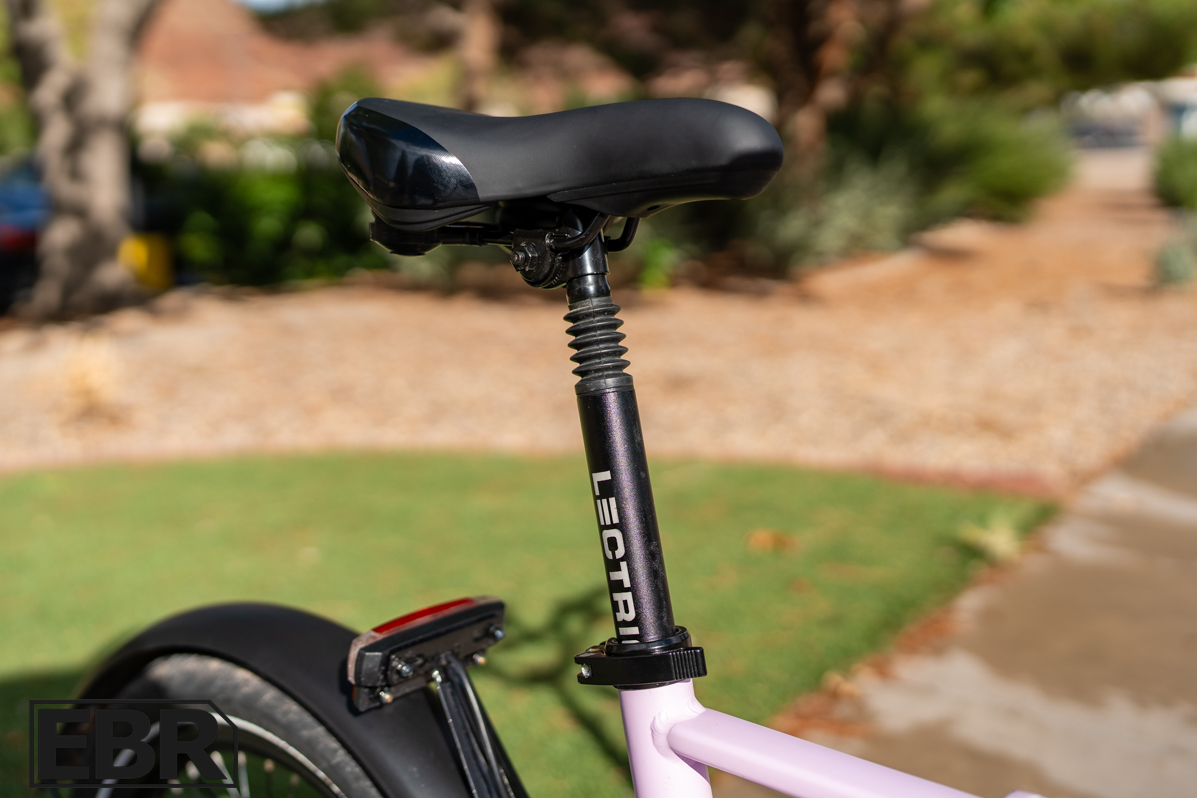
Second, Lectric includes a suspension seatpost on the $999 and $1,099 options, and that post does a really good job taking the edge off square bumps around town. Just remember this wasn’t designed for off-road riding; if trails are your goal, you’ll want to look at one of Lectric’s larger suspended models.
Pedaling/Gearing
Lectric gives you three different power output modes in the settings menu:
- Speed Limited: Delivers full motor power up to a preset speed, at which point power cuts out completely until you drop below that limit.
- Power Limited: Caps motor output based on your active PAS level, but lets you pedal as fast as you want. For example, in ECO mode, the controller gives you roughly 20% of total potential power regardless of your speed, so you still get assistance when pedaling at 13 to 15 mph.
- Speed & Power Limited: Combines the two methods, limiting both motor wattage and top assist speed by PAS level.
I personally prefer riding in Power Limited mode. Speed Limited mode caps your assist around 4 mph in ECO and 8 mph in Tour. Given that I can easily pedal 8 to 9 mph on flat ground unassisted, the Speed Limited setting felt too restrictive.
Gearing-wise, Lectric specs the XP Lite 3 with two options:
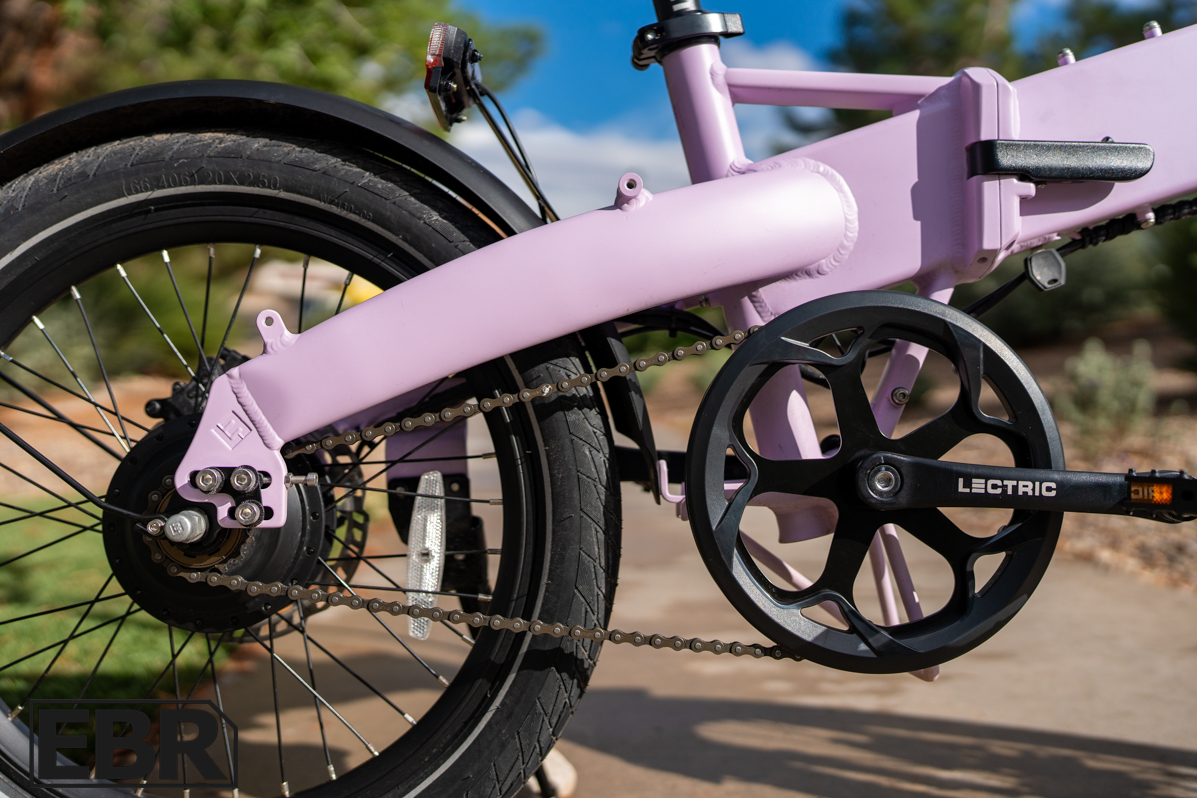
- Chain Drive: 52T front chainring and 16T rear freewheel (3.25:1 gear ratio)
- Gates Carbon Belt Drive: 70T front sprocket and 22T rear cog (3.18:1 gear ratio)
Spec’ing a single-gear, lightweight e-bike with the right gear range is notoriously difficult. Lectric found a solid middle ground where I was able to pedal up to 20 mph without ghost-pedaling, while still keeping a manageable cadence on climbs.
On the chain version, you start to feel like you’re spinning out around 18 to 20 mph. Here is our estimated pedal cadence (RPM) across speeds:
| Speed | Chain Drive Cadence (52/16T | 3.5 to 1 gear ratio) |
|---|---|
| 10 mph | 50.3 |
| 15 mph | 69.7 |
| 20 mph | 92.9 |
A cadence of 92.9 rpm is a bit faster than what I prefer, but it’s manageable.
Here are the RPM numbers for the belt drive version, which has a gear ratio of 3.182 to 1:
| Speed | Belt Drive Cadence (70/22T | 3.18 to 1 gear ratio) |
|---|---|
| 10 mph | 51.1 |
| 15 mph | 76.6 |
| 20 mph | 102.2 |
Even with that large 70T front ring, the belt-drive setup has a gear ratio about 9% lower than the chain version, meaning your legs spin faster at top speed. In practical terms: the chain drive pedals slightly better on flat ground at 20 mph, while the belt drive is slightly easier to pedal up hills.
Riding Notes
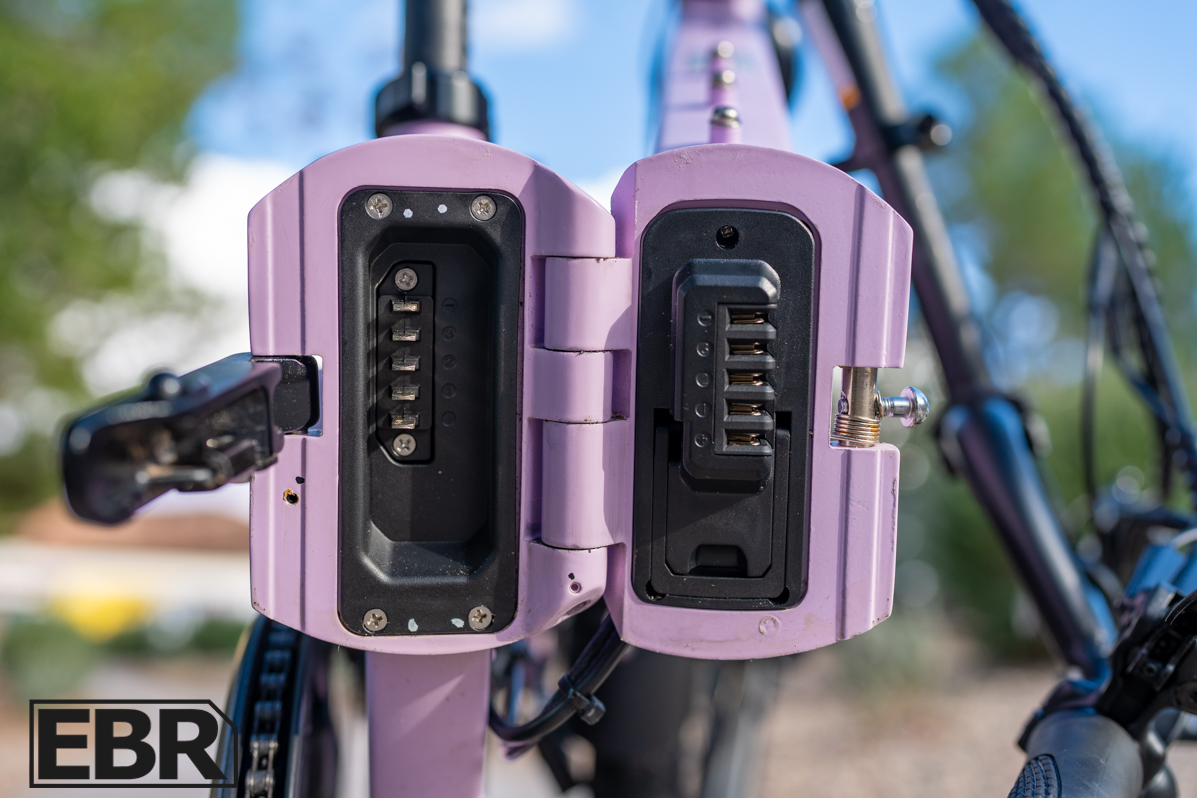
One thing to know about our test unit: the battery pack rattled inside the downtube over curbs and rocks. Our test riders initially thought the headset was loose, but everything was torqued down tight. The rattle was simply the battery pack bouncing inside the aluminum tube.
To fix it, we taped two small foam pieces to the front and back of the battery pack housing and slid it back in—problem solved. Lectric told me this tolerance issue hasn’t shown up across all units, and while our fix took two minutes, an internal shim from the factory would keep it from happening in the first place.
Power / Motor
Hill Climbing Score: 6 / 10
 |
 |
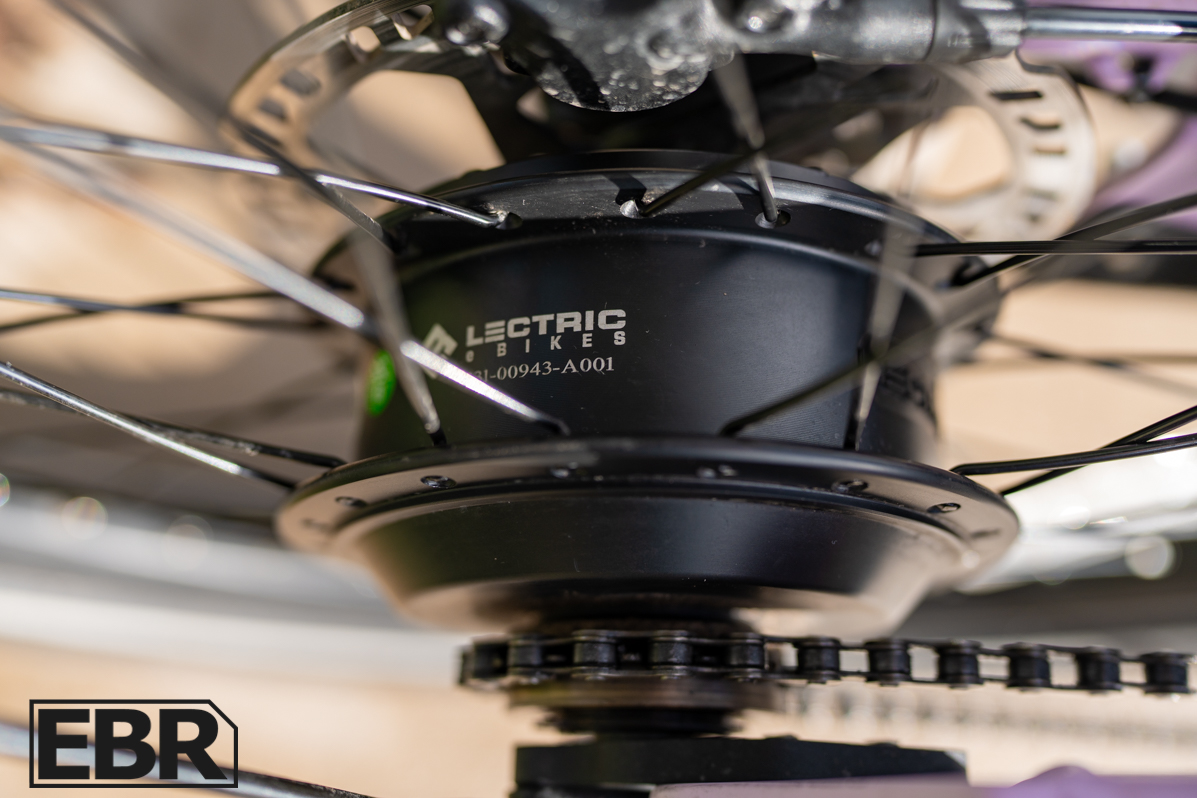
Lectric spec’d the XP Lite 3 with their Stealth M24 rear hub motor: 300W nominal, 819W peak, and 28Nm of torque. Going into this review, I was a little nervous about its hill-climbing ability given the modest 28Nm rating.
I wasn’t as worried about the 300W nominal figure since it peaks over 800W, but torque is what counts on inclines. While the motor won’t overpower you in any scenario, I was pleasantly surprised with its real-world performance.
Speed
The motor had no trouble hitting Class 2 speeds (20 mph) on flat ground. On top of that, it runs quiet (better than average for this class) and power delivery feels much more natural than I typically expect from a cadence-sensor e-bike.
Hill Climbing
The XP Lite 3 performed better than expected in our hill tests, even though it didn’t clear our test hill (the “Black Hill”) on throttle alone:
- Throttle-Only: DNF | 6.0 mph average (completed 0.29 of 0.34 miles, climbing 149 feet over 2:58 before stalling out)
- Pedal Assist (PAS 5): 2:04 | 10.1 mph average speed
Almost no 300W rear hub motor is going to conquer the Black Hill on throttle alone. However, the fact that the XP Lite 3 made it nearly 85% of the way up on throttle was impressive—I honestly didn’t expect it to make it past the first pitch.
As the numbers show, it’s not a rocket ship on hills, but it’s not meant to be. As long as you pedal and help the motor out, you’ll be able to climb almost any hill in town. Lectric doesn’t need to bump this to a heavier 500W motor unless they decide to turn the next generation into a Class 3, 28 mph bike.
Range / Battery
Range Score: 5.5 / 10
Min Assist: 44.57 Miles
Max Assist: 25.78 Miles
Our bike came with the 48 volt, 14 amp hour long-range pack, which works out to 672 watt-hours. The entry-level battery is 7.8 amp hours for 374 watt-hours. Lectric claims up to 80 miles on the long-range pack, and we got 44.57 in our minimum assist test, so a good bit under that.
However, I do not think the 80 mile max range estimate is necessarily wrong. My guess is that Lectric is quoting an estimated range based on the power output set to Speed & Power Limited, which would give you a max speed of 4-5 miles per hour.
We did our range tests in ‘Power Limited’ mode only, and the XP Lite 3 was very fast, even on ECO. In fact, we averaged between 13-14mph in our min assist range test, which is a good 4-5 mph above our average min test results.
As such, it wouldn’t surprise me if you could get between 70-80 miles on ECO in Speed & Power Limited mode. However, that would end up taking around 15 hrs of pedaling at very slow speeds, and given we had less than 1 week to do our entire review, we decided to test in the mode we think most riders will use.
Also, I think 45 miles at 14 mph is a very solid result and likely more range than the average person needs between charges.
Components
Components Score: 6.5 / 10
 |
 |
 |
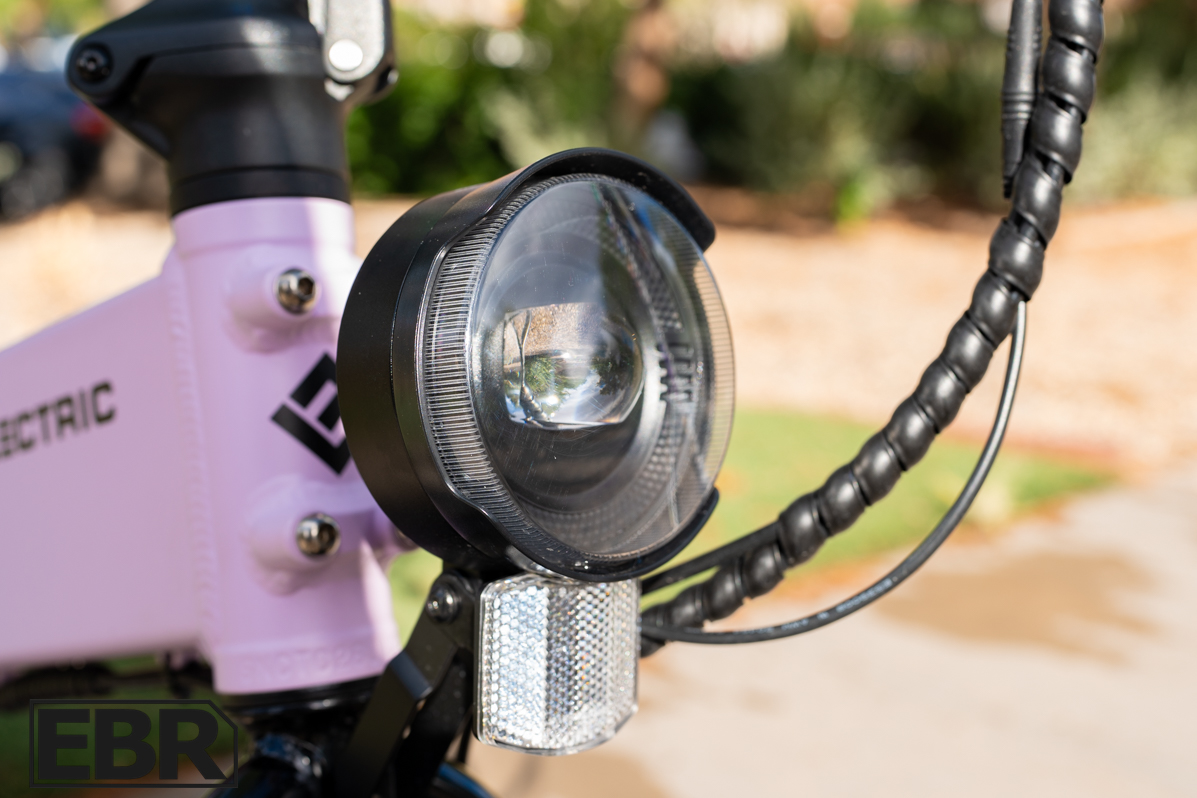 |
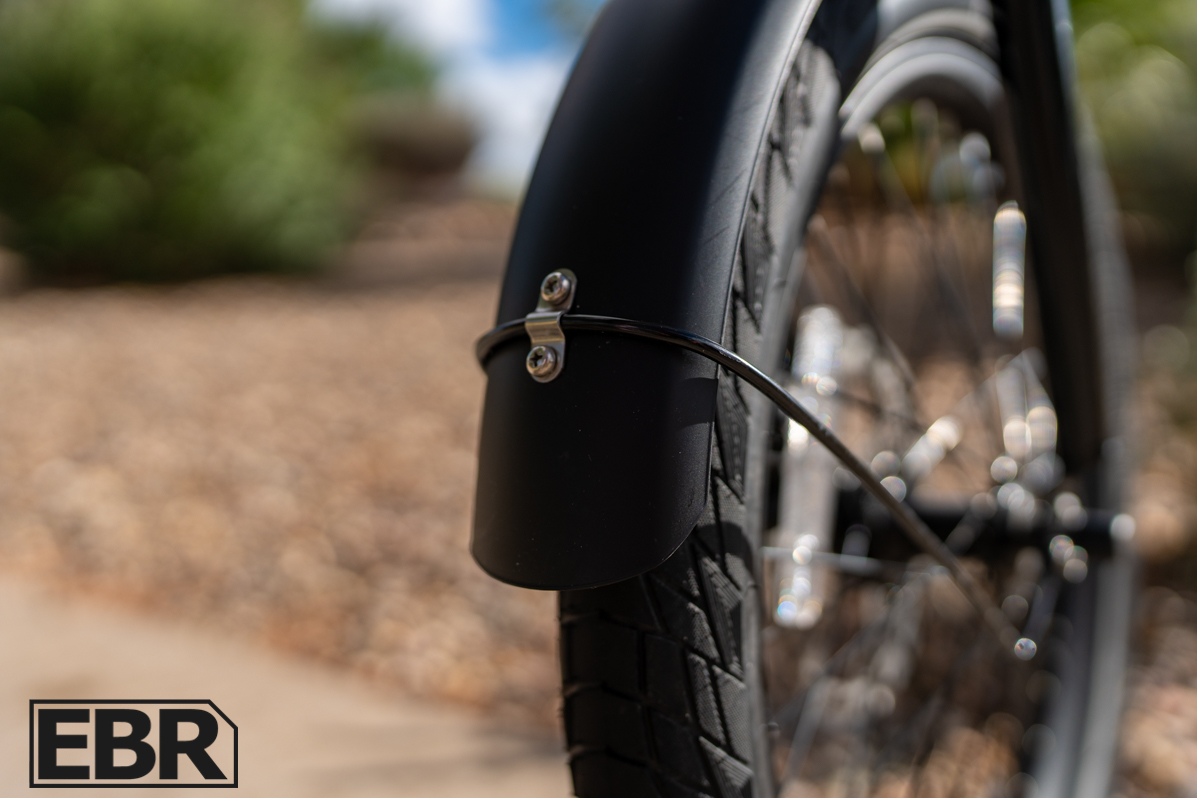
For a folding e-bike priced between $799 – $1,099 the Lectric XP Lite 3 is very well spec’d – better than we typically see.
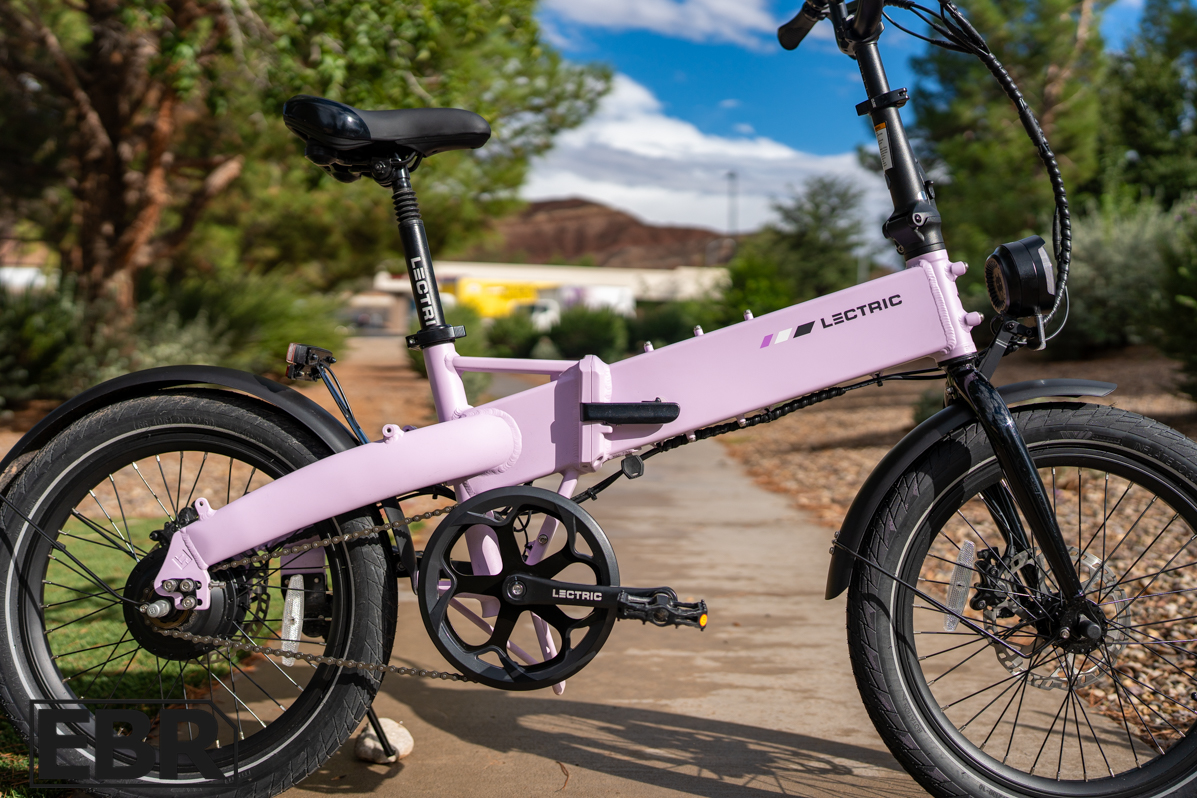
Drivetrain. All versions come with single-gear drivetrains for lower maintenance and a lighter weight bike. The $799 and $999 versions come with a chain, while the $1,099 option gives you an even lower-maintenance and grease-free carbon belt.
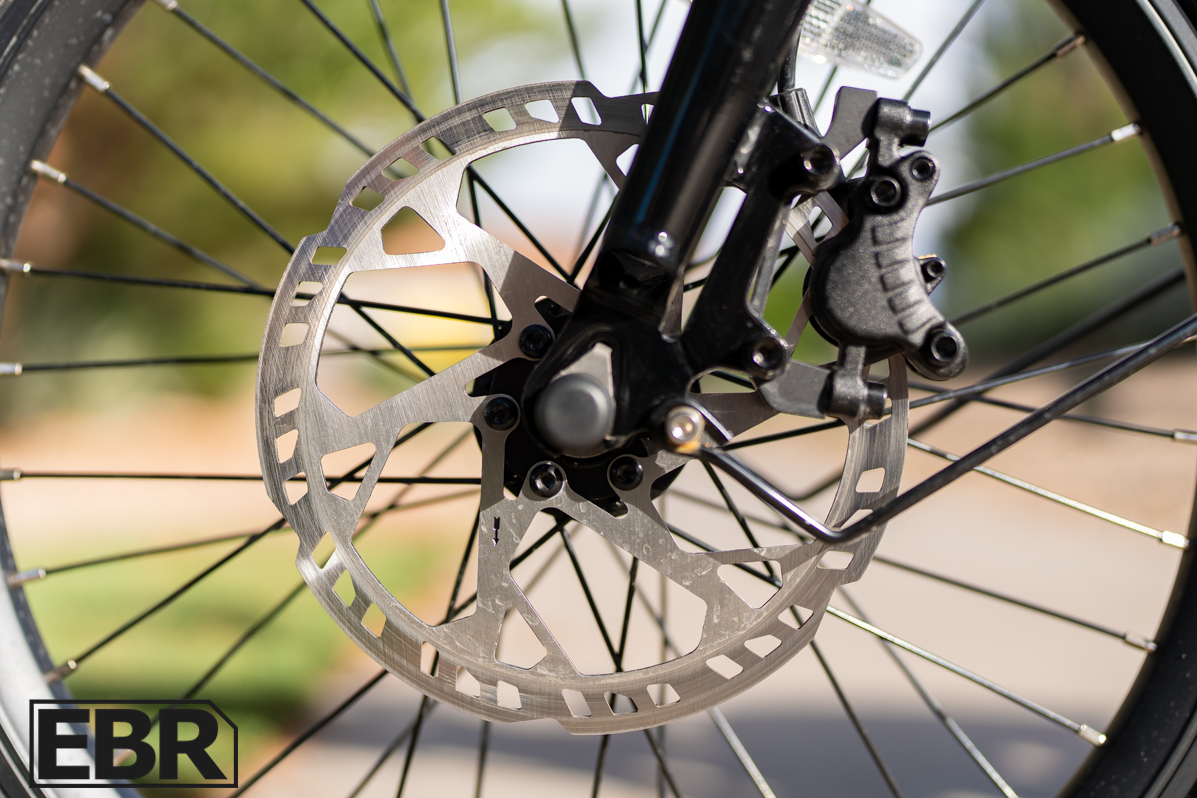
Brakes. Lectric went with the Star Union 602 hydraulic disc brakes they developed jointly with Star Union, which I was not expecting. Given that Lectric saved some money by going with Nutt brakes on the XPress Lite they just launched, I was not expecting the XP Lite to have this quality-level of hydraulic disc brakes. With 180mm x 2.3mm rotors, the braking system is fantastic.
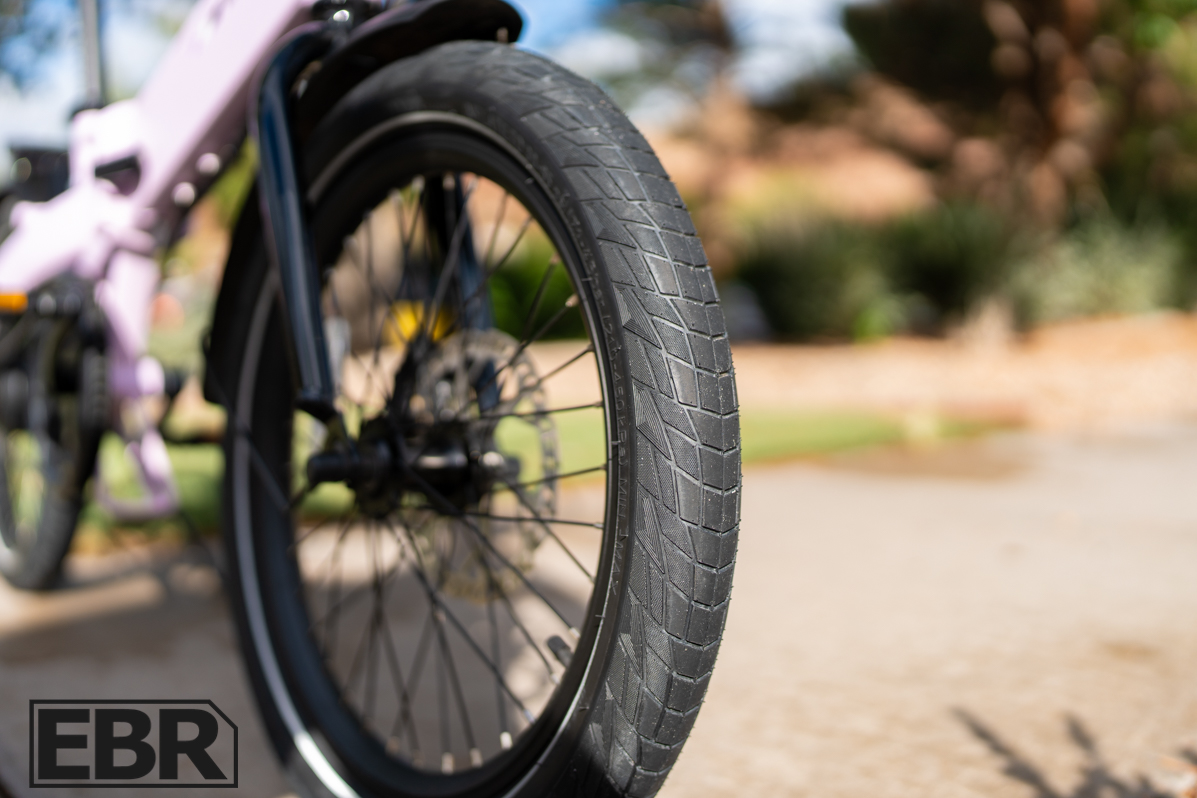
Tires and wheels. 20 inch wheels with a standard city commuter tread, and Lectric installs sealant before the bike ships. Once again, I love how Lectric puts slime in the tires at the factory – which easily saves $50 to $100 in tubes down the road (in addition to a lot of headache).
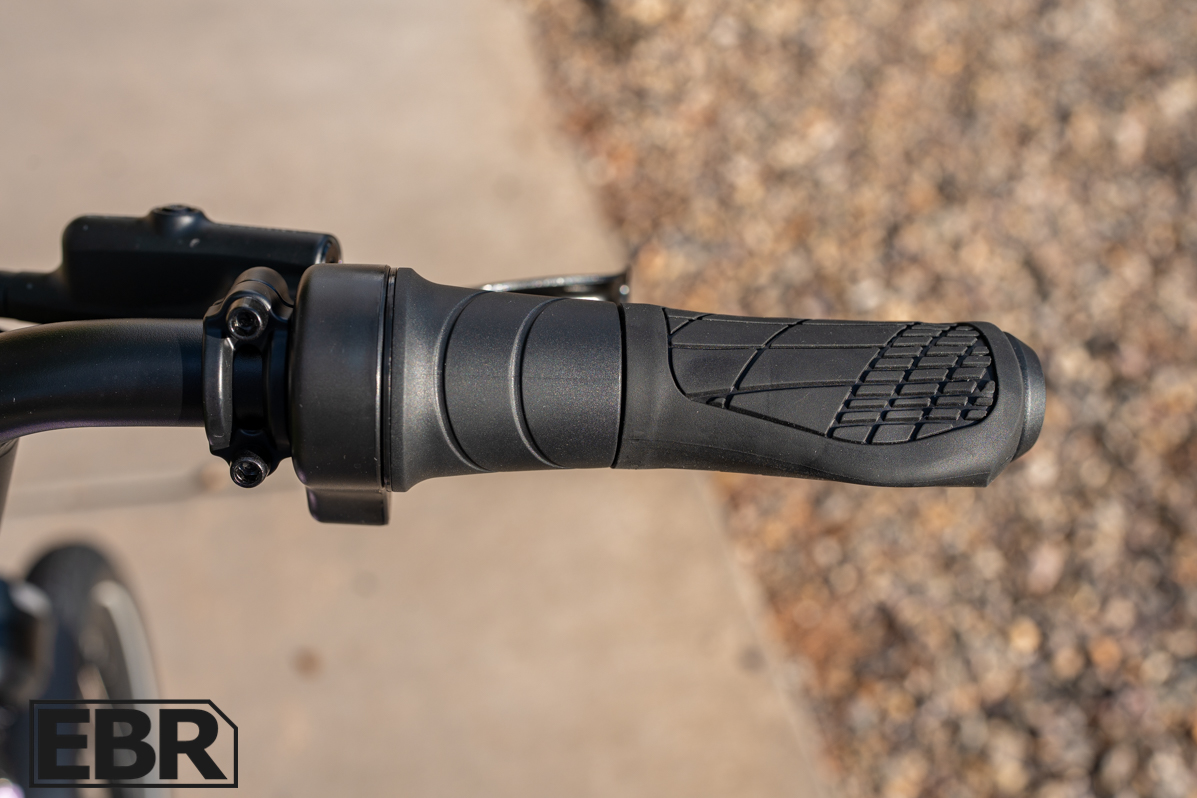
Cockpit. A 26 inch BMX style handlebar on a quill stem with 3 inches of adjustment, lockable rubber butterfly grips, and 2 finger brake levers. The throttle is a twist, not a thumb, which I think is a great choice for a single gear bike that will likely be throttled around quite a bit.
Cable management. Lectric ran the cables out the front and under the downtube instead of through it. When brands do that it usually looks like a rat’s nest, and this does not. You do not notice the cables when you are riding, and a mechanic can get to all of them to swap a controller without fishing anything through a tube or folding hinge.
Bike Assembly. Lectric shipped our bike in the same small box a customer gets, and it took 5 to 10 minutes to put together. Check your bolts anyway when it shows up.
Again, for the money, the component package here is strong where it counts, and the brakes alone are better than the price point calls for.
Screen / User Interface / App
Screen / App Score: 6 / 10
Lectric used the 3.5 inch color display from the XP 4 line, and it looks great on a bike at this price.
The default screen gives you battery, speed, and which of the five assist levels you are in. Press the middle button on the control pod and the second screen adds average speed, trip time, trip distance, and the odometer. Press it again for the third screen, which is the one I ride with, because it adds cadence, motor power output, amps, and volts. I like watching the amps and volts move and seeing what the motor is pulling.
My one complaint is the battery readout. It is labeled as a percentage, but it moves in 10% steps, so it is not a true percentage and is a little less predictable than what I like.
Hold plus and minus together and you are in the advanced settings, and Lectric wrote them in plain language instead of codes, so they are easy to understand and easy to change. You get screen brightness, sleep timer, units, tire size, bike classification, power profile, throttle output, throttle zero start, walk mode, light behavior, and an odometer reset.
Bike classification is where you choose Class 1 pedal assist only, throttle only, or Class 2 with both up to 20 mph.
Power profile is where you choose power limited, speed limited, or both, and I run power limited because it lets me control my own speed while telling the bike how much to give me.
Throttle zero start is a nice touch for anyone worried about twisting the throttle at a stop sign.
There is no app and there is a USB port under the control pod. Next time I would like an app, if only for over-the-air updates.
Bike Model Options
There are three versions:
- The $799 base model comes in Arctic White only, with the 374 watt-hour battery and the single speed chain drive, and no accessories (no rack, no front light, no fenders, and a standard seat post).
- The $999 version is the one we tested. It gets the 672 watt-hour long-range battery, the chain drive, fenders, a front light, and the suspension seat post, and you choose from Blue Mist, Matte Grey, or the Matte Lavender (which I think looks fantastic in person).
- For $1,099 you get the same bike with the Gates Carbon belt drive in place of the chain, plus the new LevelUp Lite rear rack, in JW Black or Ballerina Pink. That rack has a raised second level that makes pannier bags easier to install and leaves clearance to run bags and a basket at the same time.
My recommendation is the $999 version. The jump from 374Wh to 672Wh nearly justifies the $200 by itself, and you are also getting fenders, a light, and the seat post suspension, which would cost more than that bought separately.
If you ride to work in slacks and do not want grease anywhere near you, spend the extra $100 on the belt drive. A belt does not stretch, does not need lubing, and does not leave a mark on your pant leg.
Is the Lectric XP Lite 3 Worth Buying?
If you want a folding e-bike that is light enough to lift into a vehicle on your own and still rides like a real bicycle, this belongs right at the top of your list—especially if you’re on a budget.
The XP Lite 3 is a textbook example of a bike whose ride quality is better than the sum of its parts. Nothing on the spec sheet jumps out to win an argument in a comparison chart: it has a modest 300W, 28Nm motor, only one gear, and no suspension fork.
Then you get on and ride it, and you instantly realize what Lectric got right. The frame is stiff, the geometry is dialed, the hydraulic brakes are better than they need to be, and the bike is simply a blast to ride. That gap between the spec sheet and the pavement is why this might be my personal favorite bike in Lectric’s lineup, even if it’s far from their highest-spec model.
Two riders should be looking hard at this bike:
- City and suburban riders: Commuters who want a folder light enough to drop into a hatchback or a Honda Civic trunk without buying an exterior bike rack, and who don’t need the weight and bulk of a full-size folder like the XP 4.
- Parents shopping for a teenager: Younger riders don’t need a heavier, super powerful, moped-style e-bike (like the Juiced Scrambler). The XP Lite 3 is light, nimble, and manageable, and most parents aren’t looking to drop $1,500 to $2,000 on a first bike.
Who should look elsewhere?
- Anyone regularly riding broken pavement or rough terrain will want front suspension.
- Riders who need to throttle up long, steep hills every single day without pedaling. For either of those use cases, look at the XP 4.0 (in the 500W or 750W version) or the full-size XPress.
- Also keep in mind: while 53 pounds with the long-range battery is 20 pounds lighter than an XP 4, it is still 53 pounds—this isn’t a featherweight folder you’ll want to haul up three flights of apartment stairs daily.
Three small things I’d like to see Lectric address on the version 4: a true single-percent battery readout, a factory shim so the battery pack doesn’t rattle in the downtube, and a simple retention strap in the box for the fold. None of those would cost much to implement, and they would take a bike I already love and make it that much better.






Reader Interactions