
Review Overview
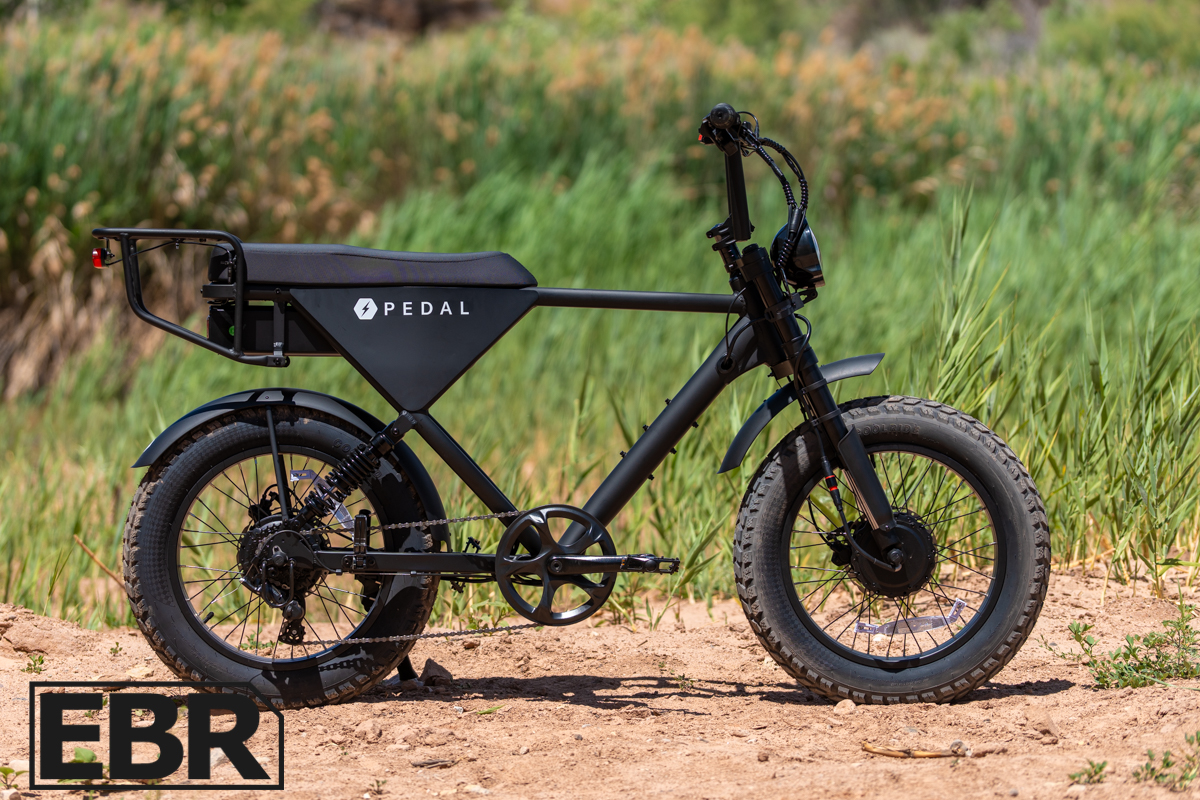
The Pedal Electric All Wheel Drive [S] is a moto-style e-bike with a 1,000W hub motor in each wheel. It ships as a Class 2 bike with throttle assist to 20 mph, can be set to Class 3, and can be unlocked to a Sport Mode that runs up to 36 mph once you sign a legal waiver and enter a code from Pedal.
If you’ve followed us for a while, you’ll probably notice that we rarely review bikes that fall into grey areas when it comes to speeds and wattage outputs – we are very big proponents of e-bikes following the 3-class system, as defined by People for Bikes. The more bikes that follow that system, the less likely we all are to have to license and register our e-bikes in the future.
That being said, I think a lot of people would have a pretty big smile after throttling around on the Pedal AWD [S] – especially larger riders over 250 lbs who struggle to find bikes that will get them up steep hills.
My Experience Riding The Pedal Electric All Wheel Drive [S]
Ride Quality Score: 8 / 10
Probably the best way to start off here is to simply say: Hold On!!
When you engage both motors and hit the throttle, the bike will lift your front wheel off the ground
The first thing I want to pass along is what this bike does from a dead stop. With both motors engaged, sitting normally without leaning forward, the front wheel starts bouncing and squirming underneath me. It will lift. I am not good at wheelies and I am too old to go trying, but it will absolutely go.
My recommendation for anyone getting on this bike for the first time is to click that red button on the left over to the right so you are using the rear motor only. The difference is immediate. Same position, same throttle, and it’s much more controllable.
Front motor only mode has its own version of the problem. It will spin out, and over a dirt section you can slide it if you are rolling slow and then punch it.
On fit, Pedal says 5’5″ to 6’4″, and this bike suits taller riders better than shorter ones. The reach is decent and I can adjust it back a bit. It feels like a big bike. At 5’5″ I would be looking at something else, unless I was around 250 lbs, in which case this will probably be fantastic. I am 5’11” with a 32-inch inseam and I can stand over it without tilting it to the side. A 5’5″ rider can stand over it too, but expect to be on your tiptoes or leaning it over.
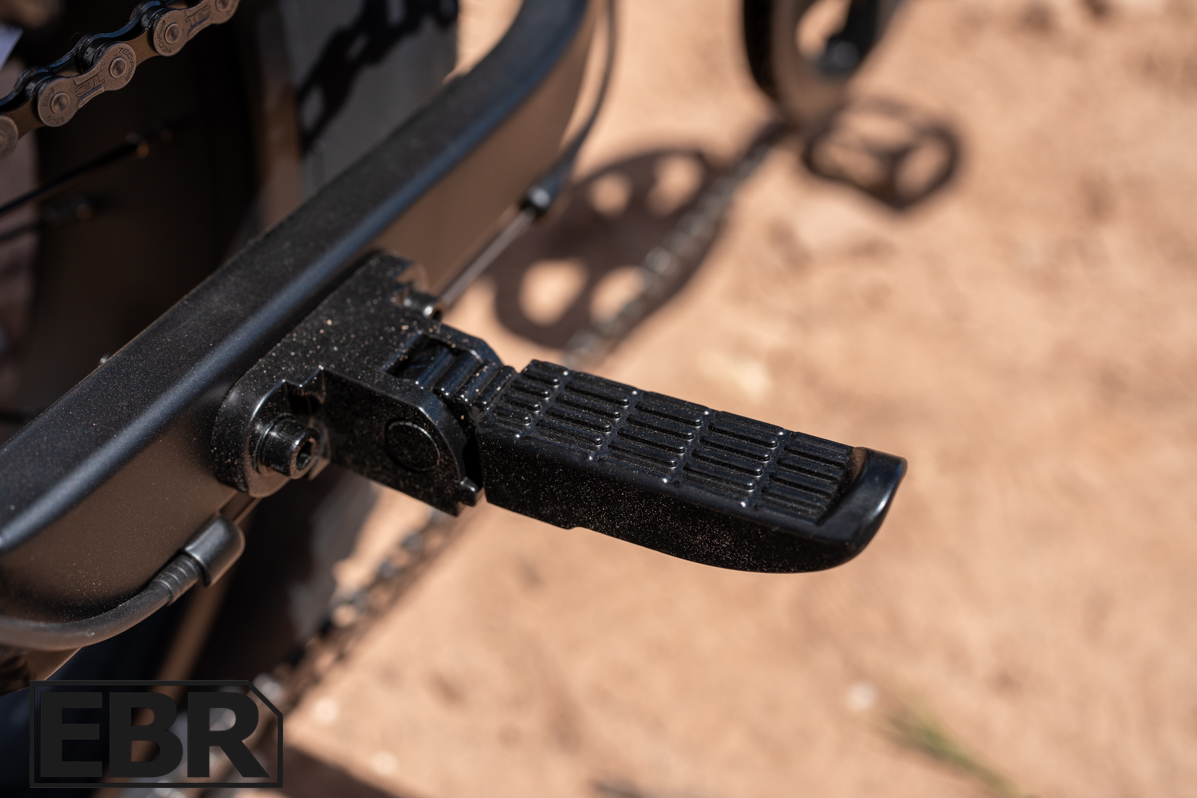
The grips are comfortable and the throttle is easy to modulate, though I would like a bit more modulation given how punchy this bike is off the line. The saddle is comfortable, including with a second person on the back. When I scoot forward to make room, the sides of the saddle bump up underneath me and I feel it, so Pedal could shave that down a little. I would personally take the rear rack off. Mounting and dismounting is harder for me with it on, and that stays true with a passenger, even though the rack does give them something to grab. Combined with the pegs, it makes a decent second seat.
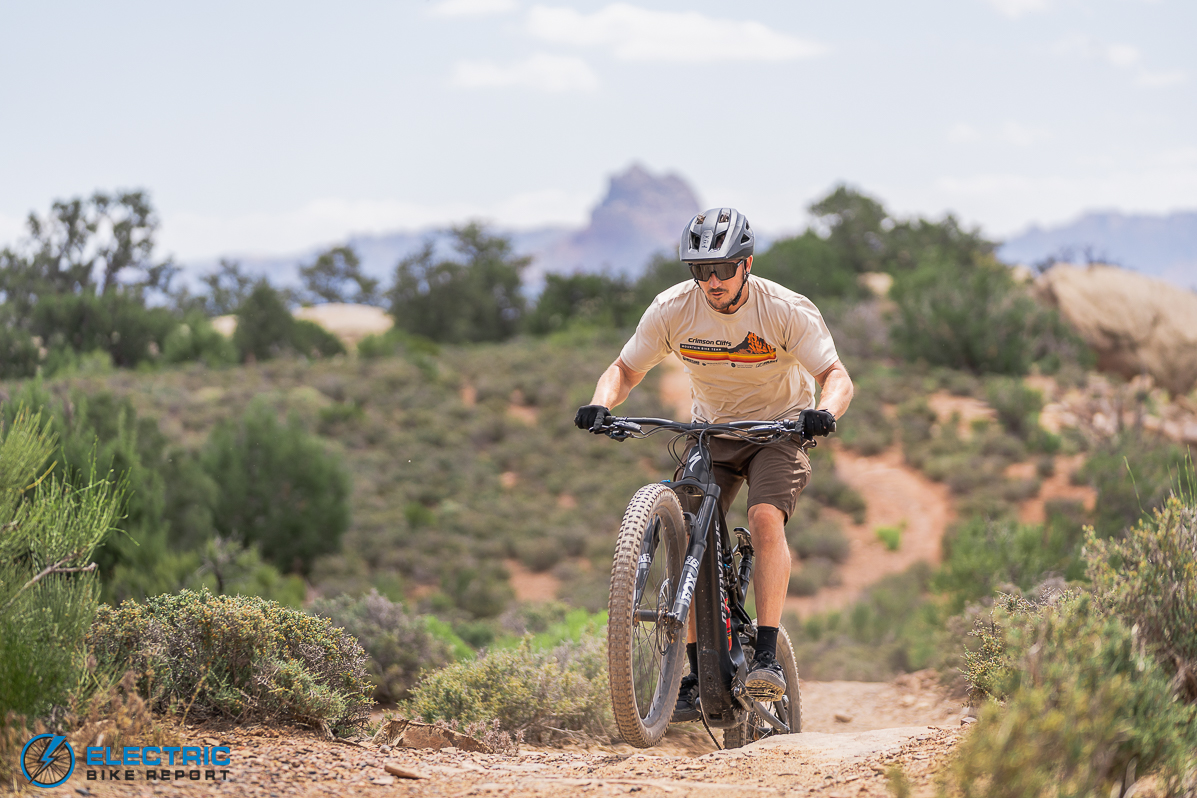
Off-road is where I had the most fun with it. What I look for in suspension is not just comfort but the ability to keep the wheels on the ground instead of bouncing around and losing traction, and this does that well even as I pick up speed.
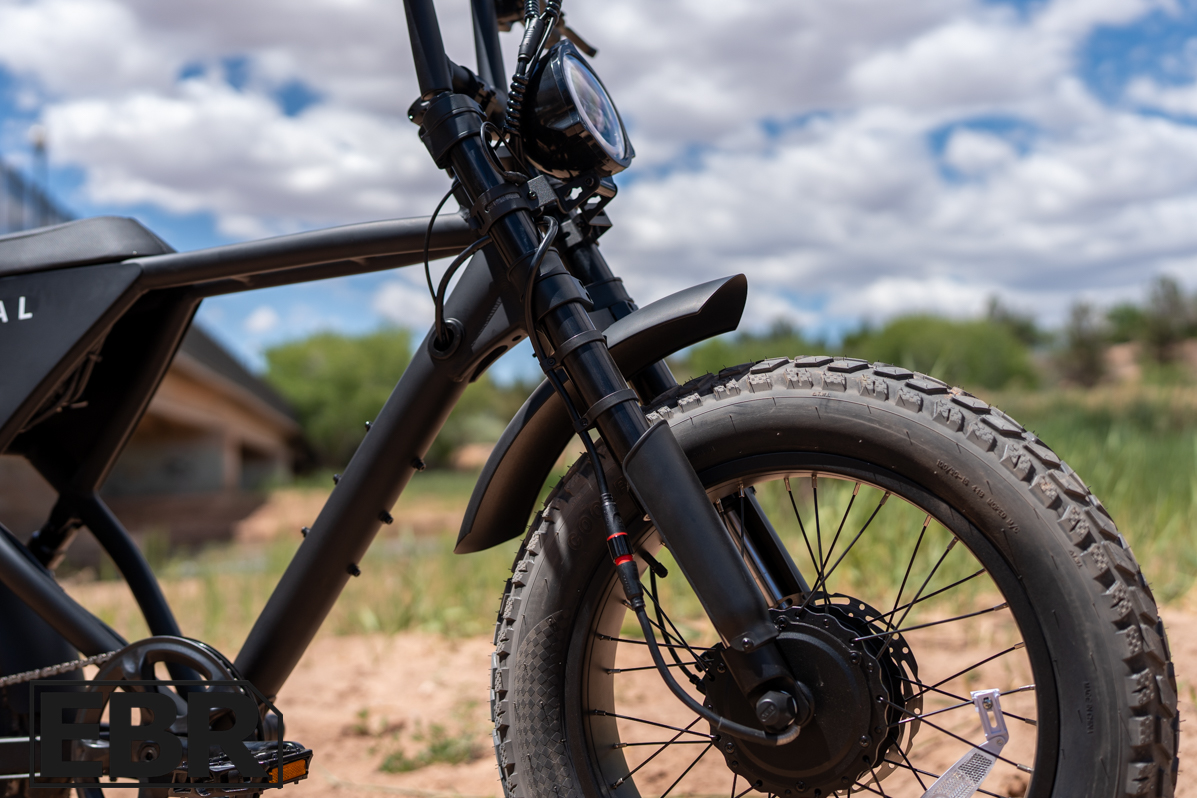
In sand and tight, loose sections I drop to PAS 3 and switch to rear motor only, then pedal. That gives me control, and it lets me keep a finger on the brake, which I cannot do while twisting a throttle. Pedaling this bike is easy enough that it does not wear out my hip flexors. One problem showed up out there: under hard fork compression, the metal front fender rubs the front tire. I can raise it about a quarter of an inch and still get some rubbing. Pedal should fix that, because I can see people pulling off a fender to avoid the noise, but then missing that fender in wet riding conditions.
Take a moment to learn how this bike behaves, then go have fun with it. This is one of those bikes that is going to put a smile on a lot of faces.
Power / Motor
Hill Climbing Score: 7 / 10
 |
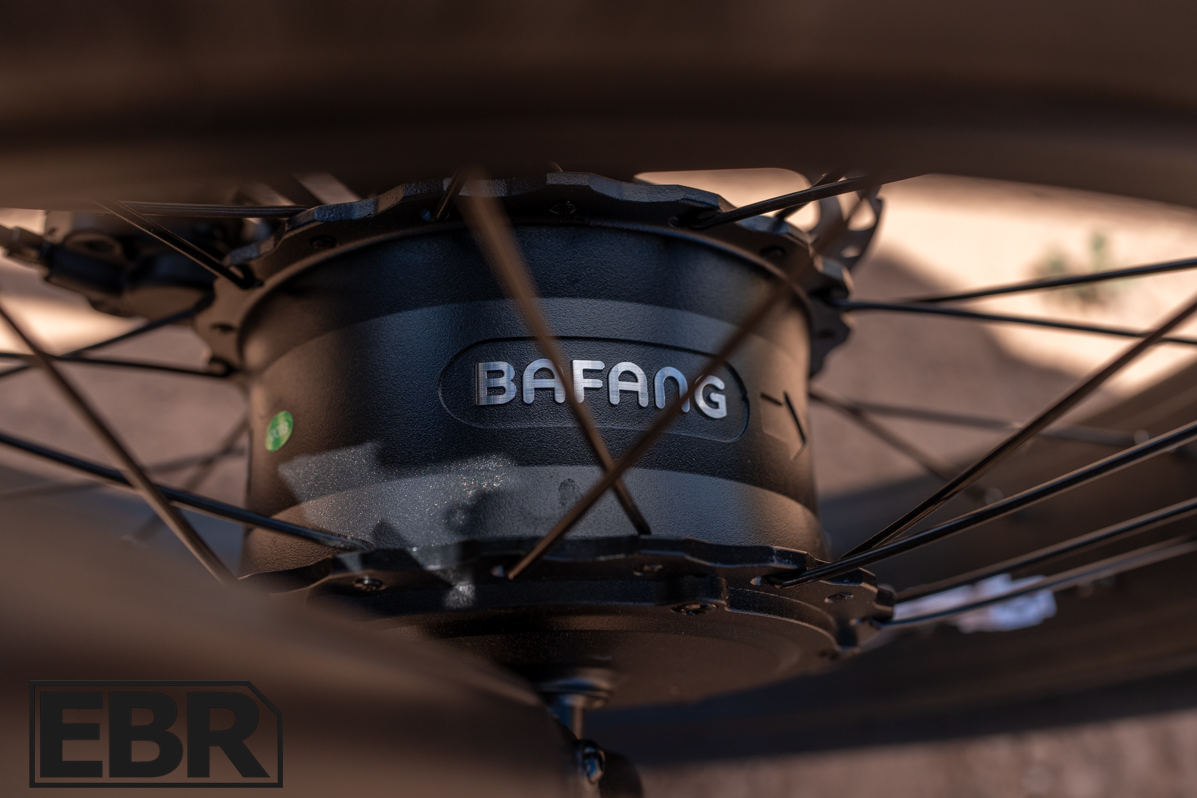 |
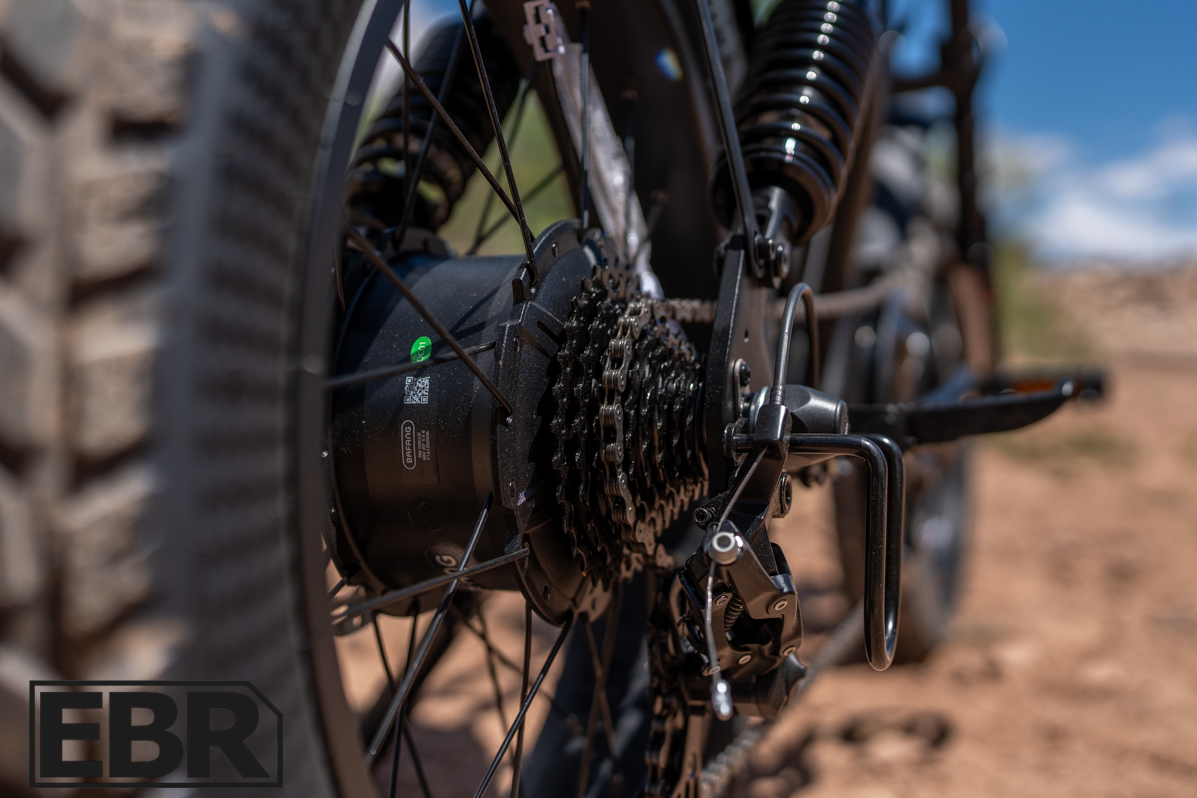
This is a very powerful, dual hub motor e-bike. Each motor is rated at 1,000W nominal and 1,500W peak, which gives you 2,000W nominal and 3,000W peak with both running, and each produces 70Nm of torque. Pedal set out to make this thing fast on the flats and strong on the hills, and the two motors accomplish that goal.
Our 0 to 20 mph throttle test with both motors took 4.5 seconds, the quickest I have recorded on any bike. Rear motor alone only took 8 seconds while the front motor took around 8.5 to 9 seconds, with some peeling out at the start if you do not weight the front end properly.
Pedaling with both motors, it only took about 5 seconds to reach 20mph, and that was with me stuck in the highest gear, so it would have been quicker otherwise. With the power off I pedaled to about 8 mph, and leg extension is better here than on some moto-style bikes, though nobody is going to ride it that way. Stepping through the assist levels, PAS 1 gave me 13 mph, PAS 2 around 14 to 15, PAS 3 around 15 to 17, PAS 4 around 18 to 20, and PAS 5 took me to 20, 21, 22.
That last number is the one thing I want Pedal to change. In PAS 5 the bike surges past 20 mph, up to 22 or 23, then tapers back down. While in theory this might not be a huge problem; however, in reality it poses a unique challenge. Every time you back off the throttle, then turn it back to full power, the bike follows that same speed pattern – you speed up to 22-23 mph before tapering back off to 20 mph.
This is a programming quirk that I haven’t seen before, and ends up pushing the bike past 20 mph too frequently.
Motor engagement is good. From a stop in PAS 4 the power comes on right away. There is about a quarter second of overrun after I stop pedaling, with a small surge you can feel, so that could be dialed in a bit. Motor noise is louder than what I usually hear, which is what happens when you have two motors pulling 1,500W each with 70Nm of torque apiece.
On our Black Hill climb, the throttle run covered the 0.35-mile segment in 64 seconds at an average of 19.5 mph and took the Strava crown for that segment. The pedal run came in at 65 seconds and 19.2 mph, so one second slower.
It has two motors, so it should beat a single 750W bike, and it does. At 106.5 lbs plus my body weight it had plenty left to get up that hill, and that points straight at who this bike serves best: heavier riders who need more wattage and more torque to climb the way a 150 or 180 lb rider does.
I think this is the most likely reason why Luca Doncic decided to buy his LA Laker’s team mates and staff the PEDAL AWD [S]. An NBA forward is likely to be over 250 lbs, and the extra power will help them enjoy the bike as sub-200lb riders do.
Range / Battery
Range Score: 9 / 10
Min Assist: N/A – We don’t test e-moto style e-bikes in MIN assist
Max Assist (throttle-only): 45.89 Miles
45.89 miles on our throttle-only MAX POWER test is pretty impressive.
One note: We range tested the bike using only one of the motors (the rear hub). This is so we can compare directly vs other moped-style e-bikes like the Juiced Scrambler or Ride1Up Revv1 DRT.
If you run both motors on max and throttle it the whole way, you will obviously get less range than that, but given the large 1,200WH battery size, we still would expect to see over 30-35 miles on MAX assist.
Pedal claims a range of 40-80 miles, and I highly recommend only focusing on that 40 miles number as most people are going to just throttle the bike around. And I don’t think anyone is going to pedal the AWD around on ECO, which is what would be required to hit that 80 mile max range.
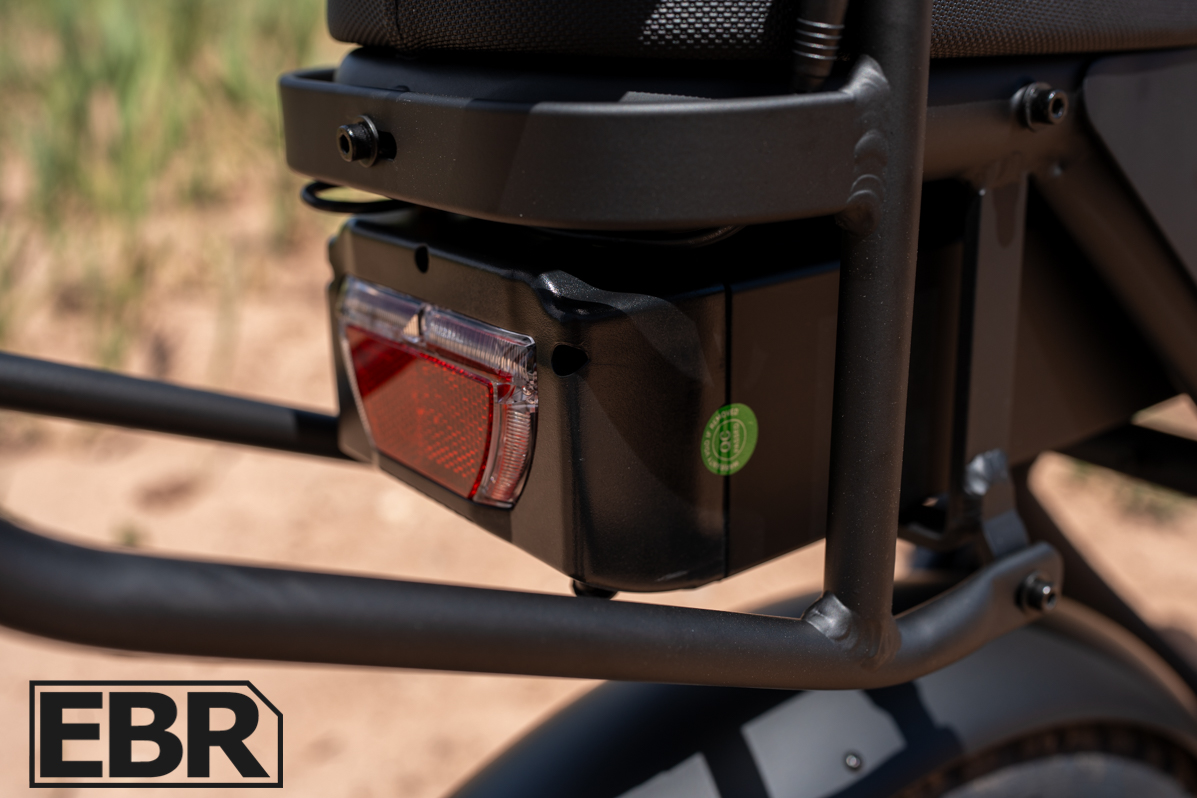
The battery is a 48V 25Ah pack for 1,200Wh of capacity, and it is UL 2271 certified while the bike as a whole carries UL 2849 certification. It slides out the tail of the frame and locks in place with its own separate set of keys. I really like the security of having 2 different keys for the AWD [S], even though it is an additional set to keep track of.
The included charger is a 2 amp unit. Running the math on a 25Ah pack, you are looking at 12 to 13 hours to go from empty (0%) to full (100%). For an extra $100 Pedal sells a 5 amp charger that cuts that to just under 5 hours. With a battery this large, I recommend buying it.
Components
Components Score: 8 / 10
 |
 |
 |
 |
At $3,495 (at time of filming), a moto-style e-bike should give you parts that can handle the weight and the speed it is capable of producing. For the most part, PEDAL does a great job of that – but there are a few areas I’d like to see some improvements.
Drivetrain
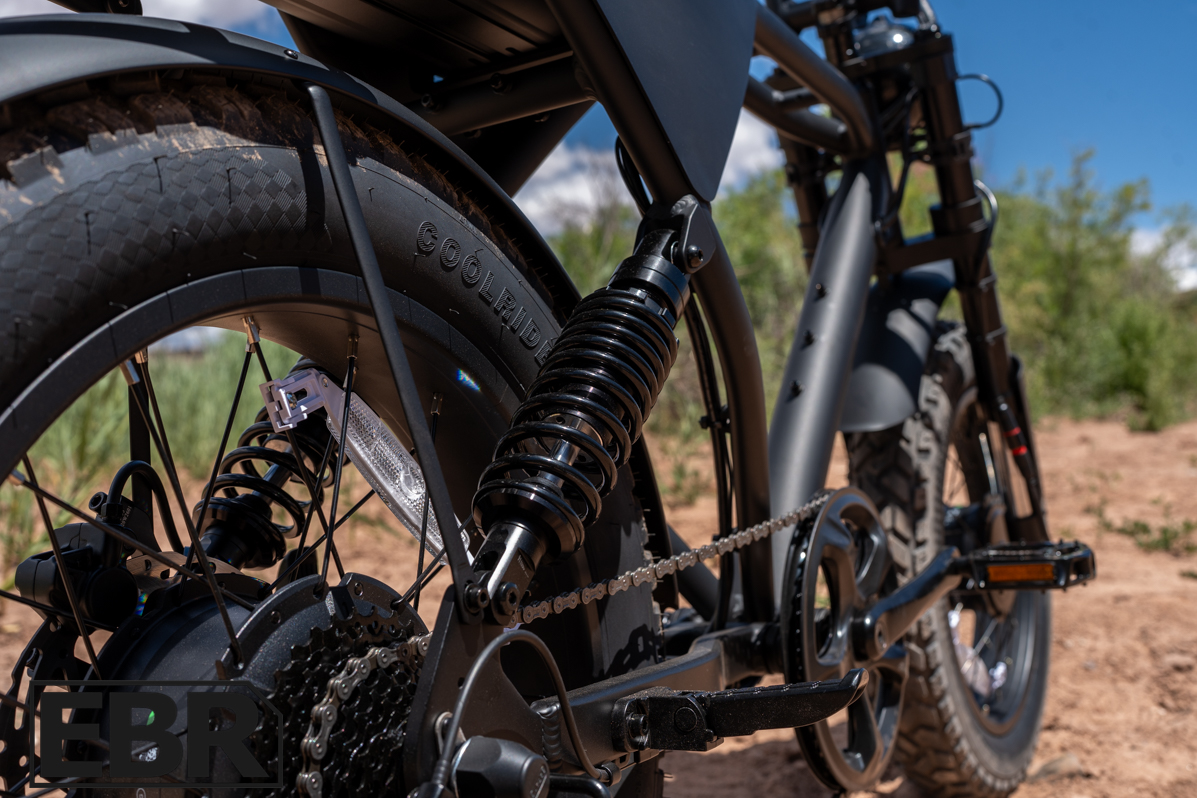
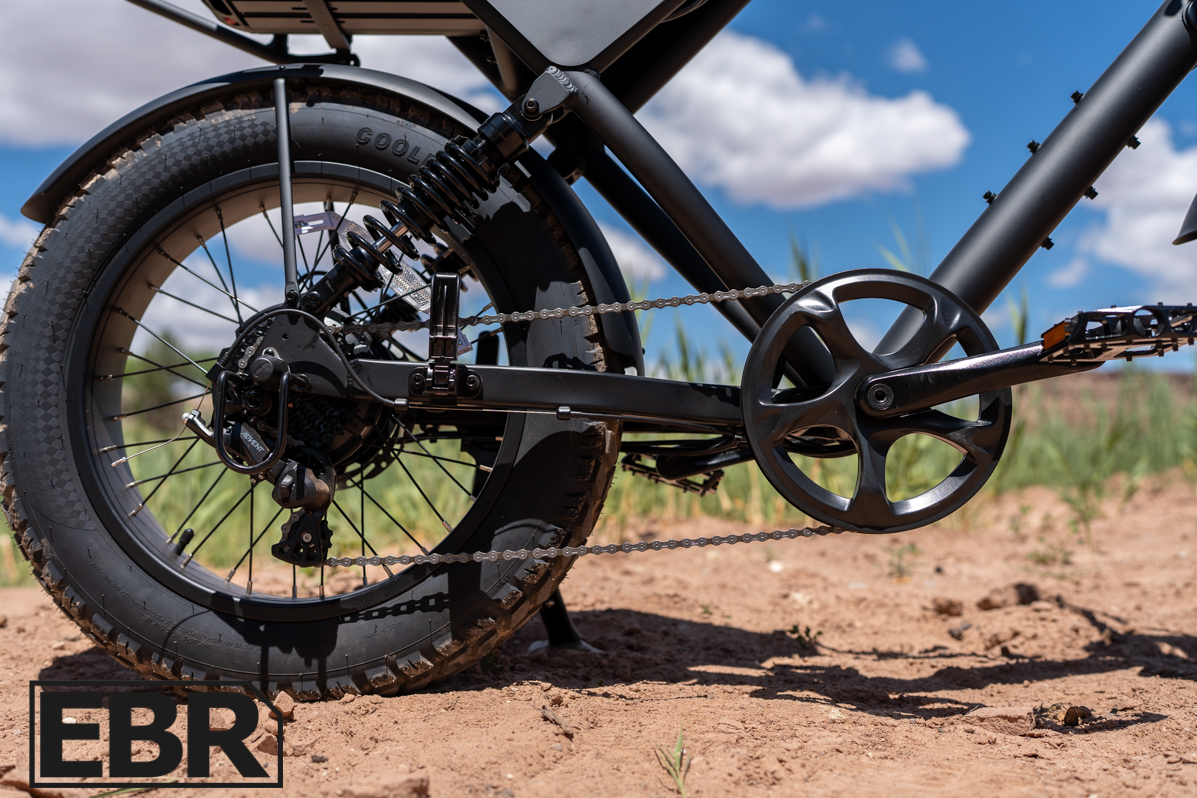
The All Wheel Drive [S] has a 9-speed microSHIFT Advent drivetrain with a 52T chainring up front and a 13-32T range in the rear.
microSHIFT is not a name most riders know the way they know Shimano, but Advent is a good drivetrain, and the piece I care about here is the clutch on the derailleur. It cuts down chain slap when you are off-road, and a lot of riders are going to be taking this bike off-road where that clutch derailleur is needed.
Even with the clutch, however, I would like Pedal to add a protective strip on the chainstay so that light chain slap does not wear the paint.
From a gearing standpoint, when climbing Black Hill I never shifted once. They could probably make this a single-speed and most riders would not notice, though the gears earn their keep if you are 250 lbs or more.
Brakes
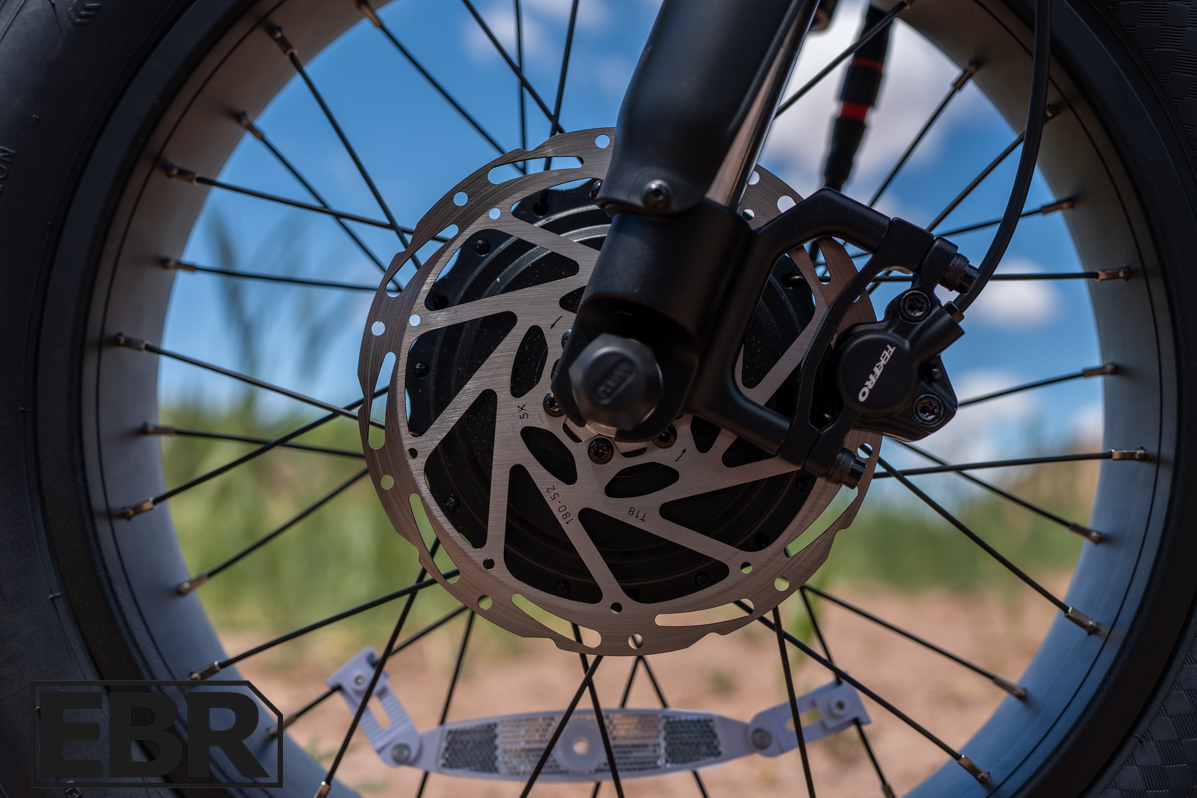
You get dual-piston Tektro hydraulic disc brakes with 180mm rotors front and rear that are 1.85mm thick. They also performed better than I expected, with good bite and good lever feel even when I slammed on the brakes going downhill over 25 mph.
I cannot criticize how they performed.
On paper, though, I would like to see Pedal go to a four-piston setup with a 203mm front rotor, or at least a thicker rotor front and rear, for the next version. You are going to burn through pads quickly on a bike this fast and this heavy.
Suspension
PEDAL did a good job with the suspension on the AWD [S]. The inverted front fork gives you 125mm of travel on 31mm stanchions with adjustable air compression and rebound, and the adjustable rear shock is plush and easy to tune. The inverted design is a better setup for a heavy moto-style bike, since the thickest part of the fork sits up by the crown and that makes the front end stiffer.
One trade-off: it is a dropout axle rather than a thru-axle, so it is not as stiff up front as it could be. That is most likely because of the front hub motor, and it is the cost of all-wheel drive.
Another issue is that when fully compressed, the bike’s front fender rubs and is very loud. While this isn’t anything that makes me concerned safety-wise, it is loud and startling every time I hear it.
Tires and wheels
You get 20″ x 4″ hybrid all-terrain tires that are puncture resistant, and I have been impressed with them on pavement and in the dirt. Pedal sells a hybrid all-terrain, a standard hybrid, and an overland option if you want to change the character of the bike.
Cockpit and accessories
The bike has 27″ flat bars with about 8.5″ of fore and aft adjustment (though no height adjustment), rubber grips, hydraulic brake levers, rapid-fire shifters under the right side of the bar, and a twist throttle. Metal fenders come standard front and rear. The included rear rack handles 45 lbs, and a front rack is available as an option.
Lighting is also powerful, with a 1,200 lumen halo headlight that has dim and bright settings and an integrated taillight with turn signals. The two-person saddle, passenger pegs, built-in alarm, and battery lock round out a well-equipped package.
One more thing on build quality. This bike was shipped to us in a box that was beaten to hell by FedEx, and I have a real beef with FedEx right now on how they handle these shipments. We pulled the bike out, assembled it, and other than a light scratch it was fine. Every bolt checked out, the brakes did not rub, and it shifted properly out of the box. Yes, it is heavy – but it is also burly and well built.
Screen / User Interface / App
Screen / App Score: 6 / 10
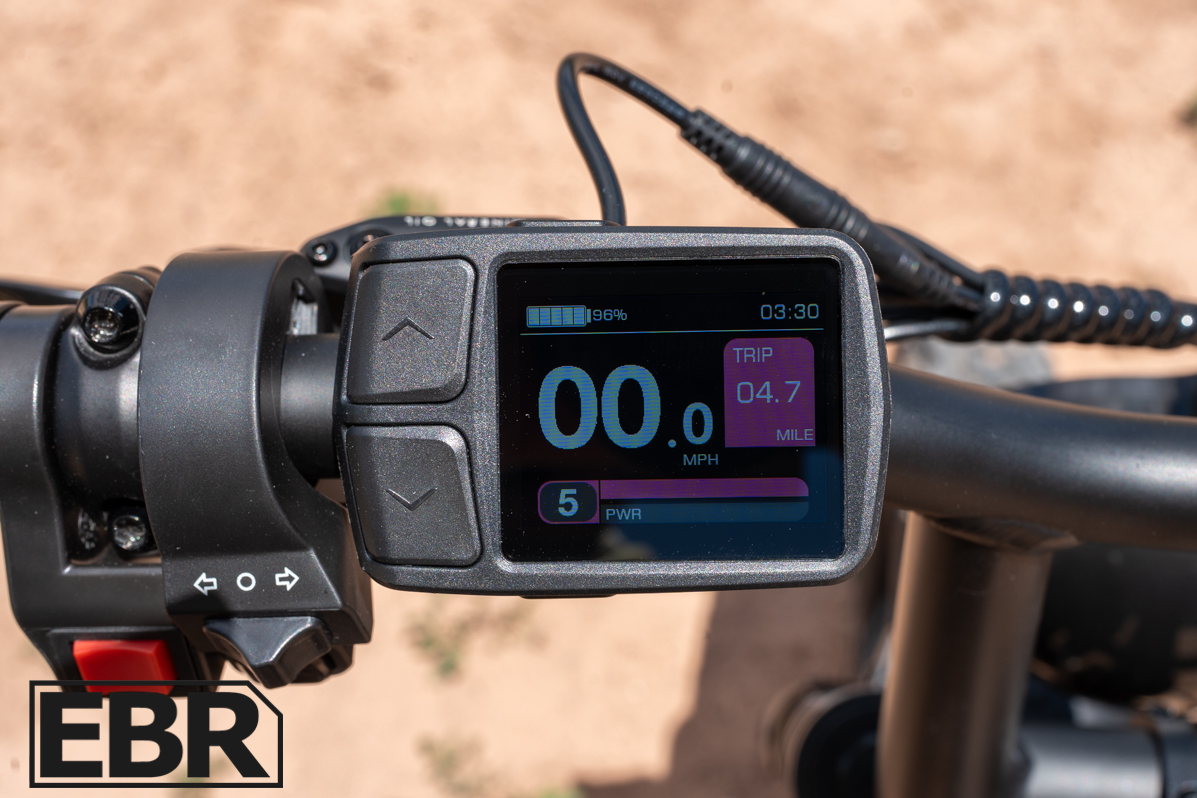
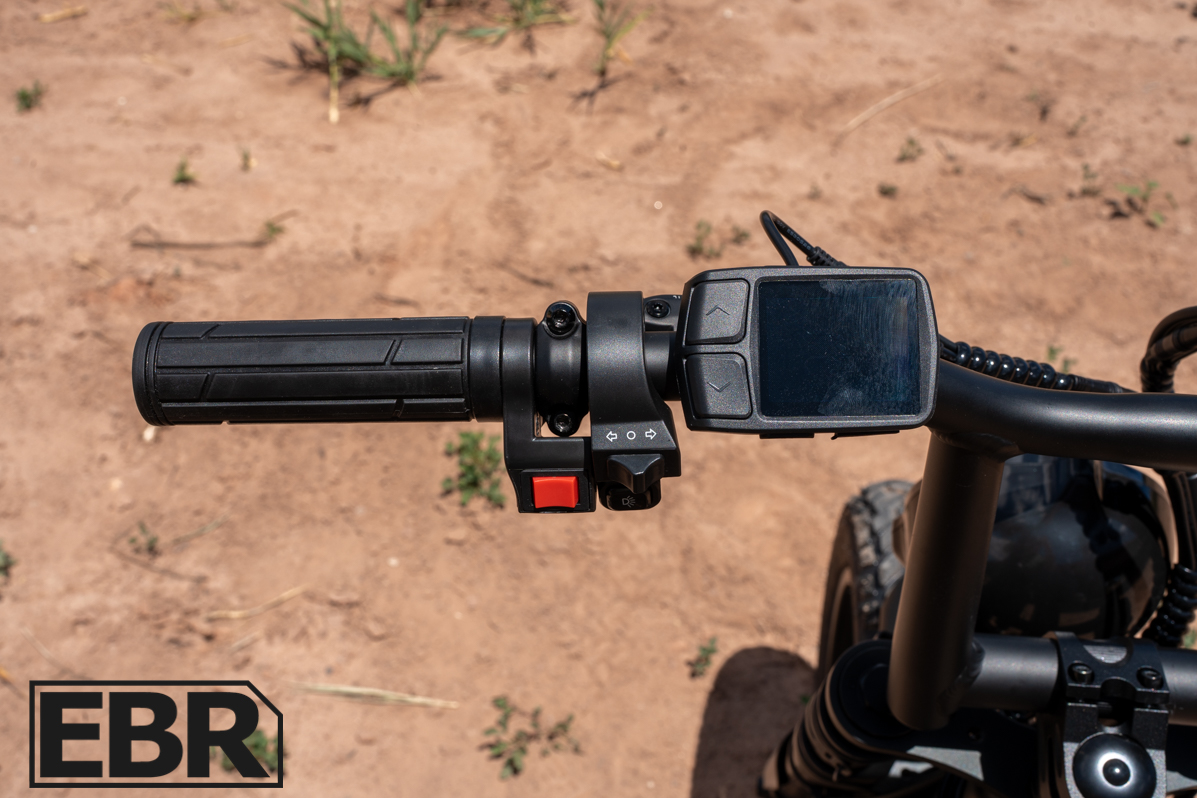
The display on the All Wheel Drive [S] is a color screen built into the same housing as the left-hand control pod. You turn it on with the button up top. Battery readout sits in the top left and gives you both a percentage and a bar graph, which I prefer over one or the other. Time is in the top right, and the main area shows speed, trip distance, and which assist level you are in. The bottom button cycles through trip time, average speed, odometer, max speed, and a ride analysis screen that shows how much time you spent in each assist level. It is fairly basic, but it is large enough to read easily and it works well.
The left pod does more than most. Up and down arrows move you through the five assist levels. To the left of those, arrow buttons control the turn signals: flick right to signal right, flick back to center to cancel.
Then there is the red button, which is the one to pay attention to. It selects which motor or motors you are running.
- Centered gives you both front and rear motors.
- Right is the rear motor only, which is where I tell every new rider to start and use until they have the skills needed to handle both motors.
- Left is front motor only, which I do not use much because I lose grip at the rear and end up spinning the front unless I weigh the bars more than normal.
My one complaint on usability is that I cannot reach those controls with my hand on the grip. I have to shift my hand over a little to get to them, which is not ideal when you are signaling a turn in traffic.
There is no companion app, which is the main reason this section does not score higher. On a bike with this much power, an app would let riders fine-tune the takeoff, cap the top speed per assist level, and receive over-the-air updates.
Bike Model Options
Pedal keeps this simple. The All Wheel Drive [S] comes in one frame size and one frame style: a moto-style step-over that Pedal rates for riders from 5’5″ to 6’4″.
There are four color options: Onyx Black, which is what we tested, Bone White, Olive Green, and Midnight Blue.
The base bike is $3,495 MSRP and is selling for $3,395 as of this review, and it comes with a single battery, the rear rack, passenger pegs, metal fenders, lights, and the alarm. From there, the AWD [S] Essentials Bundle runs $3,670 and the AWD [S+] Bundle runs $3,845, both adding accessory packages. A second 48V 20Ah battery is $850 if you want a dual-battery setup, the 5 amp fast charger is $100, and a front rack is $250. Pedal also sells alternate tires and saddle options.
My recommendation: buy the base bike and add the 5 amp charger. That $100 takes you from a 12 to 13 hour charge down to under 5, and on a 1,200Wh battery that is the upgrade you will feel every single week. The second battery makes sense if you are a heavier rider, if you ride in dual motor most of the time, or if your rides regularly run past 40 miles. Otherwise the stock pack has plenty of capacity.
Is The Pedal Electric All Wheel Drive [S] Worth Buying?
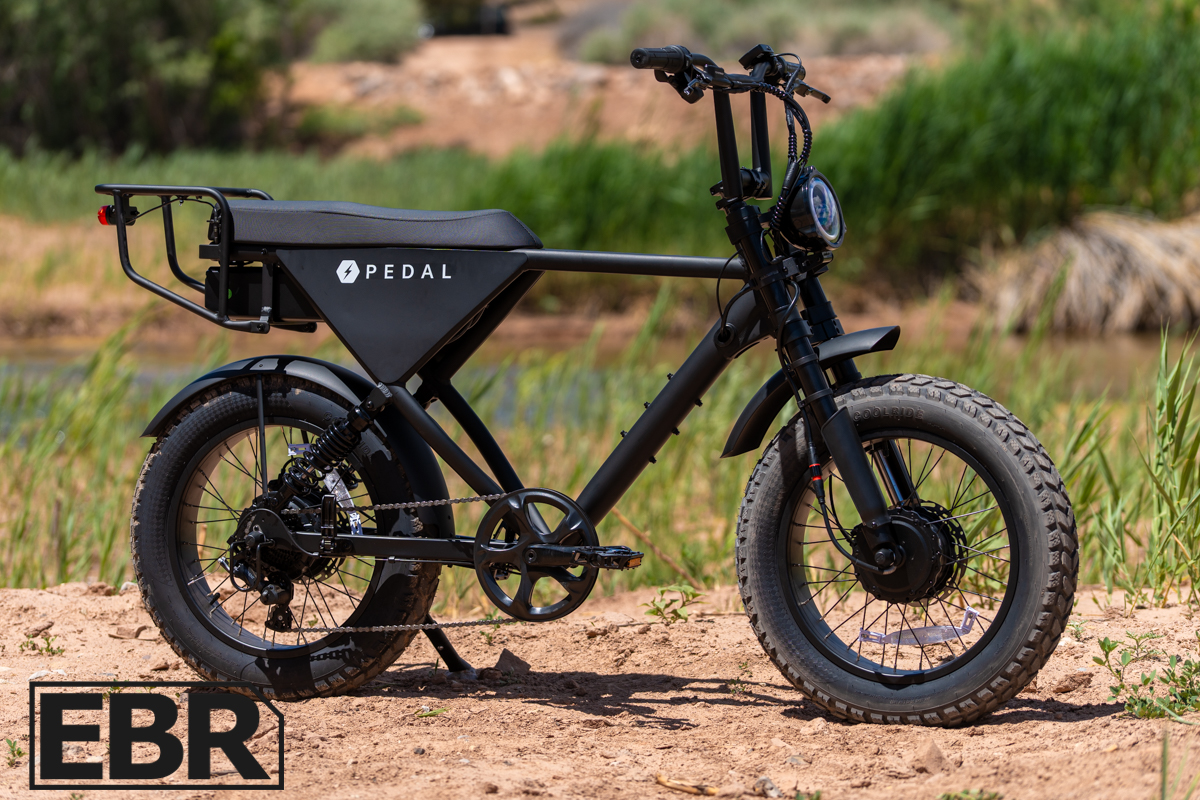
This is a powerful, fast, well-built bike that backed up its claims in every test we ran. It took our hill test crown, posted the quickest 0 to 20 time we have recorded, returned 45.89 miles of range, and held up through our brake tests in 105-degree heat without fading. The suspension is nice, and the safety and security package is thorough.
Who is this for? Start with the rider who wants something fast, punchy, and powerful, and who leans more toward moto than moped. Then there is the group I think benefits most: heavier riders. A lot of people buying a single-motor 750W bike at 250 or 300 lbs end up disappointed with how it climbs. Two motors and 140Nm of combined torque solve that. This bike also works well if you ride two-up, between the long saddle, the passenger pegs, and the rear rack. And if you have legal off-road places to open it up, Sport Mode is fun for those who can handle the speed.
Who is it not for? Shorter riders, since this is a big one-size frame that fits taller riders better. Anyone who needs to lift or carry a bike, because 106.5 lbs is a lot and it will not go on a standard hitch rack. And anyone who wants app-based tuning or over-the-air updates, because there is no app here.
A word on the legal side:
This bike dances (or speeds) in a gray area. It ships as Class 2, and Pedal makes you sign a waiver and enter an unlock code to get Sport Mode, which I appreciate. They are trying to follow the rules and make clear that 36 mph belongs off-road where motorized vehicles that fast are allowed.
Please obey the laws and do not push this bike where it does not belong, so that bikes like it stay legal for everyone.
Pedal has a legitimate hit here, partly in thanks to Luka Doncic and the Las Angeles Lakers – and no, that was not a paid promotion. Given that a lot of those guys are 250 to 300 lbs, the choice makes sense. Fix the fender rub, tighten the Class 2 programming, add a setting to tame the initial takeoff, update that weight spec, and this becomes an easy recommendation with no qualifiers at all.




Reader Interactions