

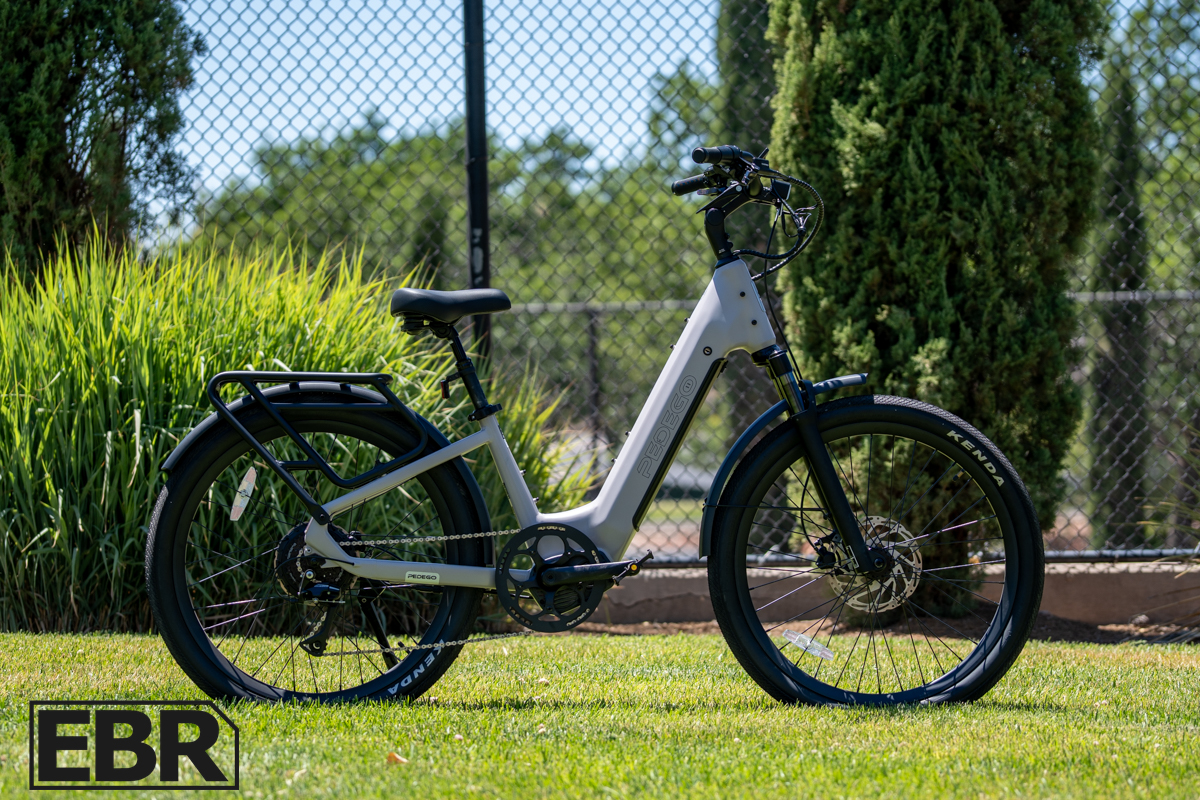
Pedego’s Ridge Rider 2 is the company’s SUV e-bike, and the idea is simple: one bike that commutes to the office on Tuesday and can then ride around the campground on the weekend.
The motor is quiet and precise, the brakes are strong, and the bike is very comfortable. Out of the box it leans a little more commuter than trail, thanks to its city-oriented tires. Add Pedego’s five-year warranty and it becomes one of the more sensible one-bike options at $2,195.
My Experience Riding the Ridge Rider 2
Ride Quality Score: 7.5 / 10
When I first pulled the Ride Rider 2 out of the box is was very apparent that Pedego and Urtopia are owned by the same parent company, and that they are leveraging that relationship as they designed and specc’d out the Ridge Rider 2. The Ride Rider 2 didn’t just remind me of the Urtopia Carbon Joy, it felt as if it was designed to be a non-identical twin.
Both bikes share the same geometry, motor, drivetrain, and brakes and the only real differences are the frame and the app/programming. In general, I think Pedego dealers are going to appreciate having a non-carbon SUV to sit right alongside the Carbon Atom in their stores.
Given how much I liked the Carbon Atom, I think this was a great move by Pedego.
With the Ride Rider 2, Pedego created a bike that functions well as that SUV cruiser/commuter that can then be taken off road (and could be even better off road if you put more knobby tires on).
At 5’11” and 185 lbs, my arms weren’t stretched out but weren’t jammed in tight, and I could stear the bike easily. A lot of that is the handlebars: 680mm wide, 83mm of rise, 40 degrees of backsweep. That swept, Dutch-cruiser shape just fits me, and I’ll admit I like these bars a little more than the ones on Urtopia’s Carbon Atom, and a couple of folks in the office feel the same way.
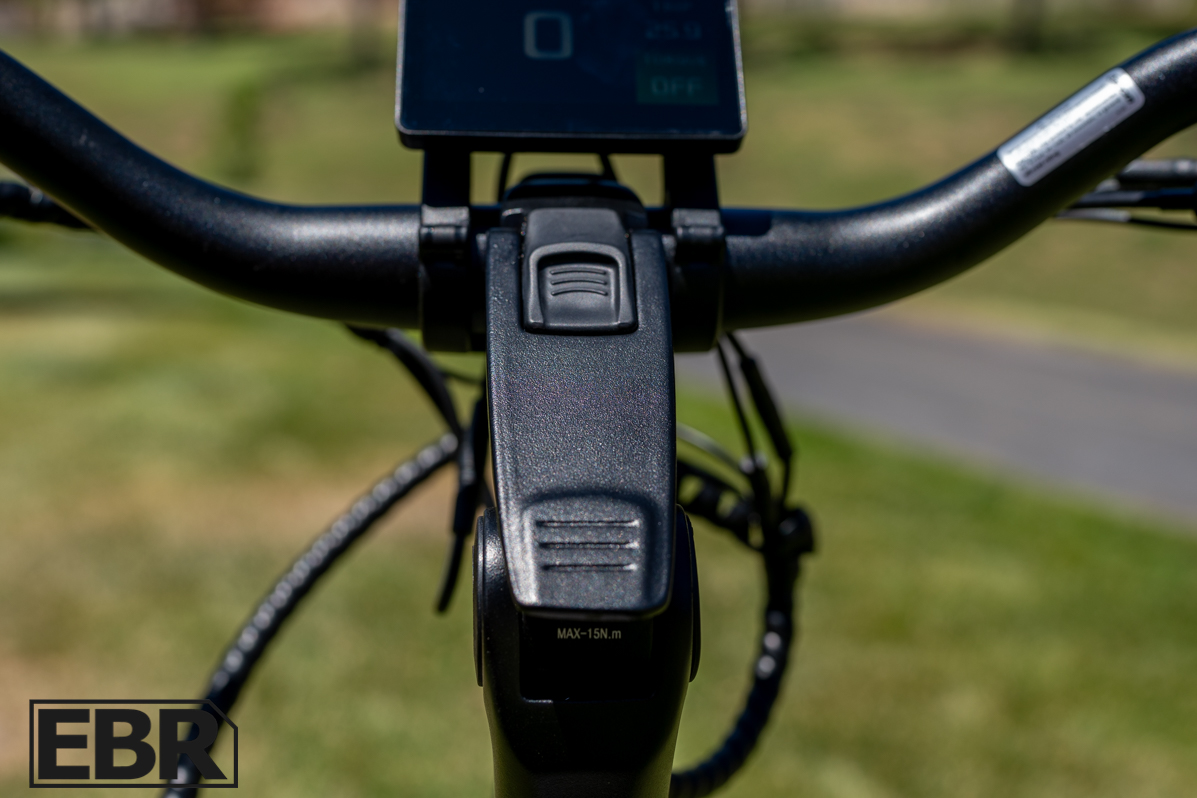
Pedego also did a good job with the bike’s adjustability. The stem adjusts 0 to 80 degrees on a quick release, so you can set your reach and bar height with no tools and no shopping for a new stem. On a one-size-fits-most bike, I appreciate that adjustability.
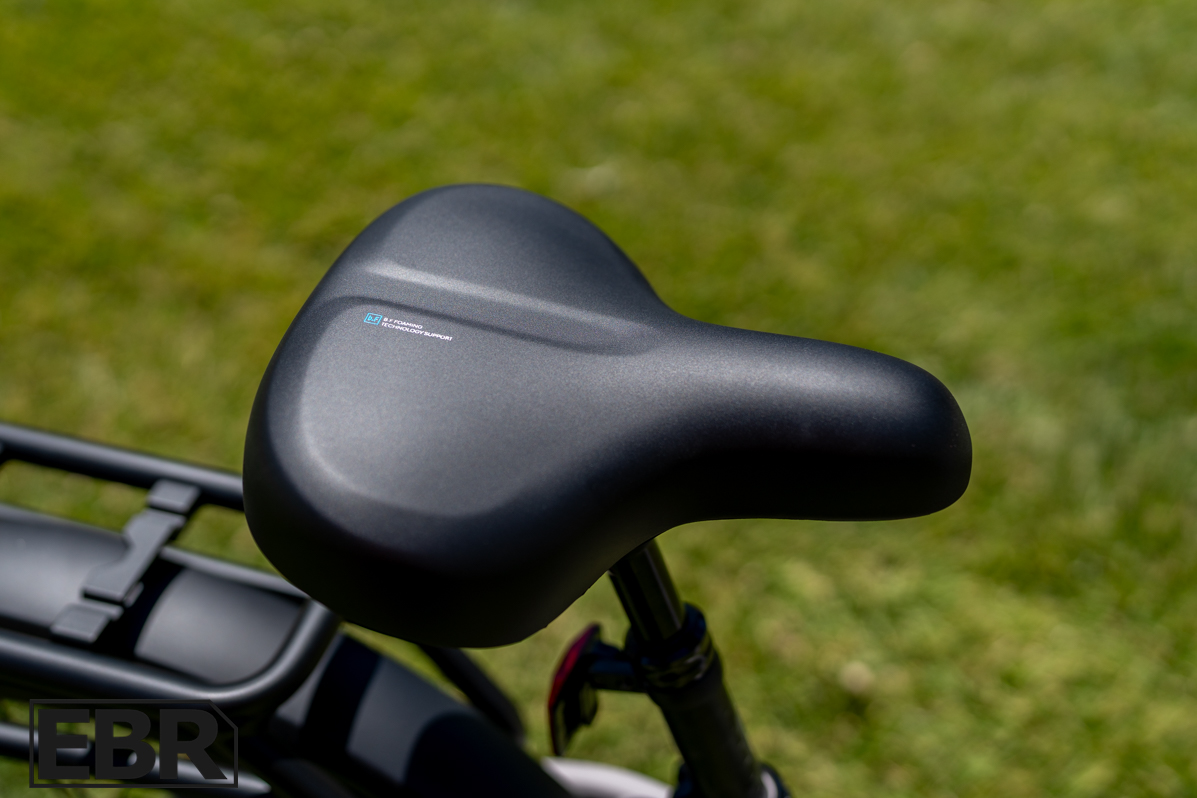
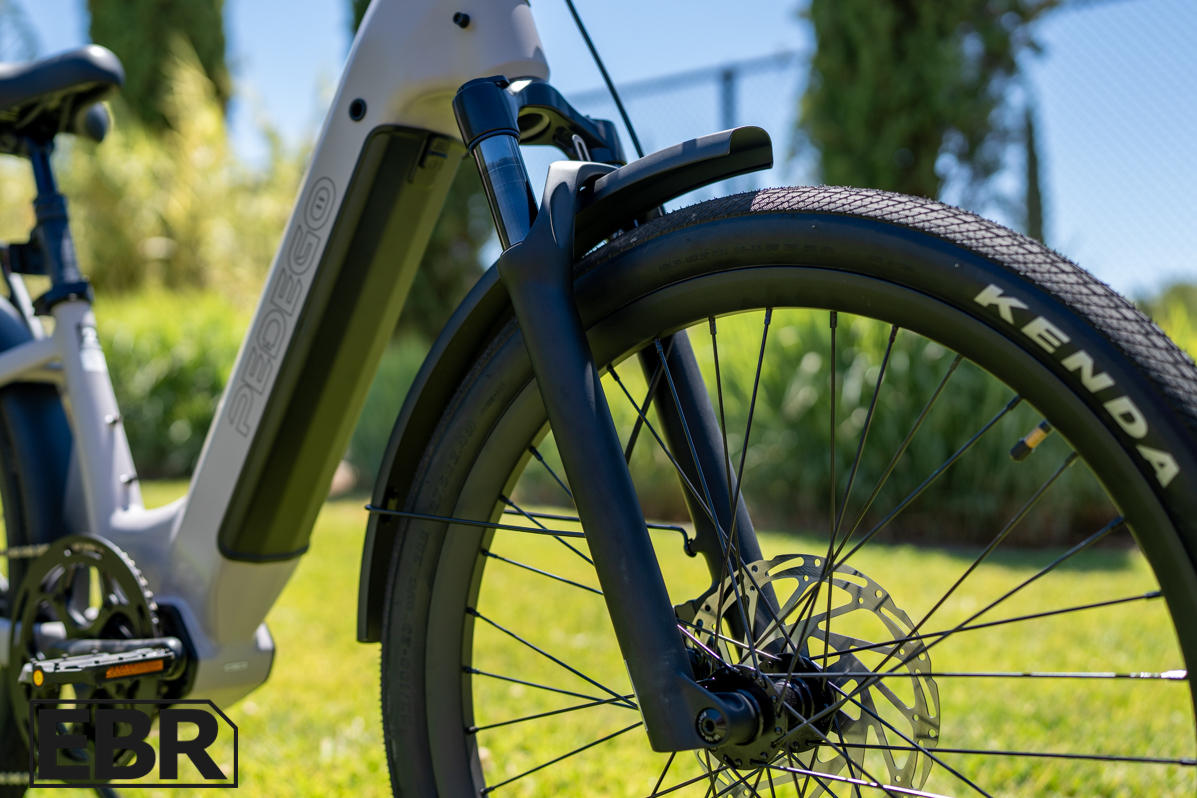
Comfort is where the bike shines. The 80mm, thru-axle fork keeps the front wheel planted on the ground and precise while it soaks up bumps, and the 30mm suspension seat post takes the sting out of the back end. Pair that with the comfort saddle and my backside stayed happy well past the point where a lot of commuters start to hurt.
One note: Pedego list the height range as 5’1″ to 6’3″ range, and I think the top end of that is a little wishful. At 5’11, I can pedal fine but still don’t have full leg extension – riders at 6’1″ and up are going to want a longer post.
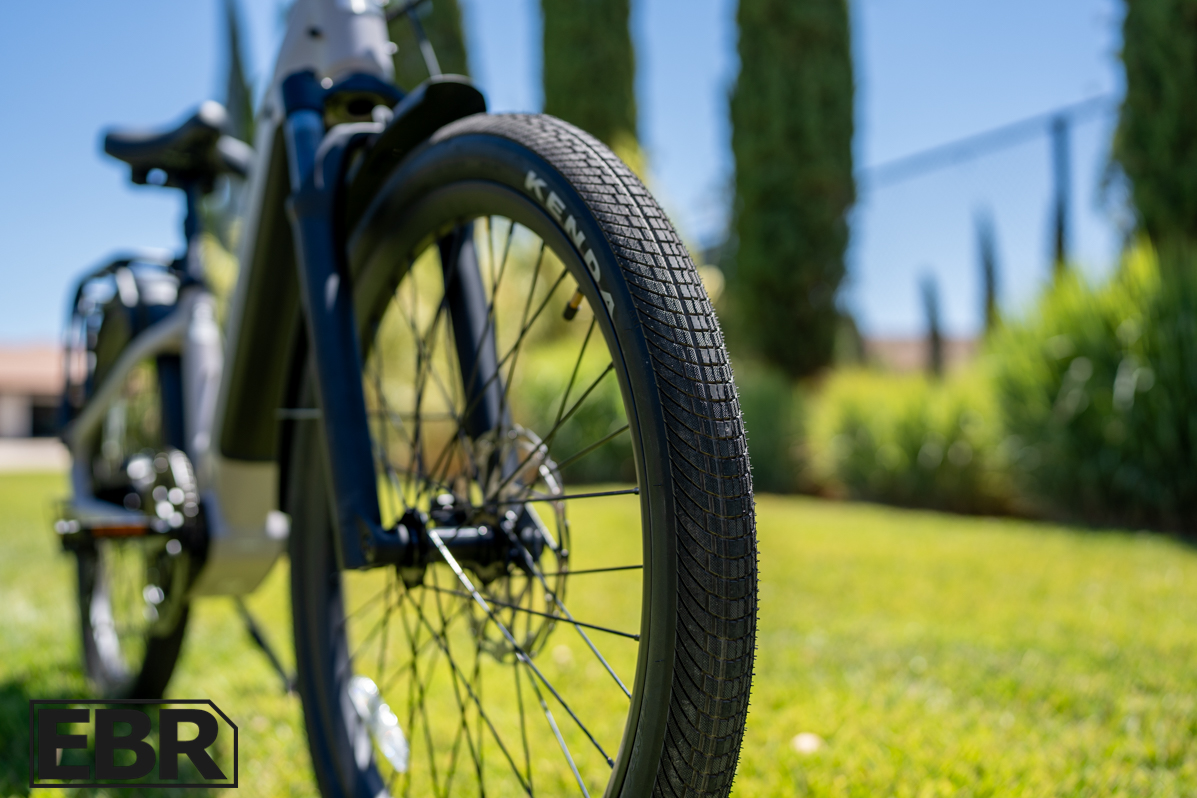
Take it onto dirt and the fork and seat post keep things comfortable on fire roads and light trails. The Kenda tires, though, lean a little bit more commuter and on loose sections I had to ease off the gas. If you ride dirt a lot, swap in something knobbier and this turns into a more robust, multi-trail ready SUV bike.
Power (Motor)
Hill Score: 9 / 10
 |
 |
The Ridge Rider 2 runs a 750W rear hub motor rated at 90 Nm of torque and peaking at 1,200 watts and feels very powerful, smooth, and quiet.
Engagement is quick and natural. In torque mode it kicks on within about an eighth to a quarter turn of the cranks, and it shuts off almost immediately when you stop pedaling, with almost an imperceptible slight amount of overrun. That fast cutoff gives me confidence when I roll into something rocky or loose and do not want a surge of power pushing me off my line.
On our Black Hill test it turned in one of the stronger climbs we have logged. It covered the roughly 0.35-mile hill in 96 seconds on throttle, around 13 mph on average, and 86 seconds pedaling, around 14.5 mph, which put it in the top quartile of the bikes we have run so far. On the steepest pitch it bottomed out near 8 mph without feeling stressed.
Range / Battery
Range Score: 9 / 10
Min Assist: Not tested yet
Max Assist: 38.8 Miles
The battery is a 48V 17.4Ah pack, 835 Wh, built with LG 21700 cells and a UL2271-certified pack. It is removable for indoor charging, and the included 48V 3A charger fills it in about 6.5 hours.
In our maximum-assist range test, and the Ridge Rider 2 went 38.8 miles at full power. For a bike this size and weight, that is better than I expected – especially given how fast the bike was throughout the test, which I credit to those LG 21700 cells and the 835 Wh pack.
Range-wise, Pedego estimates up to 90 miles, but that number is based on a 165 lb rider on flat ground at minimum assist. At my 185 lbs, with 400 to 500 feet of climbing in the mix, I would expect something closer to 70 to 80 miles on the low setting rather than 90. We haven’t had time to run a min/eco range test yet as we’ve only had the bike for a week pre-launch, so check back soon for the confirmed number.
Components
Components Score: 8 / 10
 |
|
 |
 |
At $2,195, the Ridge Rider 2 is specc’d nicely with quality components that will be easy to service over the lifespan of the bike – and that quality is further enhanced by the fact that the bike comes with Pedego’s 5-year warranty.
Starting with the frame. It is an aluminum step-through, and step-throughs can flex if they are done poorly. This one does not. Assembling it out of the box, the whole bike felt solid, and there was no flex I could detect in the frame. The 80mm fork rides on a thru-axle rather than dropouts, which stiffens the front end and lets the fork do its job better.
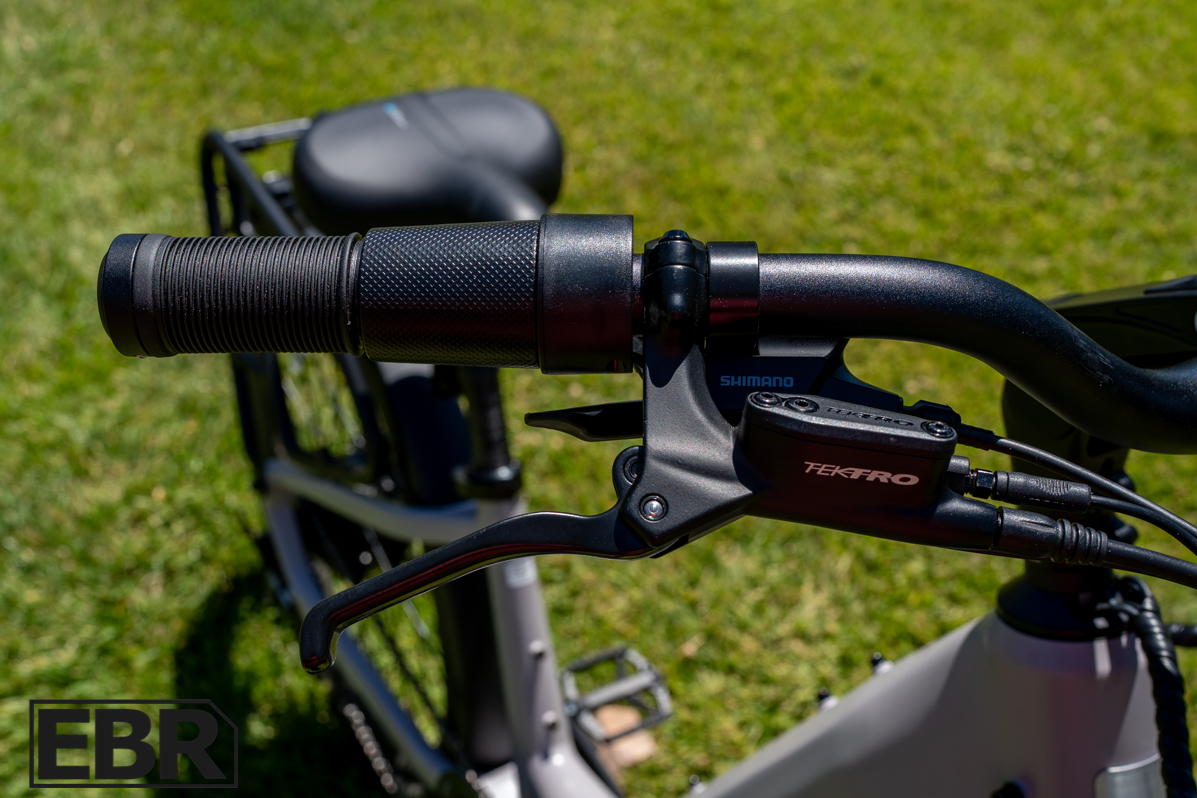
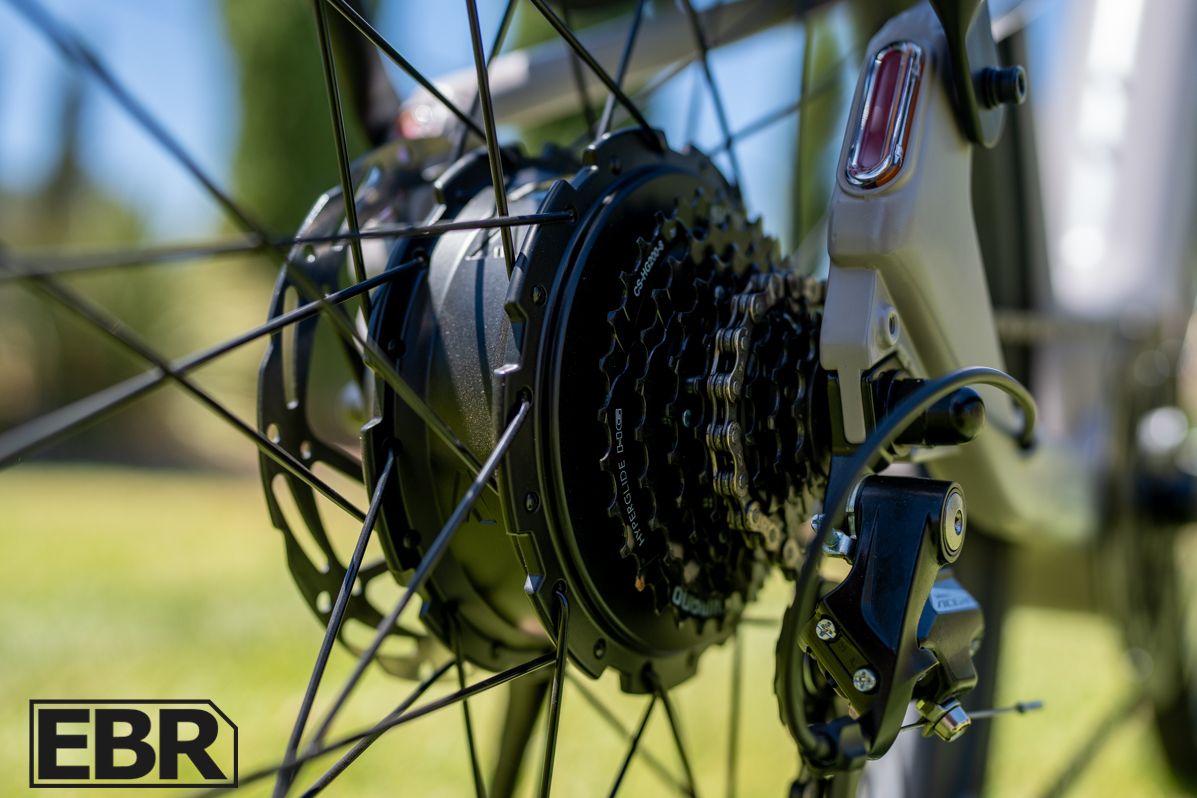
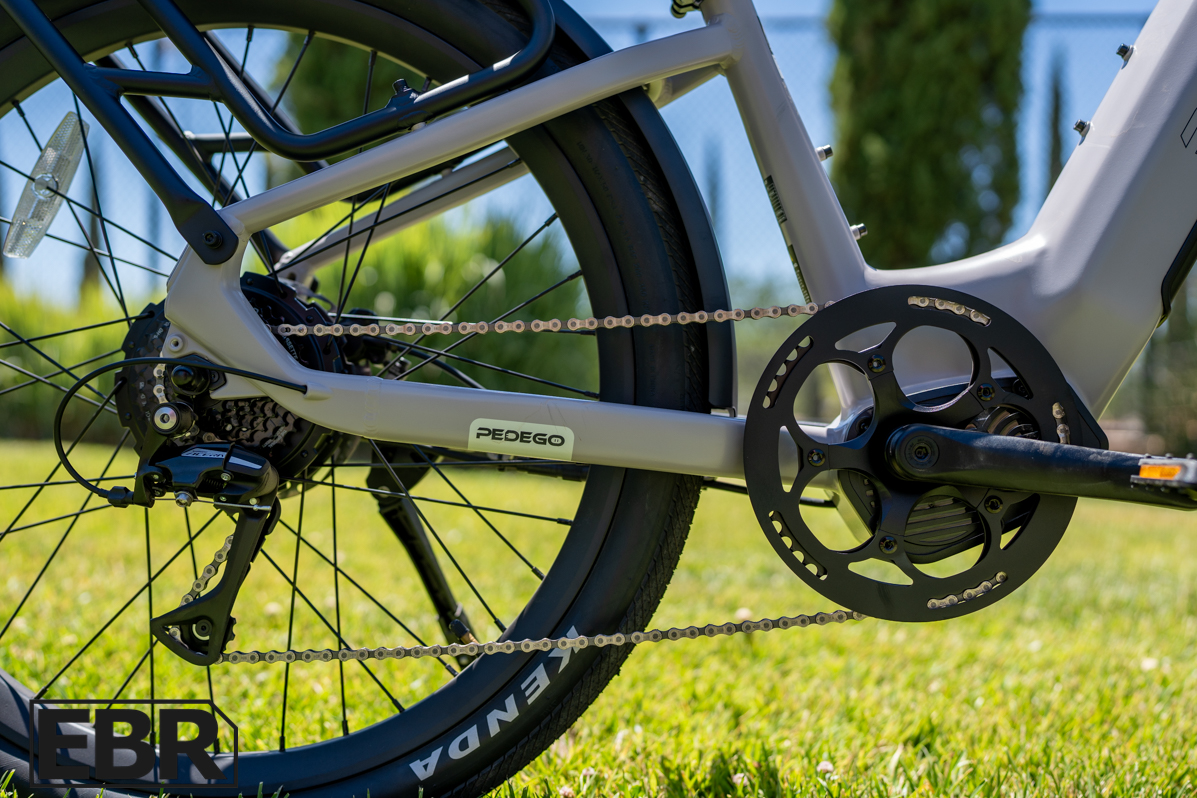
The drivetrain is a Shimano Acera 8-speed with a rapid-fire trigger shifter, an 11-32T cassette, and a 52T chainring up front. Acera sits a step above Altus and two above Tourney, so it is a solid pick at this price, and the shifting felt precise on the trail. That 52T chainring also keeps you engaged at speed. I checked for ghost pedaling at 28 mph in both torque and cruise modes and found none.
The Tektro hydraulic disc brakes are 2-piston with a 203mm front rotor and a 180mm rear, and they showed zero fade through our repeated brake-fade run down a steep hill. I would not change a thing here. Going with Tektro also means easy service down the road.
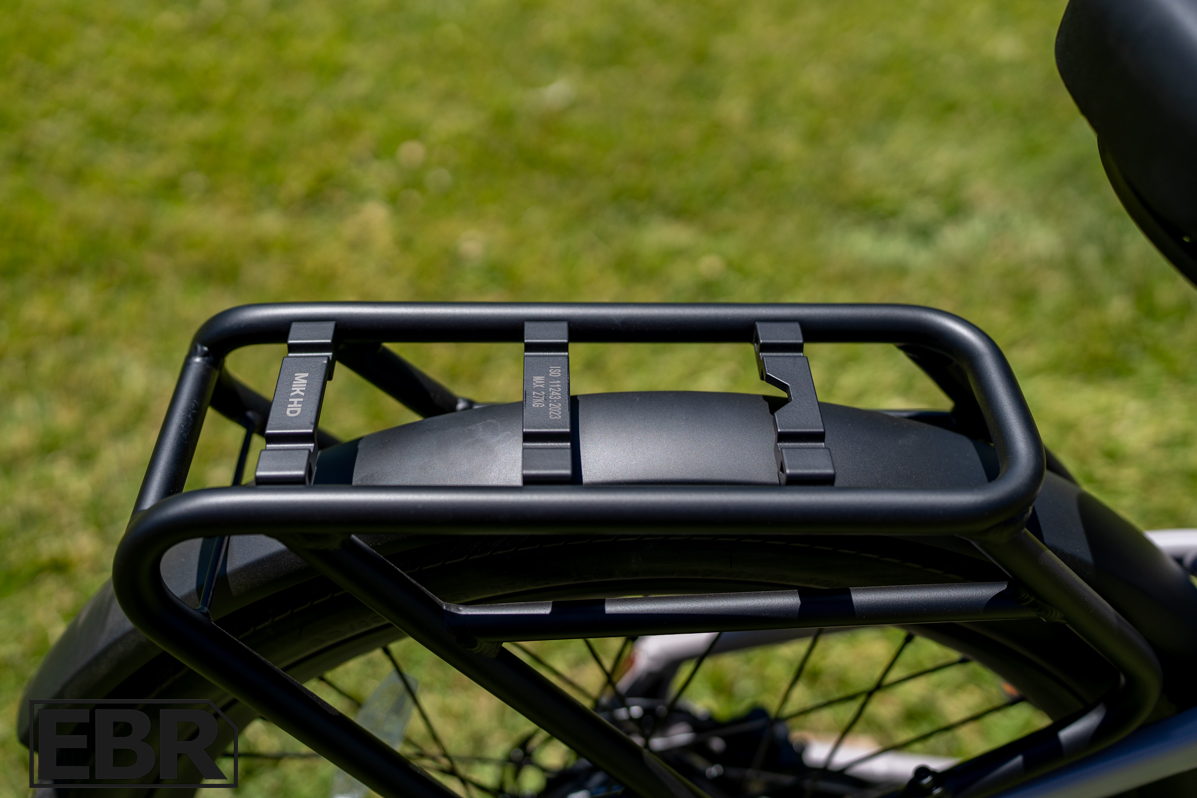
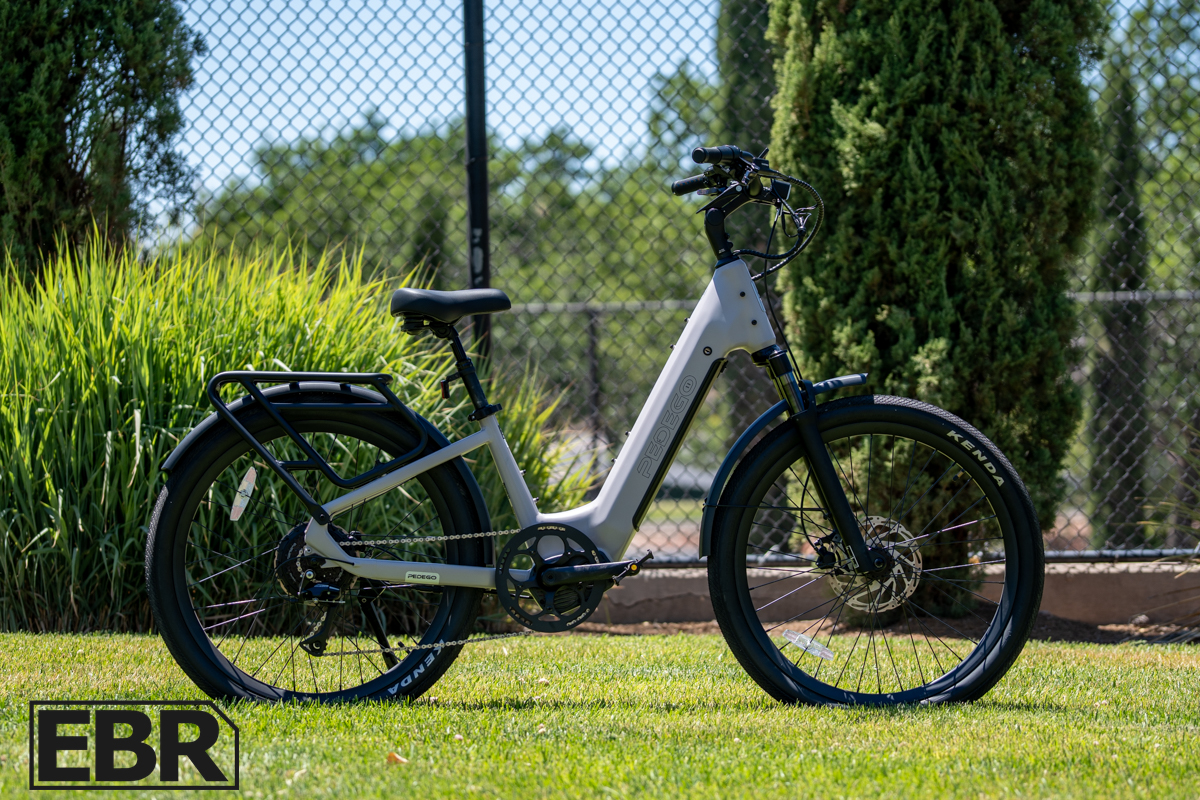
Comfort parts round it out: a 30mm suspension seat post, a comfort saddle, and lock-on vibration-dampening grips. The Kenda 27.5″ x 2.4″ tires roll fast and quiet on pavement but lean city-oriented, so hard off-road use calls for a knobbier swap. For utility you get a MIK-compatible rear rack rated to 100 lbs, metal fenders front and rear, and a bell I liked more than I expected.
There really are only a few things we’d like to see improved/changed on the Ridge Rider 2: First, there is no chainstay guard, so chain slap may eventually mark the paint. Second, the cable routing is split between the headset and down tube, which makes stem and headset service more of a chore than routing everything through the down tube would.
At $2,195 the Ride Rider 2 is right inline with most other SUV-style e-bikes on the market currently which makes this a great value when paired with a warranty that is the best I’ve seen (if there is a better one that you have seen from another brand, please let me know).
Screen / User Interface / App
Screen / App Score: 6.5 / 10
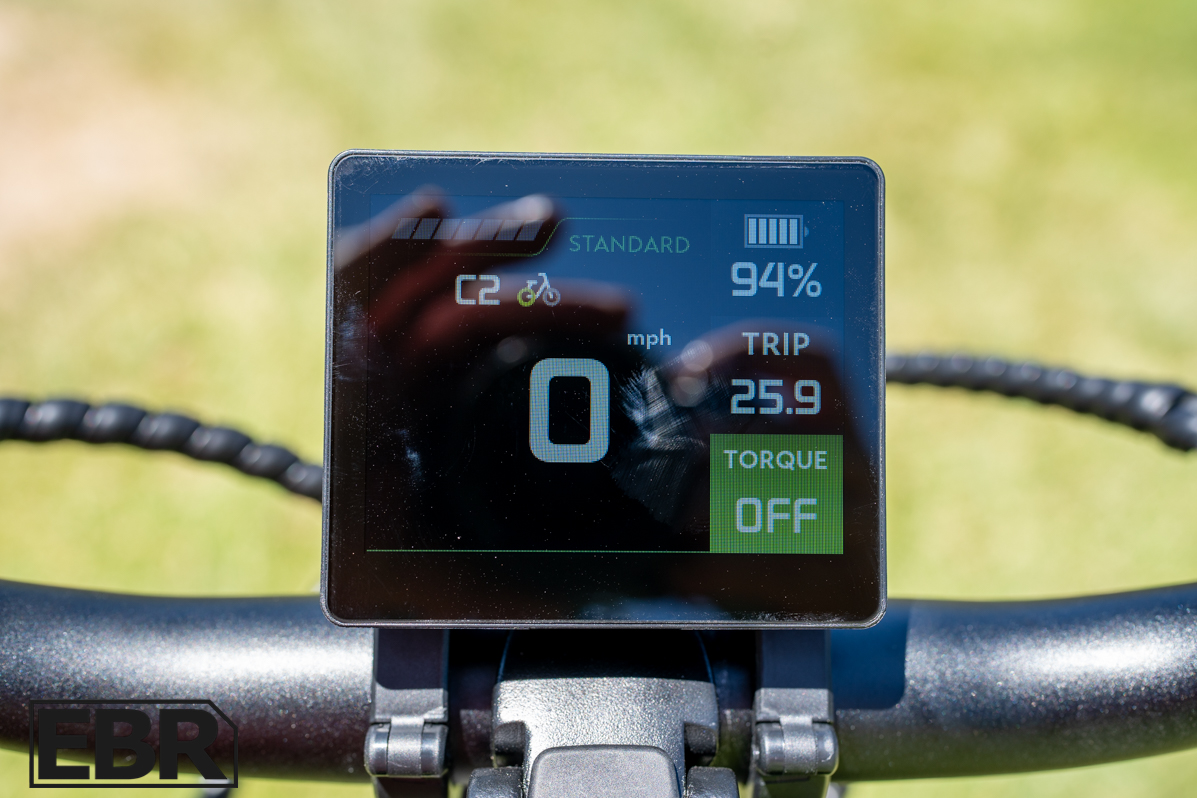
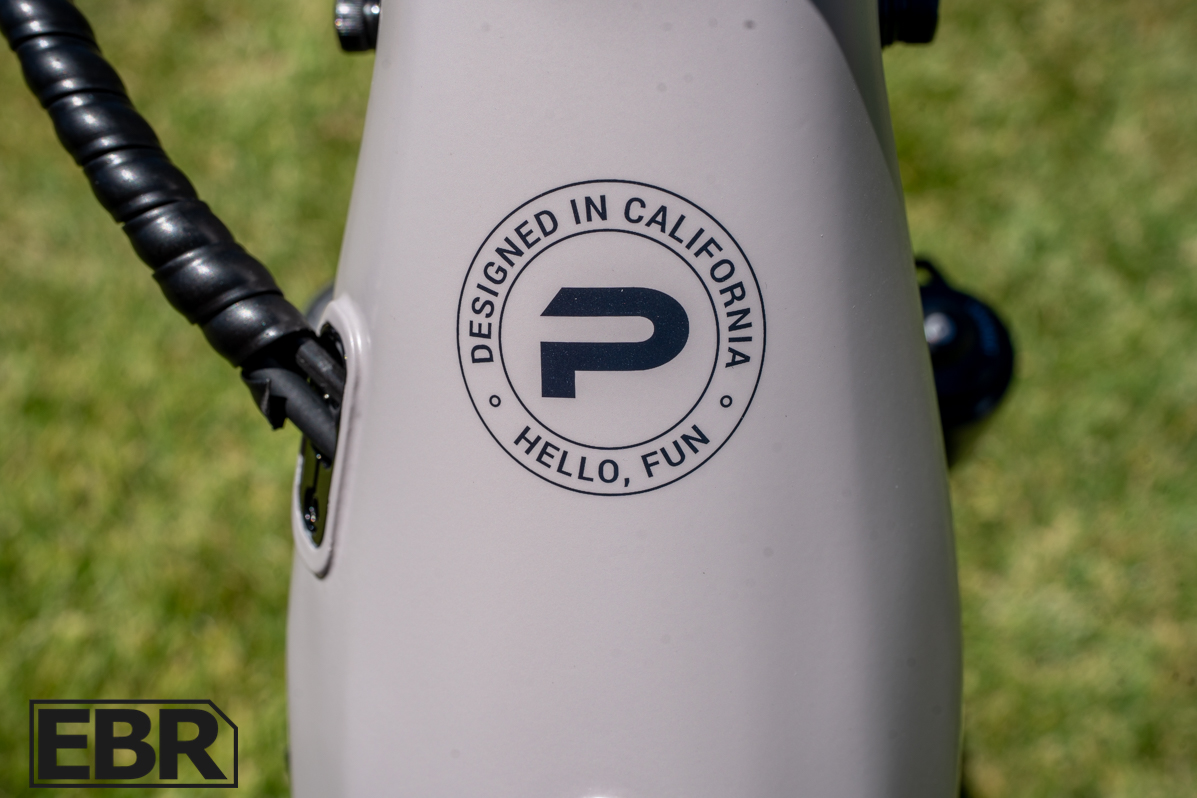
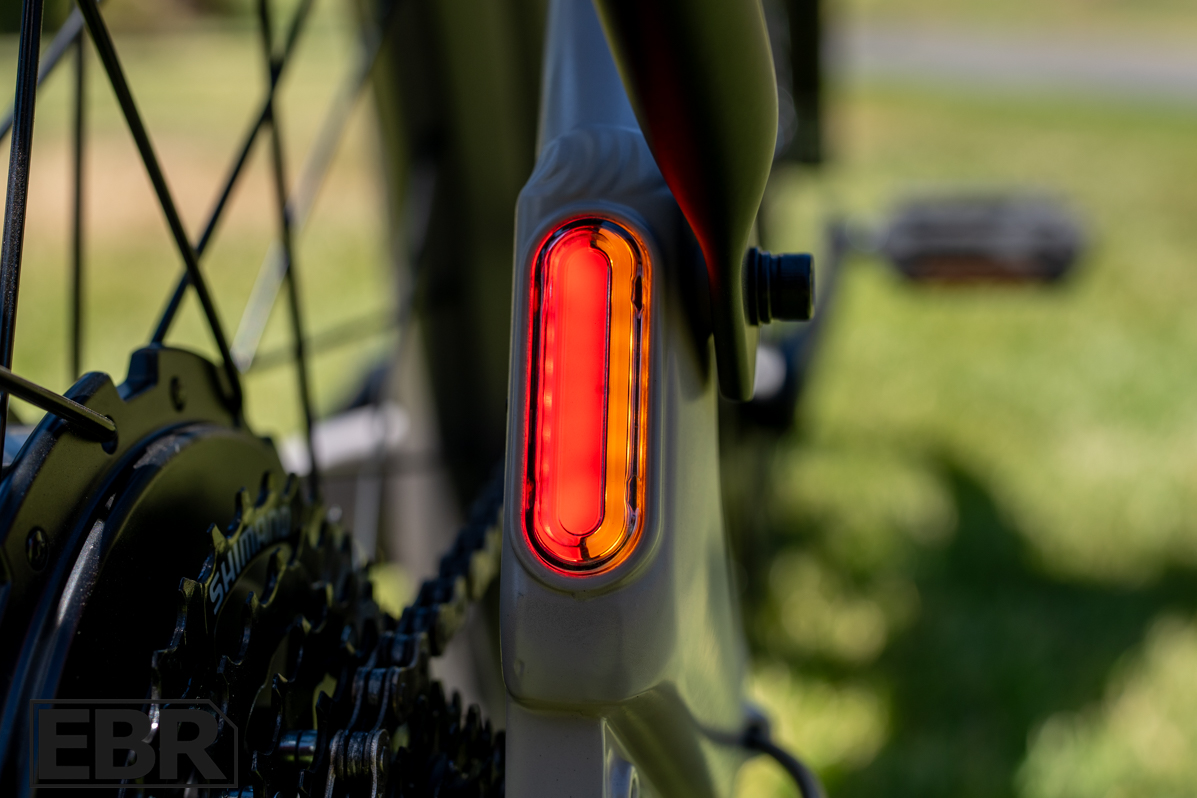
The Ridge Rider 2 uses a 3.5-inch color display with 500 nits of brightness and a USB-C port, and it greets you with a little “Hello, fun” when it powers on. The layout gives you what you need at a glance: speed, a battery readout shown in both bars and a percentage, a live power-output meter, your assist level, performance mode, trip, odometer, ride time, and your current class. That sinewave controller also helps the battery percentage read more accurately, which makes range planning easier.
What I like most here is that you do not need an app to run the bike. Every setting I would want to change lives on the display. You can adjust throttle behavior, switch between torque and cruise (cadence) modes, toggle the turn signals, set the brake light to steady or flashing, and fine-tune the power output for each assist level. The three performance modes, Mellow, Standard, and Pedego, let you cap speed for a beginner or open it up, and Mellow limits you to 15 mph, which is a nice touch for new riders.
There is an app for over-the-air updates, and Class 3 gets unlocked through a dealer rather than a menu toggle. Pedego is just starting to develop their app, so I expect to see a lot of feature additions and improvements over the next year or two.
Bike Model Options
Pedego keeps the Ridge Rider 2 lineup simple. There is one frame, a step-through in a single size, and you choose from three colors: Cloud Cover gray, Quiet Violet, and Veiled Vista, a light sage green. I am glad they skipped the usual plain black-and-white default and gave buyers some personality.
Offering one frame size keeps things straightforward and helps hold the price at $2,195, and the step-through design plus the wide stem and seat-post adjustment covers a broad range of riders. That said, this is the same feedback I gave on fit: I would like to see Pedego add a second size eventually, maybe move to a small/medium and a medium/large offering, to better serve riders at the shorter and taller ends of the stated 5’1″ to 6’3″ range.
On the class side, you do not pick a version at checkout. The bike ships as Class 1/Class 2, and if your area allows it, an authorized dealer can unlock Class 3 for you. The MIK-compatible rear rack also opens up a range of Pedego and third-party accessories, so you can build the bike out for cargo, commuting, or camping.
Is the Ridge Rider 2 Worth Buying?
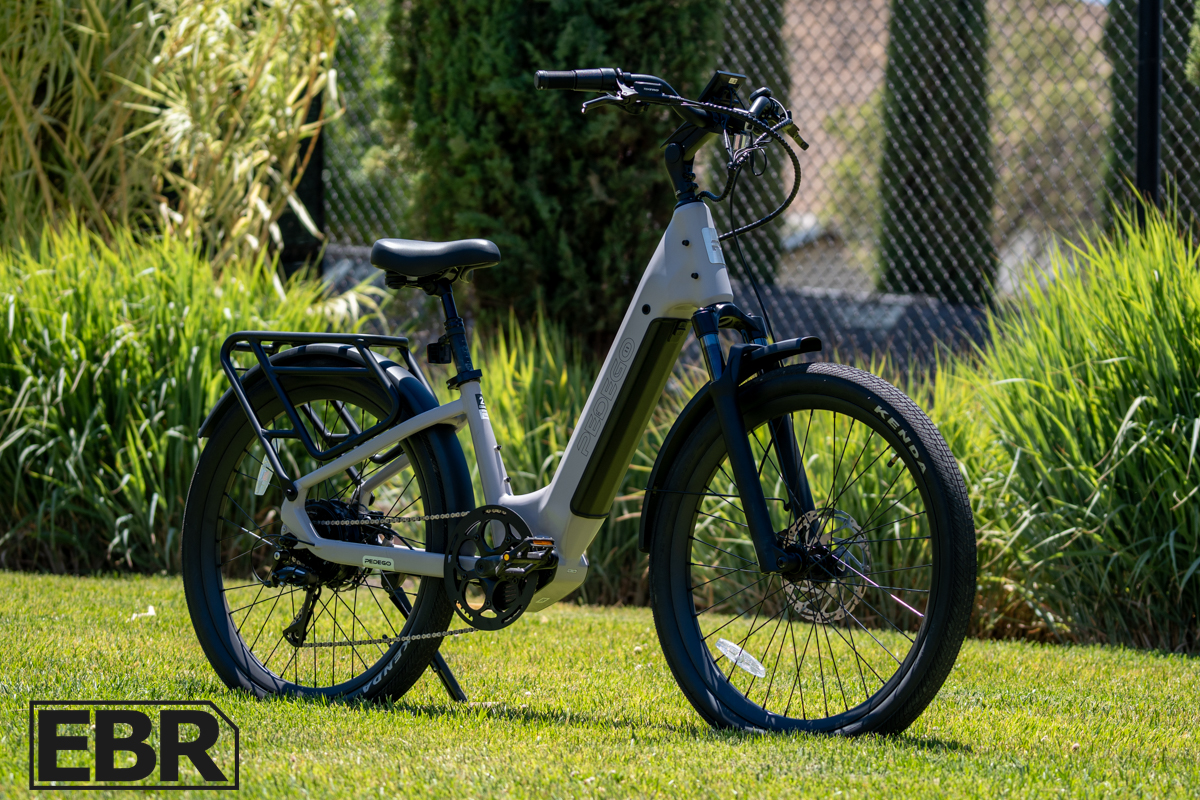
Short answer: yes. The Ridge Rider 2 does what Pedego set out to do. It is a comfortable, quiet, well-built bike that handles a weekday commute and a weekend at the campground without asking you to compromise much. I would recommend to change out the tires if you are looking to off-road more, but other than that there isn’t much that Pedego missed on the bike.
Who is it for? The rider who wants one bike to cover a lot of ground. The commuter who values turn signals, a flashing brake light, and a bright display. The person getting back on a bike after a decade who wants an upright, forgiving position and a dealer nearby for service. The RV traveler who wants all-terrain manners and a removable battery. If you fall into any of those groups, this belongs on your short list. Above all, I’d recommend this to someone who deeply prioritizes dealer service and support and who will appreciate the 5 year warranty.
This is also where the Ridge Rider 2 makes an easy case against its own sibling. It shares its motor and much of its design with the Urtopia Carbon Atom, but because it is not carbon fiber, it weighs about eight or nine pounds more, and it costs several hundred dollars less. You do not feel that weight while riding, so if you do not need the lightest possible specc’d frame, the Ridge Rider 2 is the value pick.
Add in the UL2849 certification, and LG 21700 cells, and this is a very sensible, do-it-all e-bikes at $2,195.





Reader Interactions